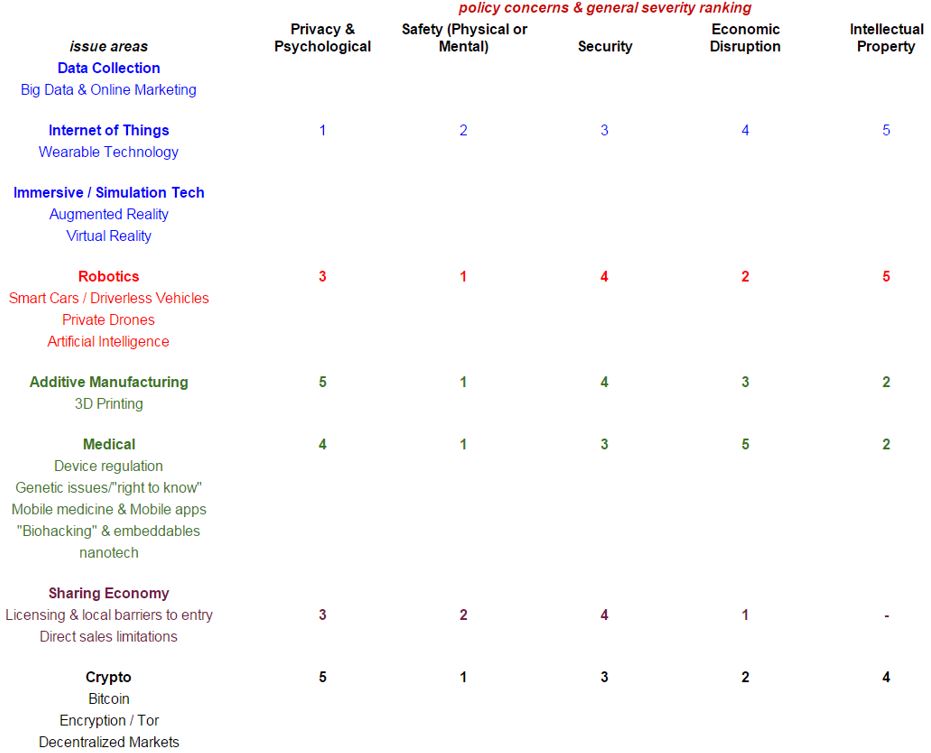
On the whiteboard that hangs in my office, I have a giant matrix of technology policy issues and the various policy “threat vectors” that might end up driving regulation of particular technologies or sectors. Along with my colleagues at the Mercatus Center’s Technology Policy Program, we constantly revise this list of policy priorities and simultaneously make an (obviously quite subjective) attempt to put some weights on the potential policy severity associated with each threat of intervention. The matrix looks like this: [Sorry about the small fonts. You can click on the image to make it easier to see.]
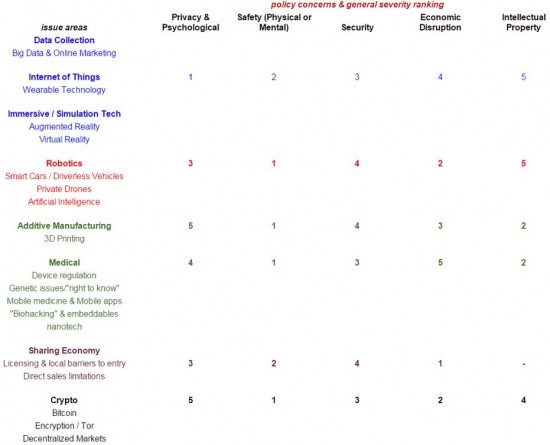
I use 5 general policy concerns when considering the likelihood of regulatory intervention in any given area. Those policy concerns are:
- privacy (reputation issues, fear of “profiling” & “discrimination,” amorphous psychological / cognitive harms);
- safety (health & physical safety or, alternatively, child safety and speech / cultural concerns);
- security (hacking, cybersecurity, law enforcement issues);
- economic disruption (automation, job dislocation, sectoral disruptions); and,
- intellectual property (copyright and patent issues).
Continue reading →
I suppose it was inevitable that the DRM wars would come to the world of drones. Reporting for the Wall Street Journal today, Jack Nicas notes that:
In response to the drone crash at the White House this week, the Chinese maker of the device that crashed said it is updating its drones to disable them from flying over much of Washington, D.C.SZ DJI Technology Co. of Shenzhen, China, plans to send a firmware update in the next week that, if downloaded, would prevent DJI drones from taking off within the restricted flight zone that covers much of the U.S. capital, company spokesman Michael Perry said.
Washington Post reporter Brian Fung explains what this means technologically:
The [DJI firmware] update will add a list of GPS coordinates to the drone’s computer telling it where it can and can’t go. Here’s how that system works generally: When a drone comes within five miles of an airport, Perry explained, an altitude restriction gets applied to the drone so that it doesn’t interfere with manned aircraft. Within 1.5 miles, the drone will be automatically grounded and won’t be able to fly at all, requiring the user to either pull away from the no-fly zone or personally retrieve the device from where it landed. The concept of triggering certain actions when reaching a specific geographic area is called “geofencing,” and it’s a common technology in smartphones. Since 2011, iPhone owners have been able to create reminders that alert them when they arrive at specific locations, such as the office.
This is complete overkill and it almost certainly will not work in practice. First, this is just DRM for drones, and just as DRM has failed in most other cases, it will fail here as well. If you sell somebody a drone that doesn’t work within a 15-mile radius of a major metropolitan area, they’ll be online minutes later looking for a hack to get it working properly. And you better believe they will find one. Continue reading →
The Federal Communications Commission (FCC) recently sought additional comment on whether it should eliminate its network non-duplication and syndicated exclusivity rules (known as the “broadcasting exclusivity” rules). It should just as well have asked whether it should eliminate its rules governing broadcast television. Local TV stations could not survive without broadcast exclusivity rights that are enforceable both legally and practicably.
The FCC’s broadcast exclusivity rules “do not create rights but rather provide a means for the parties to exclusive contracts to enforce them through the Commission rather than the courts.” (Broadcast Exclusivity Order, FCC 88-180 at ¶ 120 (1988)) The rights themselves are created through private contracts between TV stations and video programming vendors in the same manner that MVPDs create exclusive rights to distribute cable network programming.
Local TV stations typically negotiate contracts for the exclusive distribution of national broadcast network or syndicated programming in their respective local markets in order to preserve their ability to obtain local advertising revenue. The FCC has long recognized that, “When the same program a [local] broadcaster is showing is available via cable transmission of a duplicative [distant] signal, the [local] broadcaster will attract a smaller audience, reducing the amount of advertising revenue it can garner.” (Program Access Order, FCC 12-123 at ¶ 62 (2012)) Enforceable broadcast exclusivity agreements are thus necessary for local TV stations to generate the advertising revenue that is necessary for them to survive the government’s mandatory broadcast television business model.
The FCC determined nearly fifty years ago that it is an anticompetitive practice for multichannel video programming distributors (MVPDs) to import distant broadcast signals into local markets that duplicate network and syndicated programming to which local stations have purchased exclusive rights. (
See First Exclusivity Order, 38 FCC 683, 703-704 (1965)) Though the video marketplace has changed since 1965, the government’s mandatory broadcast business model is still required by law, and MVPD violations of broadcast exclusivity rights are still anticompetitive. Continue reading →
When it comes to information control, everybody has a pet issue and everyone will be disappointed when law can’t resolve it. I was reminded of this truism while reading a provocative blog post yesterday by computer scientist Ben Adida entitled “(Your) Information Wants to be Free.” Adida’s essay touches upon an issue I have been writing about here a lot lately: the complexity of information control — especially in the context of individual privacy. [See my essays on “Privacy as an Information Control Regime: The Challenges Ahead,” “And so the IP & Porn Wars Give Way to the Privacy & Cybersecurity Wars,” and this recent FTC filing.]
In his essay, Adida observes that:
In 1984, Stewart Brand famously said that information wants to be free. John Perry Barlow reiterated it in the early 90s, and added “Information Replicates into the Cracks of Possibility.” When this idea was applied to online music sharing, it was cool in a “fight the man!” kind of way. Unfortunately, information replication doesn’t discriminate: your personal data, credit cards and medical problems alike, also want to be free. Keeping it secret is really, really hard.
Quite right. We’ve been debating the complexities of information control in the Internet policy arena for the last 20 years and I think we can all now safely conclude that information control is hugely challenging regardless of the sort of information in question. As I’ll note below, that doesn’t mean control is impossible, but the
relative difficulty of slowing or stopping information flows of all varieties has increased exponentially in recent years.
But Adida’s more interesting point is the one about the selective morality at play in debates over information control. That is, people generally expect or favor information freedom in some arenas, but then get pretty upset when they can’t crack down on information flows elsewhere. Indeed, some people can get downright religious about the whole “information-wants-to-be-free” thing in some cases and then, without missing a beat, turn around and talk like information totalitarians in the next breath. Continue reading →
Should ISPs be barred under net neutrality from discriminating against illegal content? Not according to the FCC’s draft net neutrality rule, which defines efforts by ISPs to curb the “transfer of unlawful content” as reasonable network management. This exemption is meant to ensure providers have the freedom to filter or block unlawful content like malicious traffic, obscene files, and copyright-infringing data.
EFF and Public Knowledge (PK), both strong advocates of net neutrality, are not happy about the copyright infringement exemption. The groups have urged the FCC to reconsider what they describe as the “copyright loophole,” arguing that copyright filters amount to “poorly designed fishing nets.”
EFF’s and PK’s concerns about copyright filtering aren’t unreasonable. While filtering technology has come a long way over the last few years, it remains a fairly crude instrument for curbing piracy and suffers from false positives. That’s because it’s remarkably difficult to accurately distinguish between unauthorized copyrighted works and similar non-infringing files. And because filters generally flag unauthorized copies on an automated basis without human intervention, even when filters get it right, they often disrupt legal, non-infringing uses of copyrighted material like fair use.
Despite copyright filtering technology’s imperfections, however, outlawing it is the wrong approach. At its core, ISP copyright filtering represents a purely private, voluntary method of dealing with the great intellectual property challenge. This is exactly the sort of approach advocates of limited government should embrace. As Adam and Wayne argued back in 2001:
To lessen the reliance on traditional copyright protections, policymakers should ensure that government regulations don’t stand in the way of private efforts to protect intellectual property.
Continue reading →
There’s been a lot of FUD floating around about the MPAA’s plan to offer new release films for cable subscribers to watch at home on pay-per-view channels. Currently, movies come out on DVD about four months after their theatrical release, and are typically available on pay-per-view a month or two thereafter. As box office receipts have waned, Hollywood has warmed to the idea of letting consumers watch movies at home just a few weeks after being released in theaters.
Due to piracy concerns, new movies would be subject to an extra layer of copy protection. The movie studios want to use a technology called Selectable Output Control (SOC) to prevent new release films from being viewed on analog outputs. SOC makes it possible to seal the “analog hole” by disabling all unprotected paths.

Consumers are willing to pay to watch new movies at home, and content producers are willing to transmit them, but government is standing in the way. FCC regulations forbid multi-channel video programming distributors from activating SOC, but firms may apply for a waiver from these rules if they can demonstrate that consumers stand to benefit. The MPAA has applied for a waiver, arguing that “These new Services are exactly the type of ‘new business models’ that the Commission contemplated when it adopted the encoding rules.”
Under Section 304 of the Telecommunications Act of 1996, the FCC is tasked with “assuring commercial consumer availability of equipment used to access services provided by multichannel video programming distributors.” FCC regulations, therefore, mandate that all video transmitted on cable TV must be viewable on all outputs, including legacy analog connectors like RCA and S-Video. In a 2003 Notice of Proposed Rulemaking, the FCC stated that, “we are concerned that selectable output control would harm those ‘early adopters’ whose DTV equipment only has component analog inputs for high definition display, placing these consumers at risk of being completely shut off from the high-definition content they expect to receive.”
But it’s expected that early adopters will sometimes encounter technical hurdles. Why should Selective Output Control be any different? Just as HD-DVD players are effectively obsolete, and K56flex modems are no longer supported by most dial-up ISPs, people who bought HDTVs several years ago prior to the adoption of HDCP might have to live without the ability to watch new release movies at home.
Continue reading →

 The Technology Liberation Front is the tech policy blog dedicated to keeping politicians' hands off the 'net and everything else related to technology.