A new study (which is actually based on an old study) by Dr. Craig Anderson of Iowa State University and two other researchers is making news today because it suggests a link between violent video games and real-world aggression. I have written extensively about such studies here in the past, and have included a list of relevant links down below. But let me just use the opportunity to restate the fundamental problem with the way the press reports these things.
- First, the press typically accepts the assertion made by authors of studies like these that the social “science” is unanimous in support of such a link between exposure to violent video games and real-world aggression. there is another side the story, but the press usually doesn’t report on it.
- Second, reporters almost always fail to ask about how the researchers define “violent” games and the resulting “aggression” found in these studies.
- Third, reporters almost never ask about how strong the correlation is or, more importantly, what other variables might have had an influence on the the subjects who were studied. (For example, did they factor in real violence in the home or at school?)
- Finally, the reporters almost never query the researchers about the biases they bring to the task of studying this issue (namely, do these researchers have strong feelings about the content in the games they review such that they think they should be regulated in some fashion?).
Luckily, other social researchers are willing to point out these deficiencies. (See, for example, my reviews of the recent books by Drs. Kutner & Olson as well as Dr. Kourosh Dini.) With reference to the new study reported in the press today, Texas A&M researcher Dr. Christopher Ferguson has challenged the study on many of the grounds I listed above. Specifically, in a letter to the journal (Pediatrics) in which the Anderson study appeared, Dr. Ferguson argues:
Continue reading →
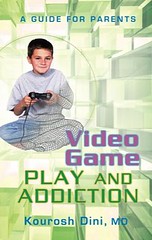 Dr. Kourosh Dini is a Chicago-based adolescent and adult psychiatrist who has just published a new book entitled, Video Game Play and Addiction: A Guide for Parents. [You can learn more about him and his many talents and interests at his blog, “Mind, Music and Technology.“] Dini’s book arrives fresh on the heels of the fine book, “Grand Theft Childhood: The Surprising Truth About Violent Video Games and What Parents Can Do,” by Drs. Lawrence Kutner and Cheryl K. Olson. [See my review of that book here.]
Like Kutner & Olson’s book, Dini’s provides a refreshingly balanced and open-minded look at the impact of video games on our kids. One of the things I liked about it is how Dr. Dini tells us right up front that he has been a gamer his entire life and explains how that has helped him frame the issues he discusses in his book. “I have played games both online and off since I was about six years of age, and I have also been involved in child psychiatry, so I felt that I would be in a good position to discuss some inherent positives and negatives associated with playing games,” he says. Dini goes into greater detail about his gaming habits later in the book and it makes it clear that he still enjoys games very much.
Some may find Dini’s gaming background less relevant than his academic credentials, but I think it is important if for no other reason than it shows how we are seeing more and more life-long gamers attain positions of prominence in various professions and writing about these issues using a sensible frame of reference that begins with their own personal experiences. For far too long now, nearly every book and article I have read about video games and their impact on society at some point includes a line like, “I’ve never really played many games” or even “I don’t much care for video games,” but then–without missing a breath–the author or analyst goes on to tell us how imminently qualified they are to be discussing the impact of video games on kids or culture. Whenever I read or hear things like that, I’m reminded of the famous line from an old TV commercial: “I’m not a doctor, but I play one on TV.” Seriously, why is it that we should continue to listen to those critics who denounce video games but who have never picked up a controller in their lives? It’s really quite insulting. Would you take automotive advice from someone who’s never tinkered with cars in their lives but instead based their opinions merely upon watching them pass by on the road? I think not.
Continue reading →

 The Technology Liberation Front is the tech policy blog dedicated to keeping politicians' hands off the 'net and everything else related to technology.