What Unites Advocates of Speech Controls & Privacy Regulation? [pdf]
by Adam Thierer & Berin Szoka
The Progress & Freedom Foundation,
Progress on Point No. 16.19
Anyone who has spent time following debates about speech and privacy regulation comes to recognize the striking parallels between these two policy arenas. In this paper we will highlight the common rhetoric, proposals, and tactics that unite these regulatory movements. Moreover, we will argue that, at root, what often animates calls for regulation of both speech and privacy are two remarkably elitist beliefs:
- People are too ignorant (or simply too busy) to be trusted to make wise decisions for themselves (or their children); and/or,
- All or most people share essentially the same values or concerns and, therefore, “community standards” should trump household (or individual) standards.
While our use of the term “elitism” may unduly offend some understandably sensitive to populist demagoguery, our aim here is not to launch a broadside against elitism as
Time magazine culture critic William H. Henry once defined it: “The willingness to assert unyieldingly that one idea, contribution or attainment is better than another.”[1] Rather, our aim here is to critique that elitism which rises to the level of political condescension and legal sanction. We attack not so much the beliefs of some leaders, activists, or intellectuals that they have a better idea of what it in the public’s best interest than the public itself does, but rather the imposition of those beliefs through coercive, top-down mandates.
That sort of elitism—elitism enforced by law—is often the objective of speech and privacy regulatory advocates. Our goal is to identify the common themes that unite these regulatory movements, explain why such political elitism is unwarranted, and make it clear how it threatens individual liberty as well as the future of free and open Internet. As an alternative to this elitist vision, we advocate an empowerment agenda: fostering an environment in which users have the tools and information they need to make decisions for themselves and their families. Continue reading →
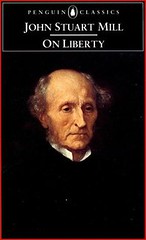 John Stuart Mill’s On Liberty turns 150 this year. Published in 1859, this slender manifesto for human liberty went on to become a classic of modern philosophy and political science. It remains a beautiful articulation of the core principles of human liberty and a just society.
Anyone familiar with the book recognizes the importance of the opening chapter and Mill’s “one very simple principle” for “the dealings of society with the individual in the way of compulsion and control, whether the means used be physical force in the form of legal penalties, or the moral coercion of public opinion”:
That principle is, that the sole end for which mankind are warranted, individually or collectively, in interfering with the liberty of action of any of their number, is self-protection. That the only purpose for which power can be rightfully exercised over any member of a civilized community, against his will, is to prevent harm to others. His own good, either physical or moral, is not a sufficient warrant. He cannot rightfully be compelled to do or forbear because it will be better for him to do so, because it will make him happier, because, in the opinions of others, to do so would be wise, or even right. These are good reasons for remonstrating with him, or reasoning with him, or persuading him, or entreating him, but not for compelling him, or visiting him with any evil in case he do otherwise. To justify that, the conduct from which it is desired to deter him, must be calculated to produce evil to some one else. The only part of the conduct of any one, for which he is amenable to society, is that which concerns others. In the part which merely concerns himself, his independence is, of right, absolute. Over himself, over his own body and mind, the individual is sovereign.
Mill went on to outline “the appropriate region of human liberty,” and divided it into:
- “liberty of conscience, in the most comprehensive sense; liberty of thought and feeling; absolute freedom of opinion and sentiment on all subjects, practical or speculative, scientific, moral, or theological. The liberty of expressing and publishing opinions may seem to fall under a different principle, since it belongs to that part of the conduct of an individual which concerns other people; but, being almost of as much importance as the liberty of thought itself, and resting in great part on the same reasons, is practically inseparable from it.”
- “liberty of tastes and pursuits; of framing the plan of our life to suit our own character; of doing as we like, subject to such consequences as may follow: without impediment from our fellow-creatures, so long as what we do does not harm them, even though they should think our conduct foolish, perverse, or wrong”
- “freedom to unite, for any purpose not involving harm to others”
Bringing it altogether, he argued:
The only freedom which deserves the name, is that of pursuing our own good in our own way, so long as we do not attempt to deprive others of theirs, or impede their efforts to obtain it. Each is the proper guardian of his own health, whether bodily, or mental and spiritual. Mankind are greater gainers by suffering each other to live as seems good to themselves, than by compelling each to live as seems good to the rest.
To this day, I do not believe there has been a more eloquent or concise summation of the central principles of libertarianism than those passages from Chapter 1 of the book.
But what many fail to remember or appreciate is the equally powerful second chapter of Mill’s treatise, “On the Liberty of Thought and Discussion.” It was a bold defense of freedom of speech and expression that was many decades ahead of its time. And it still has lessons and warnings worth heeding in our modern Information Age.
Continue reading →
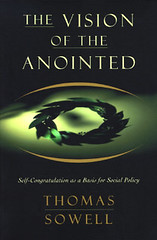 Berin recently encouraged me to re-read Thomas Sowell’s The Vision of the Anointed: Self-Congratulation as a Basis for Social Policy, which I hadn’t looked at since I first read it back in 1995 or 96. I’m glad I did since Sowell’s work has always been profoundly influential on my thinking (especially his masterpiece, A Conflict of Visions) and I had forgotten how useful The Vision of the Anointed was in helping me understand the reoccurring model that drives ideological crusades to expand government power over our lives and economy.
“The great ideological crusades of the twentieth-century intellectuals have ranged across the most disparate fields,” Sowell noted in the book. But what they all had in common, he argued, was “their moral exaltation of the anointed above others, who are to have their different views nullified and superseded by the views of the anointed, imposed via the power of government.” (p. 5) These elitist, government-expanding crusades shared several key elements, which Sowell identified as follows:
- Assertion of a great danger to the whole society, a danger to which the masses of people are oblivious.
- An urgent need for government action to avert impending catastrophe.
- A need for government to drastically curtail the dangerous behavior of the many, in response to the prescient conclusions of the few.
- A disdainful dismissal of arguments to the contrary as either uninformed, irresponsible, or motivated by unworthy purposes.
You can see this model at work on a daily basis today with our government’s various efforts to reshape our economy, but I think this model is equally applicable to debates over social policy and speech control. In particular, the various “technopanics” I have been writing about recently fit this model. (See 1, 2, 3, 4, 5). For example, consider how this plays out in the debate over online social networking:
Continue reading →
Online child safety — especially the fear of predators lurking on social networking sites (SNS) — continues to spur calls by state and federal lawmakers for regulation. At first, some federal lawmakers advocated outright bans on SNS in schools and libraries via the Deleting Online Predators Act (DOPA). Meanwhile, state and local lawmakers — specifically state Attorneys General (AGs) — have been even more vociferous in their calls for regulation in the form of mandatory age verification for social networking sites, which would cover a broad swath of online sites and activities according to their definitions of SNS. But the question that ultimately gets lost in this debate is: Just how much risk do social networking sites really pose for teens? Which risks are real and which are overblown? And what’s the best way to deal with the risks that we find to be legitimate?
 Nancy Willard devotes her life to answering those questions. Willard is one of America’s leading experts on online safety and risk prevention. She runs the Center for Safe and Responsible Internet Use and she is the author of two outstanding books, Cyberbullying and Cyberthreats and Cyber-Safe Kids, Cyber-Savvy Teens. In my opinion, Willard’s general approach to online child safety is the most enlightened, level-headed, and likely to be effective. That’s because Willard focuses on putting fears in perspective, identifying the actual risks that kids face online, and devising sensible strategies to deal with risks and problems as they are discovered. Her approach is holistic and built upon sound data, targeted risk-identification strategies, and time-tested education and mentoring methods. For my money, it’s the most sensible approach to online safety issues. In fact, when other parents ask me for “just one thing” to read on the topic, I usually recommend Willard’s work — especially her amazing book Cyber-Safe Kids, Cyber-Savvy Teens. And her background in early childhood education, special education for “at risk” children with emotional and behavior difficulties, as well as experience in computer law, means she is uniquely suited to be analyzing these issues. In sum, this is woman we should all be closely listening to on these issues.
Recently, Willard has been responding to criticisms that state AGs have leveled against the Internet Safety Technical Task Force (ISTTF) and its final report. [Disclaimer: I was a member of the ISTTF.] I’ve already outlined the ISTTF’s work at length here, but the three key takeaways from the report were that:
- the risk of predation on social network sites has been over-stated; the data suggest that cyber-bullying is the bigger problem on SNS;
- there is no silver-bullet technical solution to online child safety concerns, and mandatory age verification, in particular, would not make kids safer online but could even create bigger problems in the long-run;
- education and empowerment are the real keys to keeping kids safer online.
Continue reading →

 The Technology Liberation Front is the tech policy blog dedicated to keeping politicians' hands off the 'net and everything else related to technology.