On Tuesday, UN Secretary-General Ban Ki-Moon delivered an address to the UN Security Council “on the Non-Proliferation of Weapons of Mass Destruction.” He made many of the same arguments he and his predecessors have articulated before regarding the need for the Security Council “to develop further initiatives to bring about a world free of weapons of mass destruction.” In particular, he was focused on the great harm that could come about from the use of chemical, biological and nuclear weapons. “Vicious non-state actors that target civilians for carnage are actively seeking chemical, biological and nuclear weapons,” the Secretary-General noted. A stepped-up disarmament agenda is needed, he argued, “to prevent the human, environmental and existential destruction these weapons can cause . . . by eradicating them once and for all.”
The UN has created several multilateral mechanisms to pursue those objectives, including the Nuclear Non-Proliferation Treaty, the Chemical Weapons Convention, and the Biological Weapons Convention. Progress on these fronts has always been slow and limited, however. The Secretary-General observed that nuclear non-proliferation efforts have recently “descended into fractious deadlock,” but the effectiveness of those and similar UN-led efforts have long been challenged by the dual realities of (1) rapid ongoing technological change that has made WMDs more ubiquitous than ever, plus (2) a general lack of teeth in UN treaties and accords to do much to slow those advances, especially among non-signatories.
Despite those challenges, the Secretary-General is right to remain vigilant about the horrors of chemical, biological and nuclear attacks. But what was interesting about this address is that the Secretary-General continued on to discuss his concerns about a rising class of emerging technologies, which we usually don’t hear mentioned in the same breath as those traditional “weapons of mass destruction”: Continue reading →
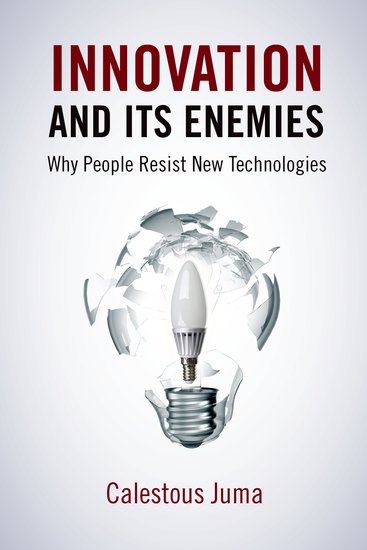
“The quickest way to find out who your enemies are is to try doing something new.” Thus begins Innovation and Its Enemies, an ambitious new book by Calestous Juma that will go down as one of the decade’s most important works on innovation policy.
Juma, who is affiliated with the Harvard Kennedy School’s Belfer Center for Science and International Affairs, has written a book that is rich in history and insights about the social and economic forces and factors that have, again and again, lead various groups and individuals to oppose technological change. Juma’s extensive research documents how “technological controversies often arise from tensions between the need to innovate and the pressure to maintain continuity, social order, and stability” (p. 5) and how this tension is “one of today’s biggest policy challenges.” (p. 8)
What Juma does better than any other technology policy scholar to date is that he identifies how these tensions develop out of deep-seated psychological biases that eventually come to affect attitudes about innovations among individuals, groups, corporations, and governments. “Public perceptions about the benefits and risks of new technologies cannot be fully understood without paying attention to intuitive aspects of human psychology,” he correctly observes. (p. 24) Continue reading →
by Berin Szoka & Adam Thierer, Progress Snapshot 5.11 (PDF)
Ten years ago, Nobel Prize-winning economist Milton Friedman lamented the “Business Community’s Suicidal Impulse:” the persistent propensity to persecute one’s competitors through regulation or the threat thereof. Friedman asked: “Is it really in the self-interest of Silicon Valley to set the government on Microsoft?” After yesterday’s FCC vote’s to open a formal “Net Neutrality” rule-making, we must ask whether the high-tech industry—or consumers—will benefit from inviting government regulation of the Internet under the mantra of “neutrality.”
The hatred directed at Microsoft in the 1990s has more recently been focused on the industry that has brought broadband to Americans’ homes (Internet Service Providers) and the company that has done more than any other to make the web useful (Google). Both have been attacked for exercising supposed “gatekeeper” control over the Internet in one fashion or another. They are now turning their guns on each other—the first strikes in what threatens to become an all-out, thermonuclear war in the tech industry over increasingly broad neutrality mandates. Unless we find a way to achieve “Digital Détente,” the consequences of this increasing regulatory brinkmanship will be “mutually assured destruction” (MAD) for industry and consumers.
New Fronts in the Neutrality Wars
The FCC’s proposed rules would apply to all broadband providers, including wireless, but not to Google or many other players operating in other layers of the Net who favor such broadband-specific rules. With this rulemaking looming, AT&T came after Google with letters to the FCC in late September and then another last week accusing the company of violating neutrality principles in their business practices and arguing that any neutrality rules that apply to ISPs should apply equally to Google’s panoply of popular services. In particular, AT&T accused Google of “search engine bias,” suggesting that only government-enforced neutrality mandates could protect consumers from Google’s supposed “monopolist” control.
The promise made yesterday by the FCC—to only apply neutrality principles to the infrastructure layer of the Net—is hollow and will ultimately prove unenforceable. Continue reading →
Over at Computerworld, Ben Rothke makes the case for “Why Information Must Be Destroyed.” “Given the vast amount of paper and digital media that amasses over time,” he argues, “effective information destruction policies and practices are now a necessary part of doing business and will likely save organizations time, effort and heartache, legal costs as well as embarrassment and more.” He continues:
Every organization has data that needs to be destroyed. Besides taxes, what unites every business is that they possess highly sensitive information that should not be seen by unauthorized persons. While some documents can be destroyed minutes after printing, regulations may require others to be archived from a few years to permanently. But between these two ends of the scale, your organization can potentially have a large volume of hard copy data occupying space as a liability, both from a legal and information security perspective. Depending on how long you’ve been in business, the number of physical sites and the number of people you employ, it’s possible to have hundreds of thousands, if not millions, of pages of hard copy stored throughout your company — much of which is confidential data that can be destroyed.
He’s no doubt correct that it makes good business sense to routinely purge data — both physical and digital — to guard against theft, misplacement, leaks, abuse, or whatever else. Of course, in the context of digital information, there are many folks who would like to see digital records purged more frequently to avoid growing concerns about online privacy. I think most of those concerns are over-stated, but it can’t hurt to destroy most collected information after a certain period to play it safe and keep customers happy.
Problem is, as we discussed here last week, if some lawmakers in Washington get their way, it might be illegal to do that! Quite obviously, data retention mandates are at odds with data destruction efforts. [Mitch Wagner has more coverage of the data retention debate over at Information Week and he quotes my PFF colleague Sid Rosenzweig.]
The Technology Liberation Front is the tech policy blog dedicated to keeping politicians' hands off the 'net and everything else related to technology. Learn more about TLF →


 The Technology Liberation Front is the tech policy blog dedicated to keeping politicians' hands off the 'net and everything else related to technology.