I want to thank Tim Wu for continuing to engage in a discussion here about his book, The Master Switch, with his various comments to my ongoing rants. After pouring out about 15,000 words over the past 4 days, I suspect I’m beginning to sound a bit like his cyber-stalker! I feel a bit bad about this because I really do like Tim a lot and find him to be one of the all-around coolest and most laid-back guys in the Net policy business. But, as I’ve noted in my ongoing series [see parts 1, 2, 3, & 4], we have profoundly different worldviews when it comes to information history and policy. And some of the recent comments he made to my 3rd post deserve a serious response.
In one of those comments he asks, “The question, then, is how you get, essentially, limited, controlled government in regulatory affairs; how you duplicate, in some sense, the limits imposed on other dangerous gov’t functions like the army. I don’t think this is having things both ways; I think this is trying to learn from what has gone wrong in the past.” In the other, he says: “The question I’m asking in the end of the book is whether we can do better; try to have rules against the worse forms abuse without a creeping regulation that turns into capture. I suspect you think that’s impossible, but I don’t.”
So, here’s my response (and I’m making it a new, dedicated post here instead of just a comment in an old thread because I feel we are getting to the heart of the difference between cyber-libertarians (like myself) and cyber-collectivists (or whatever Tim would call himself). Continue reading →
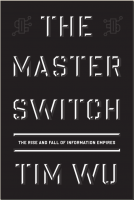 Tim Wu’s new book, The Master Switch: The Rise and Fall of Information Empires, will be released next week and it promises to make quite a splash in cyberlaw circles. It will almost certainly go down as one of the most important info-tech policy books of 2010 and will probably win the top slot in my next end-of-year list.
Of course, that doesn’t mean I agree with everything in it. In fact, I disagree vehemently with Wu’s general worldview and recommendations, and even much of his retelling of the history of information sectors and policy. Nonetheless, for reasons I will discuss in this first of many critiques, the book’s impact will be significant because Wu is a rock star in this academic arena as well as a committed activist in his role as chair of the radical regulatory activist group, Free Press. Through his work at Free Press as well as the New America Foundation, Professor Wu is attempting to craft a plan of action to reshape the Internet and cyberspace.
I stand in opposition to almost everything that Wu and those groups stand for, thus, I will be spending quite a bit of time addressing his perspectives and proposals here in coming months, just as I did when Jonathan Zittrain’s hugely important The Future of the Internet & How to Stop It was released two years ago (my first review is here and my latest critique is here). In today’s essay, I’ll provide a general overview and foreshadow my critiques to come. (Note: Tim was kind enough to have his publisher send me an advance uncorrected proof of the book a few months ago, so I’ll be using that version to construct these critiques. Please consult the final version for cited material and page numbers.) Continue reading →
Over at MediaFreedom.org, a new site devoted to fighting the fanaticism of radical anti-media freedom groups like Free Press and other “media reformistas,” I’ve started rolling out a 5-part series of essays about “The Battle for Media Freedom.” In Part 1 of the series, I defined what real media freedom is all about, and in Part 2 I discussed the rising “cyber-collectivist” threat to media freedom. In my latest installment, I offer an analytical framework that better explains the major differences between the antagonists in the battle over media freedom.
Understanding the Origins of Political Struggles
 In his many enlightening books, Thomas Sowell, a great economist and an even better political scientist, often warns of the triumph of good intentions over good economics. It’s a theme that F.A. Hayek and Milton Friedman both developed extensively before him. But Sowell has taken this analysis to an entirely differently level in books like A Conflict of Visions: Ideological Origins of Political Struggles, and
The Vision of the Anointed: Self-Congratulation as a Basis for Social Policy
. Sowell teaches us that no matter how noble one’s intentions might be, it does not mean that those ideas will translate into sound public policy. Nonetheless, since “the anointed” believe their own intentions are pure and their methods are sound, they see nothing wrong with substituting their will for the will of millions of individuals interacting spontaneously and voluntarily in the marketplace. The result is an expansion of the scope of public decision-making and a contraction of the scope of private, voluntary action. As a result, mandates replace markets, and freedom gives way central planning.
In his many enlightening books, Thomas Sowell, a great economist and an even better political scientist, often warns of the triumph of good intentions over good economics. It’s a theme that F.A. Hayek and Milton Friedman both developed extensively before him. But Sowell has taken this analysis to an entirely differently level in books like A Conflict of Visions: Ideological Origins of Political Struggles, and
The Vision of the Anointed: Self-Congratulation as a Basis for Social Policy
. Sowell teaches us that no matter how noble one’s intentions might be, it does not mean that those ideas will translate into sound public policy. Nonetheless, since “the anointed” believe their own intentions are pure and their methods are sound, they see nothing wrong with substituting their will for the will of millions of individuals interacting spontaneously and voluntarily in the marketplace. The result is an expansion of the scope of public decision-making and a contraction of the scope of private, voluntary action. As a result, mandates replace markets, and freedom gives way central planning.
Sowell developed two useful paradigms to help us better understand “the origins of political struggles.” He refers to the “constrained” versus “unconstrained” vision and separates these two camps according to how they view the nature of man, society, economy, and politics:
| “Constrained Vision” |
“Unconstrained Vision” |
| Man is inherently constrained; highly fallible and imperfect |
Man is inherently unconstrained; just a matter of trying hard enough; man & society are perfectible |
| Social and economic order develops in bottom-up, spontaneous fashion. Top down planning is hard because planners aren’t omnipotent. |
Order derives from smart planning, often from top-down. Elites can be trusted to make smart social & economic interventions. |
| Trade-offs & incentives matter most; wary of unintended consequences |
Solutions & intentions matter most; less concern about costs or consequences of action |
| Opportunities count more than end results; procedural fairness is key; Liberty trumps |
Outcomes matter most; distributive or “patterned” justice is key; Equality trumps liberty |
| Prudence and patience are virtues. There are limits to human reason. |
Passion for, and pursuit of, high ideals trumps all. Human reason has boundless potential. |
| Law evolves and is based on the experience of ages. |
Law is made by trusted elites. |
| Markets offer benefit of experience & experimentation and help develop knowledge over time. |
Markets cannot ensure desired results; must be superseded by planning & patterned justice |
| Exponents: Aristotle, Adam Smith, Edmund Burke, James Madison, Lord Acton, F.A. Hayek, Ludwig von Mises, Milton Friedman, James Buchanan, Robert Nozick |
Exponents: Plato, Rousseau, William Godwin, Voltaire, Robert Owen, John Kenneth Galbraith, John Dewey, Earl Warren, Bertrand Russell, John Rawls |

 The Technology Liberation Front is the tech policy blog dedicated to keeping politicians' hands off the 'net and everything else related to technology.