Here’s a new animated explainer video that I narrated for the Federalist Society’s Regulatory Transparency Project. The 3-minute video discusses how earlier “tech giants” rose and fell as technological innovation and new competition sent them off to what the New York Times once appropriately called “The Hall of Fallen Giants.” It’s a continuing testament to the power of “creative destruction” to upend and reorder markets, even as many pundits insist that there’s no possibility change can happen.
The Mercatus Center at George Mason University has just released a new paper by Brent Skorup and me entitled, “A History of Cronyism and Capture in the Information Technology Sector.” In this 73-page working paper, which we hope to place in a law review or political science journal shortly, we document the evolution of government-granted privileges, or “cronyism,” in the information and communications technology marketplace and in the media-producing sectors. Specifically, we offer detailed histories of rent-seeking and regulatory capture in: the early history of the telephony and spectrum licensing in the United States; local cable TV franchising; the universal service system; the digital TV transition in the 1990s; and modern video marketplace regulation (i.e., must-carry and retransmission consent rules, among others.
Our paper also shows how cronyism is slowly creeping into new high-technology sectors.We document how Internet companies and other high-tech giants are among the fastest-growing lobbying shops in Washington these days. According to the Center for Responsive Politics, lobbying spending by information technology sectors has almost doubled since the turn of the century, from roughly $200 million in 2000 to $390 million in 2012. The computing and Internet sector has been responsible for most of that growth in recent years. Worse yet, we document how many of these high-tech firms are increasingly seeking and receiving government favors, mostly in the form of targeted tax breaks or incentives. Continue reading →
This morning I spoke at a U.S. Chamber of Commerce event on “Responsible Data Uses: Benefits to Consumers, Businesses and the Economy.” In preparing for the event, I dusted off some old working notes for speeches I had delivered at other events about privacy policy and “big data” and expanded them a bit to account for recent policy developments. For what it’s worth, I figured I would post those notes here. (I apologize about the informality but I never write out my speeches, I just work from bullet points.)
—————–
Benefits of “Big Data”
“big data” has numerous micro- and macroeconomic benefits
Micro benefits:
data aggregation of all varieties has powerful social and economic benefits that are sometimes invisible to consumers and citizens but are nonetheless enjoyed by them
big data can positively impact the 3 key micro variables – quality, quantity & price – and benefit consumers / citizens in the process
Macro benefits:
Data is the lifeblood of the information economy and it has an increasing bearing on the global competitiveness of companies and countries
In the old days, when we talked about comparative and competitive advantage, the focus was on natural resources, labor, and capital.
Today, we increasingly talk about another variable: information
Data is increasing one of the most important resources that can benefit economic growth, innovation, and the competitive advantage of firms and nations.
Privacy Concerns
of course, “big data” also raises big privacy concerns for many groups and individuals
this has led to calls for regulatory action and virtually all levels of government – federal, state, local, and international – are considering expanded controls on data collection and aggregation
Wal-Mart is often cast as a villain by some labor unions, local politicians and small retailers, but for the average consumer Wal-Mart has been a savior: A relentless price-cutting machine that instantly changes the dynamics of every market it touches. Indeed, when Wal-Mart decides to jump into a sector by offering a new good or service in its stores, something akin to “the Southwest effect” on steroids kicks in: That market segment is often transformed overnight in that the good or service Wal-Mart starts delivering is essentially instantly commoditized. For the seller of that good or service, this is both a blessing and a curse: They gain the massive market reach that goes along with being in Wal-Mart’s 8,000 retail stores. On the other hand, they instantly surrender any semblance of pricing power they once had. And this typically also puts downward pressure on prices not just for the particular good carried in the Wal-Mart stores, but for that entire market segment more generally. [This exact scenario is currently playing out in the book marketplace as Wal-Mart has gone to war with Amazon in cost-cutting bonanza.]
a new solution in no-contract cellular, exclusively at more than 3,200 Walmart stores nationwide starting October 18, 2009. Straight Talk will bring to the market a new low price for no-contract wireless service with two prepaid plans now available to customers nationwide at $30 and $45 a month. Straight Talk will only be available in Walmart stores and online at www.Walmart.com and www.StraightTalk.com. The average U.S. adult spends $78 on his or her cell phone bill to receive 1000 minutes a month. By switching to the $30 Straight Talk plan, for example, the average 1,000 minutes-per-month consumer could save more than $500 per year and still be on a reliable nationwide network.
I don’t want to overplay the significance of this development, but I really do believe that Wal-Mart’s presence in this field is significant, at least for entry-level mobile phones. While it would be easy for those of us who use more advanced smartphones to shrug off the Wal-Mart announcement, it would be a mistake for reasons made clear by David Worthington over at Technologizer: Continue reading →
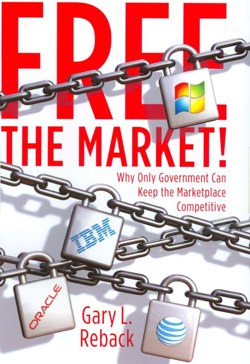
I recently finished reading Free the Market: Why Only Government Can Keep the Marketplace Competitive, a new book by noted antitrust agitator Gary L. Reback. Unsurprisingly, Reback, who led the antitrust jihad against Microsoft during the 1990s, has written a book that reads like an extended love letter to antitrust law. This man loves antitrust the way teenage girls love the Jonas Brothers — gushing, teary-eyed, ‘I-would-just-die-for-you’ sort of love. In Reback’s world, antitrust seemingly has no costs, no downsides, no trade-offs. It is our salvation and he serves as its high prophet. Everything good that happened in the world of high-tech over the past few decades? Oh, you can thank Almighty Antitrust for that. Anything bad that happened? Well, then, clearly there just wasn’t enough antitrust enforcement! That’s this book in a nutshell.
Think I’m kidding? How about this gem of quote from pg. 247: “Antitrust enforcement spawned Silicon Valley’s software industry as well.” Wow, who knew! Of course, that’s utter poppycock and should be somewhat insulting to the many entrepreneurial men and women in the high-tech world who risked everything in an attempt to build a better mousetrap. In Reback’s view of things, however, none of those mousetraps would have ever gotten built without antitrust there to supposedly shelter them from wicked “monopolists” (read: any large company) already operating in the marketplace. I’m sure many in Silicon Valley will also be surprised to hear Reback’s assertion that, “On closer examination, the Valley looks like one big public welfare project.” (p. 54) Ah yes, the old myth that government gave us the Net we know and love today. Please. Like many others, Reback spins a revisionist history of how early ARPANET involvement and seed money somehow made the Internet great when, in reality, the Net was stuck in the digital dark ages until it was finally allowed to be commercialized in 1992.
What irks me most about this book, however, is Reback’s perpetuation of the myth that antitrust is somehow not a form of economic regulation. I hear this tired old argument trotted out time and time again, even by many conservatives. Reback says, for example, that “Antitrust sets the rules of the road, so to speak, but doesn’t tell people where to drive.” By contrast, he argues, “Advocates of regulation want[] continuing government oversight and rule making to produce what would be the beneficial results of a free market… Neither approach works all the time, and decided between them remains difficult.” (p. 19) Again, this “choice” is largely a fiction since, for many industries, we end up getting both! Continue reading →
The Technology Liberation Front is the tech policy blog dedicated to keeping politicians' hands off the 'net and everything else related to technology. Learn more about TLF →


 The Technology Liberation Front is the tech policy blog dedicated to keeping politicians' hands off the 'net and everything else related to technology.