Posts tagged as:

This essay originally appeared on The Bridge under the title “Confessions of a Vidiot” on July 16, 2019.


I have a confession: I’m 50 years old and still completely in love with video games.

Image result for Time magazine video games coverI feel silly saying that, even though I really shouldn’t. Video games are now fully intertwined with the fabric of modern life and, by this point, there have been a couple of generations of adults who, like me, have played them actively over the past few decades. Somehow, despite the seemingly endless moral panics about video games, we came out alright. But that likely will not stop some critics from finding new things to panic over.

As a child of the 1970s, I straddled the divide between the old and new worlds of gaming. I was (and remain) obsessed with board and card games, which my family played avidly. But then Atari’s home version of “Pong” landed in 1976. The console had rudimentary graphics and controls, and just one game to play, but it was a revelation. After my uncle bought Pong for my cousins, our families and neighbors would gather round his tiny 20-inch television to watch two electronic paddles and a little dot move around the screen.

Every kid in the world immediately began lobbying their parents for a Pong game of their own, but then a year later something even more magical hit the market: Atari’s 2600 gaming platform. It was followed by Mattel’s “Intellivision” and Coleco’s “ColecoVision.” The platform wars had begun, and home video games had gone mainstream.

My grandmother, who lived with us at the time, started calling my brother and me “vidiots,” which was short for “video game idiots.” My grandmother raised me and was an absolute treasure to my existence, but when it came to video games (as well as rock music), the generational tensions between us were omnipresent. She was constantly haranguing my brother and me about how we were never going to amount to much in life if we didn’t get away from those damn video games!

I used to ask her why she never gave us as much grief about playing board or card games. She thought those were mostly fine. There was just something about the electronic or more interactive nature of video games that set her and the older generation off.

And, of course, there was the violence. There is no doubt that video games contained violent themes and images that were new to the gaming experience. In the analog gaming era, violent action was left mostly to the imagination. With electronic games, it was right there for us to see in all its (very bloody) glory. Continue reading →


NPR science correspondent Shankar Vedantam had a great spot on NPR’s Morning Edition today about the disputes among social scientists over the impact of violent video games on kids. [“It’s A Duel: How Do Violent Video Games Affect Kids?”] You won’t be surprised to hear I wholeheartedly agree with Texas A&M psychologist Chris Ferguson, who noted in the spot:

Ferguson says it’s easy to think senseless video game violence can lead to senseless violence in the real world. But he says that’s mixing up two separate things.  “Many of the games do have morally objectionable material and I think that is where a lot of the debate on this issue went off the rails,” he said. “We kind of mistook our moral concerns about some of these video games, which are very valid — I find many of the games to be morally objectionable — and then assumed that what is morally objectionable is harmful.”

I’ve written about Ferguson’s work and these issues more generally many times over through the years here at the TLF. Here are some of the most relevant essays:

In these essays, I’ve tried to make a couple of key points about the social science literature on “media effects” theory: Continue reading →

David Leonhardt of The New York Times penned an interesting essay a few days ago entitled, “Do Video Games Equal Less Crime?” reflecting upon the same FBI crime data I wrote about earlier this week, which showed rapid drops in violent crime last year (on top of years of steady declines).  Crimes of all sorts plummeted last year despite the serious economic recession we find ourselves in.  Downturns in the economy are typically followed by upticks in crime. Not so this time.  Which leads Leonhardt to wonder if perhaps exposure to violent media (especially violent video games) could have played a positive role in tempering criminal activity in some fashion:

Video games can not only provide hours of entertainment. They can also give people — especially young men, who play more than their fair share of video games and commit more than their fair share of crimes — an outlet for frustration that doesn’t involve actual violence. Video games obviously have many unfortunate side effects. They can promote obsessive, antisocial behavior and can make violent situations seem ordinary. But might video games also have an upside? I’m willing to consider the idea.

Go Back to the Greeks

What Leonhardt is suggesting here goes by the name “cathartic effect hypothesis” and debates have raged over it for centuries.  Seriously, the fight goes all the way back to the great Greek philosophers Plato and Aristotle. And, as with everything else, Aristotle had it right! Well, at least in my opinion he did, but I am a rabid Aristotealian.  While Plato thought the media of his day (poetry, plays & music) had a deleterious impact on culture and humanity, Aristotle took a very different view. Indeed, most historians believe it was Aristotle who first used the term katharsis when discussing the importance of Greek tragedies, which often contained violent overtones and action. He suggested that these tragedies helped the audience, “through pity and fear effecting the proper purgation of these emotions.” (See Part IV of Aristotle’s Poetics,) Aristotle spoke highly of tragedies that used provocative or titillating storytelling to its fullest effect:

Continue reading →

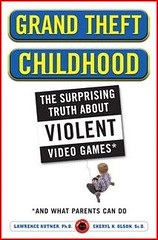
Grand Theft Childhood cover Don’t judge a book by its cover (or its title, for that matter). I’m usually faithful to that maxim, but I must admit that when I first saw the title and cover of “<a href="http://www.amazon.com/Grand-Theft-Childhood-Surprising-Violent/dp/0743299515/ref=pd_bbs_sr_1?ie=UTF8&s=books&qid=1208179493&sr=8-1″>Grand Theft Childhood: The Surprising Truth About Violent Video Games and What Parents Can Do,” I rolled my eyes and thought to myself, “here we go again.” I figured that I was in for another tedious anti-gaming screed full of myths and hysteria about games and gamers. Boy, was I wrong. Massively wrong.

Lawrence Kutner, PhD, and Cheryl K. Olson, ScD, cofounders and directors of the Harvard Medical School Center for Mental Health and Media, have written the most thoroughly balanced and refreshingly open-minded book about video games ever penned. They cut through the stereotypes and fear-mongering that have thus far pervaded the debate over the impact of video games and offer parents and policymakers common-sense advice about how to approach these issues in a more level-headed fashion. They argue that:

Today, an amalgam of politicians, health professionals, religious leaders and children’s advocates are voicing concerns about video games that are identical to the concerns raised one, two and three generations ago with the introduction of other new media. Most of these people have the best of intentions. They really want to protect children from evil influences. As in the past, a few have different agendas and are using the issue manipulatively. Unfortunately, many of their claims are based on scanty evidence, inaccurate assumptions, and pseudoscience. Much of the current research on violent video games is both simplistic and agenda driven. (p. 55)

They note that these groups, “probably worry too much about the wrong things and too little about more subtle issues and complex effects that are much more likely to affect our children.” They continue:

Continue reading →