If you haven’t seen it already, be sure to give a read to Friedman Prize winner Hernando de Soto‘s recent piece in Business Week, “The Destruction of Economic Facts.” It’s a fascinating perspective on the economic and financial turmoil that is wracking the United States and the world.
As de Soto perceives more easily from working in developing economies, an important input into functioning markets is good information—about property, ownership, debts, and so on. The “destruction of economic facts” is one of the roots of instability and uncertainty in Europe and the United States, he says. “In a few short decades the West undercut 150 years of legal reforms that made the global economy possible.”
The law and markets are information systems, says de Soto:
The rule of law is much more than a dull body of norms: It is a huge, thriving information and management system that filters and processes local data until it is transformed into facts organized in a way that allows us to infer if they hang together and make sense.
If you’re interested in information and transparency, it’s worth a read.
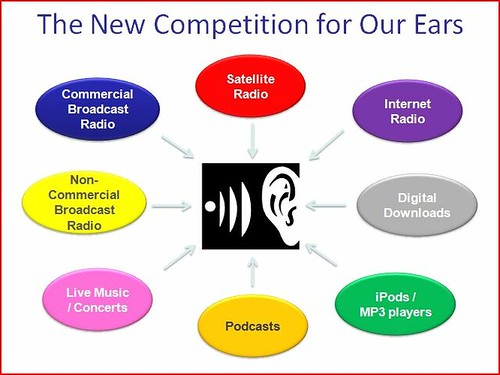
Much ink is spilled over the expanding array of video marketplace choices that are competing for the attention of our eyeballs, but much less is usually written about the competition for our ears. As this excellent new Business Week article by Olga Kharif makes clear, competition and innovation in the audio marketplace has never been more vibrant. It’s something I’ve pointed out here before and here’s a chart I created for my Media Metrics report to highlight all the new competition for our ears. We’ve come a long way since the days of my youth, when transistor radios and vinyl records were the extent of audio competition!
Catherine Holahan of Business Week points out that consumer and children’s advocacy groups are looking to expand their efforts to regulate fatty and sugary food advertising in the name of “protecting the children”:
Having successfully lobbied the government to place limits on junk food ads on TV, they now target marketing to kids via the Web. “While there are some rules for TV, there are no rules when you move online,” says Patti Miller, vice-president of children’s advocacy group Children Now and a member of the Federal Communications Commission’s Task Force on Media & Childhood Obesity. “We don’t want to reduce junk food advertising to kids [on TV] and then find that it has just moved to another platform.”
And so another classic case study in regulatory creep is born and the Net gets a little more regulated in the process as Uncle Sam becomes our Super Nanny. What’s that you say? Parents should take more responsibility for what their kids watch and eat? Silly you. Don’t you know that it takes a village to raise a village idiot? Or something like that.

I have come across some very silly applications of antitrust principles in my time, but this one has just moved up to the top of my list. Over on Business Week.com, Jason Brightman argues that video game retailers such as Game Stop are “forcing” consumers to commit to expensive product bundles in order to get their hands on a new PlayStation 3 or Nintendo Wii gaming console.
Mr. Brightman apparently thinks there is some sort of grave cosmic injustice at work when retailers bundle together gaming consoles with games or other products and require that users agree to purchase that bundle in order to be one of the first people to get their hands on a hot new console. He argues:
“Unfortunately it’s become all too common in recent years for retailers, particularly specialty stores like GameStop/EB, to pull a fast one on consumers who are all too eager to get the newest consoles at launch–remember last year’s $1,000+ Xbox 360 bundles? While it’s true that pre-order campaigns for brick-and-mortar locations allowed customers to pre-order nothing but the console, why should online consumers get the shaft? And is this even legal?… [U]nfortunately, it looks like this ‘predatory packaging’ is legal, but why the heck are consumers getting these console bundles shoved down their throats?”
Oh, come on! You have got to be kidding me. This is called capitalism, buddy. You know… supply-and-demand… rationale pricing of scarce goods… efficient market allocation, etc, etc. In fact, I want to make the exact opposite point that Brightman makes: I think the folks that are selling these consoles on a conditional basis or for a large mark-up are doing society a great service because they are ensuring that those of us who really want these scarce consoles the most can get are hands on them right away.
Unless he wants to make the argument that video game consoles have suddenly become life essential goods on par with food and water, his argument is just plain silly. After all, would anyone die if they had to wait a few weeks before they bought a stand-alone video game console at regular retail prices? How spoiled are we as a culture when we’re even having a debate about fair video game console allocation!?!
Incidentally, what about all those people on eBay selling the extra consoles they bought for major mark-ups? Should they all be in jail? Or perhaps the DOJ or FCC should regulate the video game console marketplace to determine fair prices and efficient distribution of video game consoles to the masses. Perhaps the rallying cry for this new regulatory movement can be “From each according to his [gaming] abilities, to each according to his [gaming] needs.”
Ridiculous.

 The Technology Liberation Front is the tech policy blog dedicated to keeping politicians' hands off the 'net and everything else related to technology.