Over at his blog, our old TLF colleague Tim Lee has been discussing the AT&T – T-Mobile merger and the ways libertarians should think about antitrust more generally. In his latest post, he pushes back against a brief comment I posted on a previous essay. You can head over to his site and read that exchange and then see my latest comment. But I thought I would also post it here for those interested.
____________
Tim… My thinking on antitrust is very much shaped by the choice between
ex ante vs. ex post regulation. How much faith should we place in sector-specific regulators to get things right through preemptive, prophylactic regulation versus allowing things to play out and then — on the rare occasions when intolerable monopolies over essential goods develop — letting antitrust regulators devise a remedy?
More than any other economic value, I care about experimentation. I am completely under the sway of the Austrian School of thinking about markets and competition as an ongoing experiment, an evolutionary journey, a discovery process. How are we to know if intolerable monopolies over essential goods will actually develop unless we let things play out?
As I argued in my critiques of the Lessig/Zittrain/Wu school of thinking, we need to be a bit more humble and have a little faith that ongoing experimentation and discovery will help us evolve into a better equilibrium. It’s during what some regard as a market’s darkest hour when some of the most exciting forms of disruptive technologies and innovation are developing. [I’ve elaborated more on this point in this lengthy discussion about Gary Reback’s recent book on antitrust.] Continue reading →
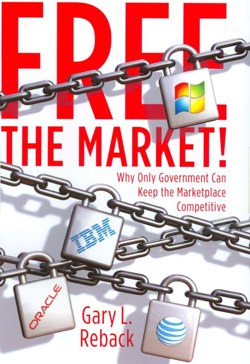 I recently finished reading Free the Market: Why Only Government Can Keep the Marketplace Competitive, a new book by noted antitrust agitator Gary L. Reback. Unsurprisingly, Reback, who led the antitrust jihad against Microsoft during the 1990s, has written a book that reads like an extended love letter to antitrust law. This man loves antitrust the way teenage girls love the Jonas Brothers — gushing, teary-eyed, ‘I-would-just-die-for-you’ sort of love. In Reback’s world, antitrust seemingly has no costs, no downsides, no trade-offs. It is our salvation and he serves as its high prophet. Everything good that happened in the world of high-tech over the past few decades? Oh, you can thank Almighty Antitrust for that. Anything bad that happened? Well, then, clearly there just wasn’t enough antitrust enforcement! That’s this book in a nutshell.
Think I’m kidding? How about this gem of quote from pg. 247: “Antitrust enforcement spawned Silicon Valley’s software industry as well.” Wow, who knew! Of course, that’s utter poppycock and should be somewhat insulting to the many entrepreneurial men and women in the high-tech world who risked everything in an attempt to build a better mousetrap. In Reback’s view of things, however, none of those mousetraps would have ever gotten built without antitrust there to supposedly shelter them from wicked “monopolists” (read: any large company) already operating in the marketplace. I’m sure many in Silicon Valley will also be surprised to hear Reback’s assertion that, “On closer examination, the Valley looks like one big public welfare project.” (p. 54) Ah yes, the old myth that government gave us the Net we know and love today. Please. Like many others, Reback spins a revisionist history of how early ARPANET involvement and seed money somehow made the Internet great when, in reality, the Net was stuck in the digital dark ages until it was finally allowed to be commercialized in 1992.
What irks me most about this book, however, is Reback’s perpetuation of the myth that antitrust is somehow not a form of economic regulation. I hear this tired old argument trotted out time and time again, even by many conservatives. Reback says, for example, that “Antitrust sets the rules of the road, so to speak, but doesn’t tell people where to drive.” By contrast, he argues, “Advocates of regulation want[] continuing government oversight and rule making to produce what would be the beneficial results of a free market… Neither approach works all the time, and decided between them remains difficult.” (p. 19) Again, this “choice” is largely a fiction since, for many industries, we end up getting both! Continue reading →

 The Technology Liberation Front is the tech policy blog dedicated to keeping politicians' hands off the 'net and everything else related to technology.