 I’m pleased to announce the release of my latest law review article, “A Framework for Benefit-Cost Analysis in Digital Privacy Debates.” It appears in the new edition of the George Mason University Law Review. (Vol. 20, No. 4, Summer 2013)
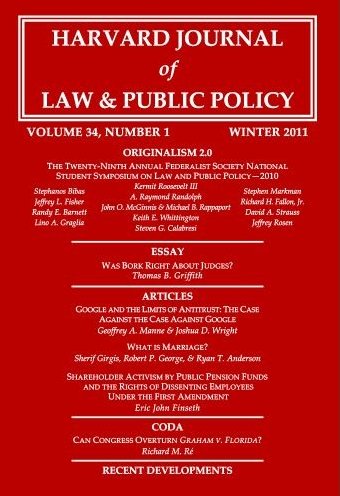
This is the second of two complimentary law review articles I am releasing this year dealing with privacy policy. The first, “The Pursuit of Privacy in a World Where Information Control is Failing,” was published in Vol. 36 of the Harvard Journal of Law & Public Policy
this Spring. (FYI: Both articles focus on privacy claims made against private actors — namely, efforts to limit private data collection — and not on privacy rights against governments.)
My new article on benefit-cost analysis in privacy debates makes a seemingly contradictory argument: benefit-cost analysis (“BCA”) is extremely challenging in online child safety and digital privacy debates, yet it remains essential that analysts and policymakers attempt to conduct such reviews. While we will never be able to perfectly determine either the benefits or costs of online safety or privacy controls, the very act of conducting a regulatory impact analysis (“RIA”) will help us to better understand the trade-offs associated with various regulatory proposals. Continue reading →
 I’m excited to announce the release of my latest law review article, “The Pursuit of Privacy in a World Where Information Control is Failing,” which appears in the next edition (vol. 36) of the Harvard Journal of Law & Public Policy. This is the first of two complimentary law review articles that I will be releasing this year dealing with privacy policy. The second, which will be published later this summer by the George Mason University Law Review, is entitled, “A Framework for Benefit-Cost Analysis in Digital Privacy Debates.” (FYI: Both articles focus on privacy claims made against private actors — namely, efforts to limit private data collection — and not on privacy rights against governments.)
The new
Harvard Journal article is divided into three major sections. Part I focuses on some of normative challenges we face when discussing privacy and argues that there may never be a widely accepted, coherent legal standard for privacy rights or harms here in the United States. It also explores the tensions between expanded privacy regulation and online free speech. Part II turns to the many enforcement challenges that are often ignored when privacy policies are being proposed or formulated and argues that legislative and regulatory efforts aimed at protecting privacy must now be seen as an increasingly intractable information control problem. Most of the problems policymakers and average individuals face when it comes to controlling the flow of private information online are similar to the challenges they face when trying to control the free flow of digitalized bits in other information policy contexts, such as online safety, cybersecurity, and digital copyright.
If the effectiveness of law and regulation is limited by the normative considerations discussed in Part I and the practical enforcement complications discussed in Part II, what alternatives remain to assist privacy-sensitive individuals? I address that question in Part III of the paper and argue that the approach America has adopted to deal with concerns about objectionable online speech and child safety offers a path forward on the privacy front as well. Continue reading →
Today I filed roughly 30 pages worth of comments with the Federal Trade Commission (FTC) in its proceeding on “Protecting Consumer Privacy in an Era of Rapid Change: a Proposed Framework for Businesses and Policy Makers.” [Other comments filed in the proceeding can be found here.] Down below, I’ve attached the Table of Contents from my filing so you can see the major themes I’ve addressed, and I’ve also attached the entire document in a Scribd reader. In coming days and weeks, I’ll be expanding upon some of these themes in follow-up essays.
In my filing, I argue that while it remains impossible to predict with precision the impact a new privacy regulatory regime will have the Internet economy and digital consumers, regulation
will have consequences; of that much we can be certain. As the FTC and other policy makers move forward with proposals to expand regulation in this regard, it is vital that the surreal “something-for-nothing” quality of current privacy debate cease. Those who criticize data collection or online advertising and call for expanded regulation should be required to provide a strict cost-benefit analysis of the restrictions they would impose upon America’s vibrant digital marketplace.
In particular, it should be clear that the debate over Do Not Track and online advertising regulation is fundamentally tied up with the future of online content, culture, and services. Thus, regulatory advocates must explain how the content and services supported currently by advertising and marketing will be sustained if current online data collection and ad targeting techniques are restricted. Continue reading →
Today, Berin Szoka and I both testified at the first of three Federal Trade Commission workshops on “Exploring Privacy.” Today’s all-day event featured five panel discussions, and remarks by FTC Chairman Jon Leibowitz, Commissioner Pamela Jones Harbour, and David C. Vladeck, Director of the FTC’s Bureau of Consumer Protection. Our TLF co-blogging colleague Jim Harper also testified on the first panel of the day on “Benefits and Risks of Collecting, Using, and Retaining Consumer Data.” I was on the second panel of the day on “Consumer Expectations and Disclosures.” And Berin was on the third panel on “Online Behavioral Advertising.” The fourth panel was on “Information Brokers” and the fifth panel was on “Exploring Existing Regulatory Frameworks.” On my panel, we discussed the usefulness of privacy polls and surveys. I attempted to make a few simple points when asked for my opinions:
- While privacy polls and surveys may offer us some interesting insights into how some in the public think about advertising and privacy in the abstract, ultimately, they are no substitute for real-world experiments in which people make real choices, in real time, often with real money, and face many real trade-offs. [See this paper.]
- Moreover, such polls and surveys fail to account for the fact that consumers are empowered with real privacy controls so they can make the privacy choices that are right for them, rather than a one-size-fits-all choice imposed by someone else. [See this ongoing series and this paper.]
- (1) & (2) are especially the case since privacy is a highly subjective condition. [See this paper by Jim Harper.]
- It remains unclear what the harms are that we are trying to protect consumers against. [See this paper and this blog post.]
- Because of (1), (2), (3), and (4) we need to understand that rational ignorance may often be at work here. Many consumers likely won’t feel the need to read privacy policies or take steps to “protect their privacy” online.
Continue reading →
What Unites Advocates of Speech Controls & Privacy Regulation? [pdf]
by Adam Thierer & Berin Szoka
The Progress & Freedom Foundation,
Progress on Point No. 16.19
Anyone who has spent time following debates about speech and privacy regulation comes to recognize the striking parallels between these two policy arenas. In this paper we will highlight the common rhetoric, proposals, and tactics that unite these regulatory movements. Moreover, we will argue that, at root, what often animates calls for regulation of both speech and privacy are two remarkably elitist beliefs:
- People are too ignorant (or simply too busy) to be trusted to make wise decisions for themselves (or their children); and/or,
- All or most people share essentially the same values or concerns and, therefore, “community standards” should trump household (or individual) standards.
While our use of the term “elitism” may unduly offend some understandably sensitive to populist demagoguery, our aim here is not to launch a broadside against elitism as
Time magazine culture critic William H. Henry once defined it: “The willingness to assert unyieldingly that one idea, contribution or attainment is better than another.”[1] Rather, our aim here is to critique that elitism which rises to the level of political condescension and legal sanction. We attack not so much the beliefs of some leaders, activists, or intellectuals that they have a better idea of what it in the public’s best interest than the public itself does, but rather the imposition of those beliefs through coercive, top-down mandates.
That sort of elitism—elitism enforced by law—is often the objective of speech and privacy regulatory advocates. Our goal is to identify the common themes that unite these regulatory movements, explain why such political elitism is unwarranted, and make it clear how it threatens individual liberty as well as the future of free and open Internet. As an alternative to this elitist vision, we advocate an empowerment agenda: fostering an environment in which users have the tools and information they need to make decisions for themselves and their families. Continue reading →
 I’m pleased to announce the release of my latest law review article, “A Framework for Benefit-Cost Analysis in Digital Privacy Debates.” It appears in the new edition of the George Mason University Law Review. (Vol. 20, No. 4, Summer 2013)
 The Technology Liberation Front is the tech policy blog dedicated to keeping politicians' hands off the 'net and everything else related to technology.