NPR science correspondent Shankar Vedantam had a great spot on NPR’s Morning Edition today about the disputes among social scientists over the impact of violent video games on kids. [“It’s A Duel: How Do Violent Video Games Affect Kids?”] You won’t be surprised to hear I wholeheartedly agree with Texas A&M psychologist Chris Ferguson, who noted in the spot:
Ferguson says it’s easy to think senseless video game violence can lead to senseless violence in the real world. But he says that’s mixing up two separate things. “Many of the games do have morally objectionable material and I think that is where a lot of the debate on this issue went off the rails,” he said. “We kind of mistook our moral concerns about some of these video games, which are very valid — I find many of the games to be morally objectionable — and then assumed that what is morally objectionable is harmful.”
I’ve written about Ferguson’s work and these issues more generally many times over through the years here at the TLF. Here are some of the most relevant essays:
In these essays, I’ve tried to make a couple of key points about the social science literature on “media effects” theory: Continue reading →
 Information overload is a hot topic these days. I’ve really enjoyed recent essays by Aaron Saenz (“Are We Too Plugged In? Distracted vs. Enhanced Minds”), Michael Sacasas (“Technology Sabbaths and Other Strategies for the Digitized World“), and Peggy Noonan (“Information Overload is Nothing New“) discussing this concern in a thoughtful way. Thoughtful discussion about this issue is sometimes hard to find because, as I’ve noted here before, information overload is a subject that bitterly divides Internet optimists and pessimists. The pessimists tend to overplay the issue and discuss it in apocalyptic terms. The optimists, by contrast, often dismiss the concern out of hand. Certainly there must be some reasonable middle ground on this issue, no?
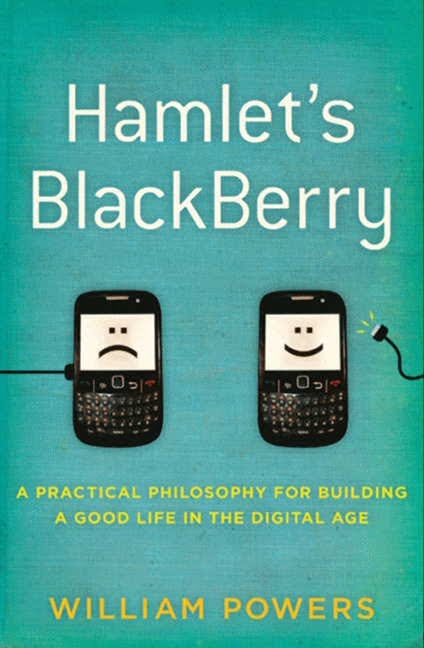
There is, and some of it can be found in a fine new book,
Hamlet’s BlackBerry: A Practical Philosophy for Building a Good Life in the Digital Age, by William Powers. Powers, a former staff writer for the Washington Post
, is a gifted storyteller and his walk though the history of philosophy and technology makes this slender volume an enjoyable, quick read. He begins by reminding us that:
whenever new devices have emerged, they’ve presented the kinds of challenges we face today — busyness, information overload, that sense of life being out of control. These challenges were as real two millennia ago as they are today, and throughout history, people have been grappling with them and looking for creative ways to manage life in the crowd. (p. 5)
His key insight is that humans
can adapt to new technology, but it takes time, patience, humility, and a little effort. “The key is to strike a balance,” he says, between “the call of the crowd” and the “need for time and space apart” from it. (p. 4) The problem we face today is that all the pressure is on us to be what he calls “Digital Maximalists.” That is, many of us are increasingly out to maximize the time spent in front of various digital “screens” whether we have made the determination that is really in our best interest or not. It has just gradually happened, Powers argues, because “The goal is no longer to be ‘in touch’ but to erase the possibility of ever being out of touch.” (p. 15)
Continue reading →
Over at MediaFreedom.org, a new site devoted to fighting the fanaticism of radical anti-media freedom groups like Free Press and other “media reformistas,” I’ve started rolling out a 5-part series of essays about “The Battle for Media Freedom.” In Part 1 of the series, I defined what real media freedom is all about, and in Part 2 I discussed the rising “cyber-collectivist” threat to media freedom. In my latest installment, I offer an analytical framework that better explains the major differences between the antagonists in the battle over media freedom.
Understanding the Origins of Political Struggles
 In his many enlightening books, Thomas Sowell, a great economist and an even better political scientist, often warns of the triumph of good intentions over good economics. It’s a theme that F.A. Hayek and Milton Friedman both developed extensively before him. But Sowell has taken this analysis to an entirely differently level in books like A Conflict of Visions: Ideological Origins of Political Struggles, and
The Vision of the Anointed: Self-Congratulation as a Basis for Social Policy
. Sowell teaches us that no matter how noble one’s intentions might be, it does not mean that those ideas will translate into sound public policy. Nonetheless, since “the anointed” believe their own intentions are pure and their methods are sound, they see nothing wrong with substituting their will for the will of millions of individuals interacting spontaneously and voluntarily in the marketplace. The result is an expansion of the scope of public decision-making and a contraction of the scope of private, voluntary action. As a result, mandates replace markets, and freedom gives way central planning.
In his many enlightening books, Thomas Sowell, a great economist and an even better political scientist, often warns of the triumph of good intentions over good economics. It’s a theme that F.A. Hayek and Milton Friedman both developed extensively before him. But Sowell has taken this analysis to an entirely differently level in books like A Conflict of Visions: Ideological Origins of Political Struggles, and
The Vision of the Anointed: Self-Congratulation as a Basis for Social Policy
. Sowell teaches us that no matter how noble one’s intentions might be, it does not mean that those ideas will translate into sound public policy. Nonetheless, since “the anointed” believe their own intentions are pure and their methods are sound, they see nothing wrong with substituting their will for the will of millions of individuals interacting spontaneously and voluntarily in the marketplace. The result is an expansion of the scope of public decision-making and a contraction of the scope of private, voluntary action. As a result, mandates replace markets, and freedom gives way central planning.
Sowell developed two useful paradigms to help us better understand “the origins of political struggles.” He refers to the “constrained” versus “unconstrained” vision and separates these two camps according to how they view the nature of man, society, economy, and politics:
| “Constrained Vision” |
“Unconstrained Vision” |
| Man is inherently constrained; highly fallible and imperfect |
Man is inherently unconstrained; just a matter of trying hard enough; man & society are perfectible |
| Social and economic order develops in bottom-up, spontaneous fashion. Top down planning is hard because planners aren’t omnipotent. |
Order derives from smart planning, often from top-down. Elites can be trusted to make smart social & economic interventions. |
| Trade-offs & incentives matter most; wary of unintended consequences |
Solutions & intentions matter most; less concern about costs or consequences of action |
| Opportunities count more than end results; procedural fairness is key; Liberty trumps |
Outcomes matter most; distributive or “patterned” justice is key; Equality trumps liberty |
| Prudence and patience are virtues. There are limits to human reason. |
Passion for, and pursuit of, high ideals trumps all. Human reason has boundless potential. |
| Law evolves and is based on the experience of ages. |
Law is made by trusted elites. |
| Markets offer benefit of experience & experimentation and help develop knowledge over time. |
Markets cannot ensure desired results; must be superseded by planning & patterned justice |
| Exponents: Aristotle, Adam Smith, Edmund Burke, James Madison, Lord Acton, F.A. Hayek, Ludwig von Mises, Milton Friedman, James Buchanan, Robert Nozick |
Exponents: Plato, Rousseau, William Godwin, Voltaire, Robert Owen, John Kenneth Galbraith, John Dewey, Earl Warren, Bertrand Russell, John Rawls |
 David Leonhardt of The New York Times penned an interesting essay a few days ago entitled, “Do Video Games Equal Less Crime?” reflecting upon the same FBI crime data I wrote about earlier this week, which showed rapid drops in violent crime last year (on top of years of steady declines). Crimes of all sorts plummeted last year despite the serious economic recession we find ourselves in. Downturns in the economy are typically followed by upticks in crime. Not so this time. Which leads Leonhardt to wonder if perhaps exposure to violent media (especially violent video games) could have played a positive role in tempering criminal activity in some fashion:
Video games can not only provide hours of entertainment. They can also give people — especially young men, who play more than their fair share of video games and commit more than their fair share of crimes — an outlet for frustration that doesn’t involve actual violence. Video games obviously have many unfortunate side effects. They can promote obsessive, antisocial behavior and can make violent situations seem ordinary. But might video games also have an upside? I’m willing to consider the idea.
Go Back to the Greeks
What Leonhardt is suggesting here goes by the name “cathartic effect hypothesis” and debates have raged over it for centuries. Seriously, the fight goes all the way back to the great Greek philosophers Plato and Aristotle. And, as with everything else, Aristotle had it right! Well, at least in my opinion he did, but I am a rabid Aristotealian. While Plato thought the media of his day (poetry, plays & music) had a deleterious impact on culture and humanity, Aristotle took a very different view. Indeed, most historians believe it was Aristotle who first used the term
katharsis when discussing the importance of Greek tragedies, which often contained violent overtones and action. He suggested that these tragedies helped the audience, “through pity and fear effecting the proper purgation of these emotions.” (See Part IV of Aristotle’s Poetics,) Aristotle spoke highly of tragedies that used provocative or titillating storytelling to its fullest effect:
Continue reading →
This week, I have been up at Harvard University participating in another meeting of the Internet Safety Technical Task Force (ISTTF), of which I am a member. The ISTTF was organized earlier this year pursuant to an agreement between 49 state attorneys general (AGs) and social networking giant MySpace.com. A group of experts from academia, non-profit organizations, and industry were appointed to the Task Force, which is charged with evaluating the market for online child safety tools and methods and issuing a report on the matter to the AGs at the end of this year. ISTTF members have been meeting privately and publicly in both Cambridge, MA and Washington, D.C. The Task Force has been very ably chaired by John Palfrey, co-director of Harvard’s Berkman Center for Internet & Society.
Although the ISTTF is looking at a wide variety of tools and methods associated with online child protection (ex: filters, monitoring tools, educational campaigns, etc.), many of the AGs who crafted the agreement with MySpace that led to the Task Force’s formation have made it clear that they are
most interested in having the ISTTF evaluate age verification / online verification technologies. In fact, at the start of this week’s session at Harvard Law School, AGs Martha Coakely of Massachusetts and Richard Blumenthal of Connecticut both spoke and made it abundantly clear they expect the Task Force to develop age and identify-verification tools for social networking sites (SNS). AG Blumenthal said we need to deal with “the dangers of anonymity” and repeated his standard line about online age verification: “If we can put a man on the moon, we can make the Internet safe.” [Of course, putting a man on the moon took hundreds of billions of dollars and a decade to accomplish, but never mind that fact! Moreover, one could also argue that if we can put a man on the moon we can cure hunger, AIDS, and the common cold, but some things are obviously easier said than done. Finally, putting a man on the moon didn’t require all Americans or their kids to give up their anonymity or privacy rights in order to accomplish the feat!]
On many occasions here before, I have outlined various questions and reservations about proposals to mandate online age verification. Last year, I also published a lengthy white paper on the issue and hosted a lively debate on Capitol Hill [transcript here] about this. I also have discussed age verification in my book on parental controls and online child safety. [Braden Cox also talked about his experiences up at Harvard this week here, and CNet’s Chris Soghoian had a brutal assessment of this week’s proposals on his “Surveillance State” blog.]
In this essay, I will discuss the new fault lines in the debate over online age verification and outline where I think we are heading next on this front. I will argue:
- There is now widespread understanding that it is extraordinarily difficult to verify the ages and identities of minors online using the methods we typically use to verify adults. Because of this, age verification proponents are increasingly proposing two alternative models of verifying kids before they go online or visit SNS…
- First, for those who continue to believe that we must do whatever we can to verify kids themselves, schools and school records are increasingly being viewed as the primary mechanism to facilitate that. This raises two serious questions: Do we want schools to serve as DMVs for our children? And, do we want more school records or information about our kids being accessed or put online?
- Second, for those who are uncomfortable with the idea of verifying kids or using schools, or school records, to accomplish that task, parental permission-based forms of authentication are becoming the preferred regulatory approach. Under this scheme, which might build upon the regulatory model found in the Children’s Online Privacy Protection Act of 1998 (COPPA), parents or guardians would be verified somehow and then would vouch for their children before they were allowed on a SNS, however defined. But how do we establish a clear link between parents and kids? And will parents be willing to surrender a great deal more information (about themselves and their kids) before their kids can go online? And, is it sensible to use a law that was meant to protect the privacy and personal information of children to potentially gather a great deal more information about them, and their parents?
- It remains very unclear how either of those two verification methods would make children safer online. Indeed, that could actually make kids less safe by compromising their personal information and creating a false sense of security online for them and their parents.
- It is highly unlikely the Internet Safety Technical Task Force will be able to reach consensus on this complicated, controversial issue. A small camp will likely flock to the sort of proposals mentioned above. Another, larger camp (including me) will flock to education-based approaches to child safety as well increased reliance on other parental empowerment tools and strategies, industry self-regulatory efforts, social norms, and better intervention strategies for troubled youth. But the age verification debate will go on and, as was the case over the past two years, the legal battleground will be state capitals across America, with AGs likely pushing for age verification mandates regardless of what the Task Force concludes.
Continue reading if you are interested in the details.
Continue reading →
As Braden mentioned, we were both down in Raleigh, North Carolina this week testifying at a big hearing on mandatory age verification for social networking sites.
It was quite a heated battle. The legislation, SB 132, was supported at the hearing by North Carolina attorney general Roy Cooper, several of his staff attorneys, a couple of NC senate lawmakers, and some folks from Aristotle, a company that claims it has devised a workable age verification solution for social networking purposes. A vote on the proposal was delayed and we’re still awaiting the final outcome.
Down below, I have attached the outline of my remarks in which I argued that age verification mandates would actually make kids
less safe online. Here’s why:
Continue reading →
In late March, I hosted a congressional seminar entitled “Age Verification for Social Networking Sites: Is It Possible? And Desirable?” I brought together 5 experts in the field to debate the issue, including:
- John Cardillo, President & CEO, Sentinel
- Jay Chaudhuri, Special Counsel to North Carolina Attorney General Roy Cooper
- Raye Croghan, Vice President, IDology, Inc.
- Tim Lordan, Executive Director, Internet Education Foundation
- Jeff Schmidt, CEO, Authis
It was an outstanding discussion and I’m happy to report that the transcript is now available online here. Also, you can listen to the audio from the event here. Also, you can find the big study of mine that we discussed that day here.
http://documents.scribd.com/ScribdViewer.swf?document_id=2887394&access_key=key-18jii1mp0o9wovvaijjs&page=&version=1&auto_size=true
Jennifer Medina of the New York Times penned an article yesterday on the debate over social networking fears leading to calls for age verification mandates. She noted that measures are moving in several states that would require social networking sites to age-verify users before they are allowed to visit the sites or create profiles there. But Medina also noted that there are many difficult questions about how age verification would work and how “social networking” would even be defined. (I summarize these questions in my recent PFF report, “Social Networking and Age Verification: Many Hard Questions; No Easy Solutions.”)
Ms. Medina was also kind enough to interview me for the story and she summarizes some of what I had to say in her piece. In a nutshell, I stressed that the most effective way to deal with this problem is to get serious about dealing with sex offenders instead of trying to regulate law-abiding citizens. We need to be locking up convicted sex offenders for a lot longer in this country to make sure they behind bars instead of behind keyboards seeking to prey on our children.
I also stressed the importance of online safety education as part of the strategy here. But my comments on that didn’t make the cut in the story. But you can read my big recent paper on this issue for additional details.
Lisa Lerer of Forbes was nice enough to do a feature story this week about my views on the panic over social networking and the push for age verification of such sites. Her piece is entitled “Why MySpace is a Safe Space,” and begins as follows: “Adam Thierer doesn’t look like much of a revolutionary. But last month he challenged both Washington and conventional wisdom with a fairly radical proposition: Perhaps MySpace and the Internet aren’t so scary for kids, after all.”
I don’t really regard what I’ve been saying in my recent essays or big new PFF study as “revolutionary.” Rather, if you spend any time studying this issue and these sites in a dispassionate, educated way, I think the conclusions I draw seem quite reasonable. Unfortunately, I don’t think many policy makers or critics have spent any serious time on these sites or seriously explored the relative danger of online social networking sites relative to offline social networking places. A classic “moral panic” has developed because of this: An older generation fears a new medium that it does not use or understand.
Anyway, read my discussion with Lisa for more details.
I’m putting the wraps on a big paper on the dangers of mandating age verification for social networking websites. One of the questions I ask in the study is exactly how broadly “social networking sites” will be defined for purposes of regulation? Will chat rooms, hobbyist sites, listservs, instant messaging, video sharing sites, online marketplaces or online multiplayer gaming sites qualify? If so, how will they be policed and how burdensome will age-verification mandates become for smaller sites? Finally, does the government currently have the resources to engage in such policing activities since almost all websites now have a social networking component? I explore these and other questions in my paper.
But now I have another type of site to add to list, and not one that I originally gave much consideration to: online newspapers. Over the weekend, the
USA Today relaunched its website, not only to freshen up its look, but also to fundamentally change the ways the site works. According to the editors, the new features of the site will give readers the ability to:
Continue reading →

 The Technology Liberation Front is the tech policy blog dedicated to keeping politicians' hands off the 'net and everything else related to technology.