 Looking for a concise overview of how Internet architecture has evolved and a principled discussion of the public policies that should govern the Net going forward? Then look no further than Christopher Yoo‘s new book, The Dynamic Internet: How Technology, Users, and Businesses are Transforming the Network. It’s a quick read (just 140 pages) and is worth picking up. Yoo is a Professor of Law, Communication, and Computer & Information Science at the University of Pennsylvania and also serves as the Director of the Center for Technology, Innovation & Competition there. For those who monitor ongoing developments in cyberlaw and digital economics, Yoo is a well-known and prolific intellectual who has established himself as one of the giants of this rapidly growing policy arena.
Yoo makes two straight-forward arguments in his new book. First, the Internet is changing. In Part 1 of the book, Yoo offers a layman-friendly overview of the changing dynamics of Internet architecture and engineering. He documents the evolving nature of Internet standards, traffic management and congestion policies, spam and security control efforts, and peering and pricing policies. He also discusses the rise of peer-to-peer applications, the growth of mobile broadband, the emergence of the app store economy, and what the explosion of online video consumption means for ongoing bandwidth management efforts. Those are the supply-side issues. Yoo also outlines the implications of changes in the demand-side of the equation, such as changing user demographics and rapidly evolving demands from consumers. He notes that these new demand-side realities of Internet usage are resulting in changes to network management and engineering, further reinforcing changes already underway on the supply-side.
Yoo’s second point in the book flows logically from the first: as the Internet continues to evolve in such a highly dynamic fashion, public policy must as well. Yoo is particularly worried about calls to lock in standards, protocols, and policies from what he regards as a bygone era of Internet engineering, architecture, and policy. “The dramatic shift in Internet usage suggests that its founding architectural principles form the mid-1990s may no longer be appropriate today,” he argues. (p. 4) “[T]he optimal network architecture is unlikely to be static. Instead, it is likely to be dynamic over time, changing with the shifts in end-user demands,” he says. (p. 7) Thus, “the static, one-size-fits-all approach that dominates the current debate misses the mark.” (p. 7) Continue reading →
Wow, what a year for cyberlaw and information technology policy books! Both in terms of number of titles and the gravity of the books released, 2010 was one of the biggest years of the past decade (perhaps matched only by 2006 or 2008 in terms of significance). So, here’s my annual list of the Most Important Info-Tech Policy Books of 2010.
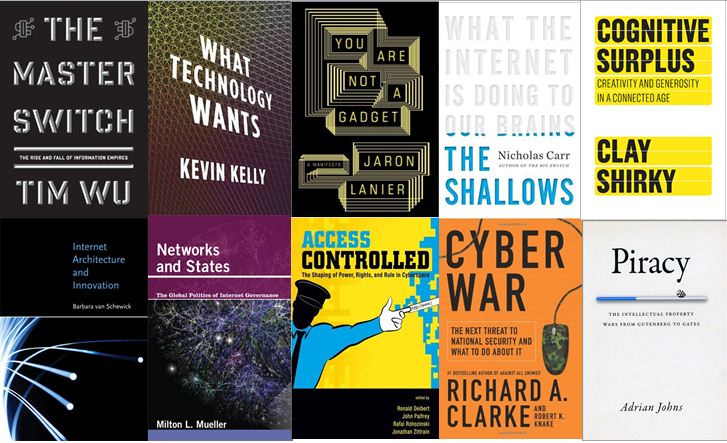 First, however, as is the case each year [see my 2008 & 2009 lists], I need to repeat a few disclaimers. First, what qualifies as an “important” info-tech policy book is highly subjective, but I would define it as a title that many people — especially scholars in the field — are currently discussing and that we will likely be referencing for many years to come. But I “weight” books in the sense that narrowly-focused titles lose a few points. For example, books that deal mostly with privacy issues, copyright law, or antitrust policy do not exactly qualify as the same sort of “info-tech policy book” as other titles that offer a broader exploration of policy issues / concerns. For that reason, “big picture” info-tech policy books tend to rank higher on my lists.
The second caveat: Merely because a book appears on my list
it does not necessarily mean I agree with everything in it. In fact, as was the case in previous years, I found much with which to disagree in my picks for the most important books of 2010 and I find that the cyber-libertarianism I subscribe to has very few fans out there.
With those caveats in mind, here are my choices for the Most Important Info-Tech Policy Books of 2010. Continue reading →
What Unites Advocates of Speech Controls & Privacy Regulation? [pdf]
by Adam Thierer & Berin Szoka
The Progress & Freedom Foundation,
Progress on Point No. 16.19
Anyone who has spent time following debates about speech and privacy regulation comes to recognize the striking parallels between these two policy arenas. In this paper we will highlight the common rhetoric, proposals, and tactics that unite these regulatory movements. Moreover, we will argue that, at root, what often animates calls for regulation of both speech and privacy are two remarkably elitist beliefs:
- People are too ignorant (or simply too busy) to be trusted to make wise decisions for themselves (or their children); and/or,
- All or most people share essentially the same values or concerns and, therefore, “community standards” should trump household (or individual) standards.
While our use of the term “elitism” may unduly offend some understandably sensitive to populist demagoguery, our aim here is not to launch a broadside against elitism as
Time magazine culture critic William H. Henry once defined it: “The willingness to assert unyieldingly that one idea, contribution or attainment is better than another.”[1] Rather, our aim here is to critique that elitism which rises to the level of political condescension and legal sanction. We attack not so much the beliefs of some leaders, activists, or intellectuals that they have a better idea of what it in the public’s best interest than the public itself does, but rather the imposition of those beliefs through coercive, top-down mandates.
That sort of elitism—elitism enforced by law—is often the objective of speech and privacy regulatory advocates. Our goal is to identify the common themes that unite these regulatory movements, explain why such political elitism is unwarranted, and make it clear how it threatens individual liberty as well as the future of free and open Internet. As an alternative to this elitist vision, we advocate an empowerment agenda: fostering an environment in which users have the tools and information they need to make decisions for themselves and their families. Continue reading →

 The Technology Liberation Front is the tech policy blog dedicated to keeping politicians' hands off the 'net and everything else related to technology.