Posts tagged as:

I wanted to bring to your attention this Federalist Society podcast discussion I hosted a few weeks ago on, “Tech Policy Under the Biden Administration and 117th Congress.” I was joined by Jennifer Huddleston, Director of Technology & Innovation Policy at the American Action Forum, and Blake Reid, Clinical Professor at the University of Colorado Law School.

We discussed key policy debates – such as antitrust and “Big Tech,” online speech and Section 230, and the race to 5G – and considered how the new presidential administration and Congress might approach innovation and the tech industry in 2021 and beyond. Note: You might also want to check out this earlier essay by Jennifer on, “5 Tech Policy Topics to Follow in the Biden Administration and 117th Congress.”

[originally published on Plaintext on June 21, 2017.]

This summer, we celebrate the 20th anniversary of two developments that gave us the modern Internet as we know it. One was a court case that guaranteed online speech would flow freely, without government prior restraints or censorship threats. The other was an official White House framework for digital markets that ensured the free movement of goods and services online.

The result of these two vital policy decisions was an unprecedented explosion of speech freedoms and commercial opportunities that we continue to enjoy the benefits of twenty years later.

While it is easy to take all this for granted today, it is worth remembering that, in the long arc of human history, no technology or medium has more rapidly expanded the range of human liberties — both speech and commercial liberties — than the Internet and digital technologies. But things could have turned out much differently if not for the crucially important policy choices the United States made for the Internet two decades ago. Continue reading →

The Obama Administration has just released a draft “Consumer Privacy Bill of Rights Act of 2015.” Generally speaking, the bill aims to translate fair information practice principles (FIPPs) — which have traditionally been flexible and voluntary guidelines — into a formal set of industry best practices that would be federally enforced on private sector digital innovators. This includes federally-mandated Privacy Review Boards, approved by the Federal Trade Commission, the agency that will be primarily responsible for enforcing the new regulatory regime.

Many of the principles found in the Administration’s draft proposal are quite sensible as best practices, but the danger here is that they could soon be converted into a heavy-handed, bureaucratized regulatory regime for America’s highly innovative, data-driven economy.

No matter how well-intentioned this proposal may be, it is vital to recognize that restrictions on data collection could negatively impact innovation, consumer choice, and the competitiveness of America’s digital economy.

Online privacy and security is vitally important, but we should look to use alternative and less costly approaches to protecting privacy and security that rely on education, empowerment, and targeted enforcement of existing laws. Serious and lasting long-term privacy protection requires a layered, multifaceted approach incorporating many solutions.

That is why flexible data collection and use policies and evolving best practices will ultimately serve consumers better than one-size-fits all, top-down regulatory edicts. Continue reading →

What sort of public policy vision should govern the Internet of Things? I’ve spent a lot of time thinking about that question in essays here over the past year, as well as in a new white paper (“The Internet of Things and Wearable Technology: Addressing Privacy and Security Concerns without Derailing Innovation”) that will be published in the Richmond Journal of Law & Technology early next year.

But I recently heard three policymakers articulate their recommended vision for the Internet of Things (IoT) and I found their approach so inspiring that I wanted to discuss it here in the hopes that it will become the foundation for future policy in this arena.

Last Thursday, it was my pleasure to attend a Center for Data Innovation (CDI) event on “How Can Policymakers Help Build the Internet of Things?” As the title implied, the goal of the event was to discuss how to achieve the vision of a more fully-connected world and, more specifically, how public policymakers can help facilitate that objective. It was a terrific event with many excellent panel discussions and keynote addresses.

Two of those keynotes were delivered by Senators Deb Fischer (R-Neb.) and Kelly Ayotte (R-N.H.). Below I will offer some highlights from their remarks and then relate them to the vision set forth by Federal Trade Commission (FTC) Commissioner Maureen K. Ohlhausen in some of her recent speeches. I will conclude by discussing how the Ayotte-Fischer-Ohlhausen vision can be seen as the logical extension of the Clinton Administration’s excellent 1997 Framework for Global Electronic Commerce, which proposed a similar policy paradigm for the Internet more generally. This shows how crafting policy for the IoT can and should be a nonpartisan affair. Continue reading →

DroneIf you want a devastating portrait of how well-intentioned regulation sometimes has profoundly deleterious unintended consequences, look no further than the Federal Aviation Administration’s (FAA) current ban on commercial drones in domestic airspace. As Jack Nicas reports in a story in today’s Wall Street Journal (“Regulation Clips Wings of U.S. Drone Makers“), the FAA’s heavy-handed regulatory regime is stifling America’s ability to innovate in this space and remain competitive internationally. As Nicas notes:

as unmanned aircraft enter private industry—for purposes as varied as filming movies, inspecting wind farms and herding cattle—many U.S. drone entrepreneurs are finding it hard to get off the ground, even as rivals in Europe, Canada, Australia and China are taking off. The reason, according to interviews with two-dozen drone makers, sellers and users across the world: regulation. The FAA has banned all but a handful of private-sector drones in the U.S. while it completes rules for them, expected in the next several years. That policy has stifled the U.S. drone market and driven operators underground, where it is difficult to find funding, insurance and customers. Outside the U.S., relatively accommodating policies have fueled a commercial-drone boom. Foreign drone makers have fed those markets, while U.S. export rules have generally kept many American manufacturers from serving them.

Of course, the FAA simply responds that they are looking out for the safety of the skies and that we shouldn’t blame them. Continue reading →

Looks like we can count on another tax landing on our cell phones soon thanks to the taxaholics in the Obama Administration.  According to Jeff Silva of RCR Wireless:

Though details on the Obama budget are few and far between, some information was made available. The administration estimates that spectrum license fees would raise $4.8 billion over the next 10 years.

Don’t be fooled into thinking that wireless carriers will just eat those fees.  Those fees will be coming to bill near you soon in the form of another stupid government tax burden on our wireless phones.

You know, because we’re not already paying enough in taxes on our phones.

(P.S.  I’m actually a little surprised that the “progressives” in this administration would support this proposal since a tax on mobile phones will end up being about as regressive as taxes can get.)

Is $1,200,000,000,000.00.  That’s the expected 2009 Federal budget deficit.  Since the current Federal debt is estimated at a “mere” $10.6 trillion, this means that we’re expected to add nearly 9% in a single year to a debt accumulated over 233 years (since 1774).  This number also amounts to more than 8% of the U.S. economy. 

So what does this have to do with technology policy?  To start with, this figure comes from Congressional Budget Office estimates, which “don’t account for the huge economic stimulus bill Obama is expected to propose soon to try to jolt the economy.”  So, while the Obama team has talked about big “public works” and “infrastructure” spending (which used to be called, variously, “make-work,” “pork barrel” and “corporate welfare”), there’s sure to be huge pressure not to waste more taxpayer money on top of this staggering figure.  Whatever blame Bush deserves, Obama probably doesn’t want to go down in history as the man who finally caused the U.S. government to default on its unmanageable debt burden.

One certainly could make an argument that the kind of technology-related “infrastructure” stimulus Obama has talked about (e.g., broadband subsidies) would be less of a waste of money than, say, simply building more bridges (as Japan did in the 1990s, its “lost decade”) or other reflexively Keynesian responses.  But even so, I suspect that the total amount of funding made available for such projects won’t be anywhere near enough to satisfy the technology policy Left.  

This could result in increased pressure on the Administration to increase regulation of the technology sector in order to implement tech-leftist ideas about “protecting” users’ privacy, promoting media diversity or “fairness”, mandating net “neutrality,” “opening up” spectrum, etc.  Such  proposals might seem attractive precisely because they generally wouldn’t require increased Federal expenditures other than the cost of hiring more bureaucrats (which means more government employee union jobs anyway—hardly a bad thing for Democrats)—while the economic consequences of such proposals for companies and consumers will probably surely be trivialized.  For example, if the advocates of government control at the so-called “Free Press” can’t get universal broadband, they’ll probably press that much harder to cripple online advertising and traffic management by ISPs, just to name two popular bogeymen.obamas-new-new-deal
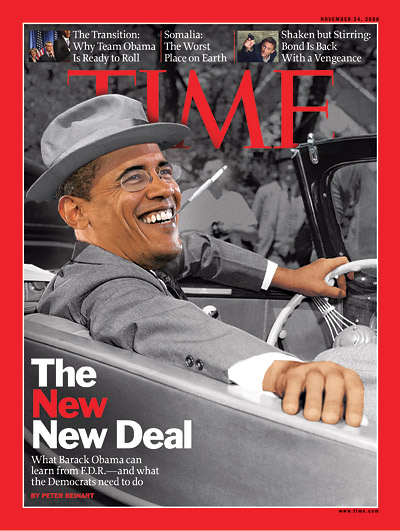
One might think that a sharp economic decline would cause policy-makers to think twice before undermining the business models that have supported IT innovation and real infrastructure investment.  But one has only to look at the policies of FDR’s first two terms to see how even an amiable, soft-spoken president elected on a mantra of change and “uniting” the nation in a time of crisis could consistently choose to place “Reform” (i.e., increased regulation) over “Recovery” (i.e., the health of the economy)—with devastating economic consequences.

Continue reading →