Posts tagged as:

Ted Dziuba has penned a humorous and sharp-tongued piece for The Register about last week’s Adblock vs. NoScript fiasco.  For those of you who aren’t Firefox junkies, a nasty public spat broke out between the makers of these two very popular Firefox Browser extensions (they are the #1 and #3 most popular downloads respectively).  To make a long and complicated story much shorter, basically, NoScript didn’t like Adblock placing them on their list of blacklisted sites and so they fought back by tinkering with the NoScript code to evade the prohibition.  Adblock responded by further tinkering with their code to circumvent the circumvention!  And then, as they say, words were exchanged.

Thus, a war of words and code took place.  In the end, however, it had a (generally) happy ending with NoScript backing down and apologizing. Regardless, Mr. Dzuiba doesn’t like the way things played out:

The real cause of this dispute is something I like to call Nerd Law.  Nerd Law is some policy that can only be enforced by a piece of code, a public standard, or terms of service. For example, under no circumstances will a police officer throw you to the ground and introduce you to his friend the Tazer if you crawl a website and disrespect the robots.txt file. The only way to adjudicate Nerd Law is to write about a transgression on your blog and hope that it gets to the front page of Digg. Nerd Law is the result of the pathological introversion software engineers carry around with them, being too afraid of confrontation after that one time in high school when you stood up to a jock and ended up getting your ass kicked.

Dziuba goes on to suggest that “If you actually talk to people, network, and make agreements, you’ll find that most are reasonable” and, therefore, this confrontation and resulting public fight could have been avoided. They “could have come to a mutually-agreeable solution,” he says.

But no. Sadly, software engineers will do what they were raised to do. And while it may be a really big hullabaloo to a very small subset of people who Twitter and blog their every thought as if anybody cared, to the rest of us, it just reaffirms our knowledge that it’s easy to exploit your average introvert.  After all, what’s he gonna do? Blog about it?

OK, so maybe the developers could have come to some sort of an agreement if they had opened direct channels of communications or, better yet, if someone at the Mozilla Foundation could have intervened early on and mediated the dispute.  At the end of the day, however, that did not happen and a public “Nerd War”  ensued.  But I’d like to say a word in defense of Nerd Law and public fights about “a piece of code, a public standard, or terms of service.”

Continue reading →

As a means of introducing myself to TLF readers, this is an article that I wrote for the PFF blog in September that has not been previously mentioned on the TLF. Most of my other PFF blog posts have been cross-posted by Adam Thierer or Berin Szoka, but I’ve taken ownership of those posts so they appear on my TLF author page.

This is the first in a series of articles that will focus directly on technology instead of technology policy. With an average age of 57, most members of Congress were at least 30 when the IBM PC was introduced in 1981. So it is not surprising that lawmakers have difficulty with cutting-edge technology. The goal of this series is to provide a solid technical foundation for the policy debates that new technologies often trigger. No prior knowledge of the technologies involved is assumed, but no insult to the reader’s intelligence is intended.

This article focuses on cookies–not the cookies you eat, but the cookies associated with browsing the World Wide Web. There has been public concern over the privacy implications of cookies since they were first developed. But to understand them , you must know a bit of history.

According to Tim Berners Lee, the creator of the World Wide Web, “[g]etting people to put data on the Web often was a question of getting them to change perspective, from thinking of the user’s access to it not as interaction with, say, an online library system, but as navigation th[r]ough a set of virtual pages in some abstract space. In this concept, users could bookmark any place and return to it, and could make links into any place from another document. This would give a feeling of persistence, of an ongoing existence, to each page.”[1. Tim Berners-Lee, Weaving The Web: The Original Design and Ultimate Destiny of the World Wide Web. p. 37. Harper Business (2000).] The Web has changed quite a bit since the early 1990s.

Today, websites are much more dynamic and interactive, with every page being customized for each user. Such customization could include automatically selecting the appropriate language for the user based on where they’re located, displaying only content that has been added since the last time the user visited the site, remembering a user who wants to stay logged into a site from a particular computer, or keeping track of items in a virtual shopping cart. These features are simply not possible without the ability for a website to distinguish one user from another and to remember a user as they navigate from one page to another. Today, in the Web 2.0 era, instead of Web pages having persistence (as Berners-Lee described), we have dynamic pages and “user-persistence.”

This paper describes the various methods websites can use to enable user-persistence and how this affects user privacy. But the first thing the reader must realize is that the Web was not initially designed to be interactive; indeed, as the quote above shows, the goal was the exact opposite. Yet interactivity is critical to many of the things we all take for granted about web content and services today.

Continue reading →

By Adam Thierer & Berin Szoka

The goal of our “Privacy Solution Series,” as we noted in the first installment, is to detail the many “technologies of evasion” (i.e., user-empowerment or user “self-help” tools) that allow web surfers to better protect their privacy online—and especially to defeat tracking for online behavioral advertising purposes.  These tools and methods form an important part of a layered approach that, in our view, provides an effective alternative to government-mandated regulation of online privacy.

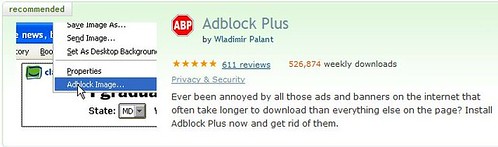
In this second installment in this series, we will highlight Adblock Plus (ABP), a free downloadable extension for the Firefox web browser (as well as for the Flock browser, though we focus on the Firefox version here).

Adblock Plus

Purpose: The primary purpose of Adblock Plus is to block online ads from being downloaded and displayed on a user’s screen as they browse the Web.  In a broad sense, this functionality might be considered a “privacy” tool by those who consider it an intrusion upon, or violation of, their “privacy” to be “subjected” to seeing advertisements as they browse the web.  But if one thinks of privacy in terms of what others know about you, Adblocking is not so much about “privacy” as about user annoyance (measured in terms of distracting images cluttering webpages or simply in terms of long download times for webpages).  In this sense, ABP may not qualify as a “technology of evasion,” strictly speaking.  But, as explained below the fold, ABP does allow its users to “evade” some forms of online tracking by blocking the receipt of some, but not all, tracking cookies.

Cost: Like almost all other Firefox add-ons, both the ABP extensions and the filter subscriptions on which it relies (as described below) are free.

Popularity / Adoption: While there are a wide variety of ad-blocking tools available, Adblock Plus is far and away the leader.  ABP has proven enormously popular since its release in November 2005 as the successor to Adblock, which was first developed in 2002 and reached over 10,000,000 downloads before being abandoned by its developer and even today garners nearly 40,000 downloads a week.  This history of Adblock provides further details.

ABP was named one the 100 best products of 2007 by PC World magazine and is now the #1 most downloaded add-on for Firefox with over 500,000 weekly downloads, up significantly for just a few months.  In a blog post last month, ABP creator Wladimir Palant estimated that “no more than 5% of Firefox users have Adblock Plus installed,” but that percentage is bound to grow larger as more people discover Adblock.  As one indicator of ABP’s popularity, the number of Google searches for “Adblock” has nearly eclipsed the number of searches for “identity theft,” which seems like a far more serious concern than having to look at web ads. Continue reading →