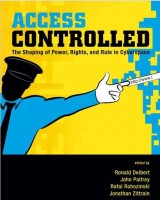
 Faithful readers know of my geeky love for tech policy books. I read lots of ’em. There’s a steady stream of Amazon.com boxes that piles up on my doorstop some days because my mailman can’t fit them all in my mailbox. But I go pretty hard on all the books I review. It’s rare for me pen a glowing review. Occasionally, however, a book will come along that I think is both worthy of your time and which demands a place on your bookshelf because it is such an indispensable resource. Access Controlled: The Shaping of Power, Rights, and Rule in Cyberspace is one of those books.
Smartly organized and edited by Ronald J. Deibert, John G. Palfrey, Rafal Rohozinski, and Jonathan Zittrain, Access Controlled is essential reading for anyone studying the methods governments are using globally to stifle online expression and dissent. As I noted of their previous edition, Access Denied: The Practice and Policy of Global Internet Filtering, there is simply no other resource out there like this; it should be required reading in every cyberlaw or information policy program.
The book, which is a project of the OpenNet Initiative (ONI), is divided into two parts. Part 1 of the book includes six chapters on “Theory and Analysis.” They are terrifically informative essays, and the editors have made them all available online here (I’ve listed them down below with links embedded). The beefy second part of the book provides a whopping 480 pages(!) of detailed regional and country-by-country overviews of the global state of online speech controls and discuss the long-term ramifications of increasing government meddling with online networks.
In their interesting chapter on “Control and Subversion in Russian Cyberspace,” Deibert and Rohozinski create a useful taxonomy to illustrate the three general types of speech and information controls that states are deploying today. What I find most interesting is how, throughout the book, various authors document the increasing movement away from “first generation controls,” which are epitomized by “Great Firewall of China”-like filtering methods, and toward second- and third-generation controls, which are more refined and difficult to monitor. Here’s how Deibert and Rohozinski define those three classes (or “generations”) of controls: Continue reading →
Harvard’s Jonathan Zittrain has launched an interesting new project called “HerdictWeb,” which “seeks to gain insight into what users around the world are experiencing in terms of web accessibility; or in other words, determine the herdict.” It’s a useful tool for determining whether governments are blocking certain websites for whatever reason. Here’s Zittrain’s sock puppet video with all the details!
http://www.youtube.com/v/NggzBHSXdCo&hl=en&fs=1
The website is quite slick and very user-friendly, and they’ve even created a downloadable Firefox button that will automatically check site accessibility while you’re surfing the Net.
The information gathered from this effort will be useful for the OpenNet Initiative that Zittrain and John Palfrey co-created (with others from Univ. of Toronto, Oxford Univ., and Univ. of Cambridge) and wrote about in their excellent book, Access Denied: The Practice and Policy of Global Internet Filtering, which was one of my favorite technology policy books of the past year. The data collected will give them, and us, a fuller picture of just how widespread global filtering and censorship efforts really are. I encourage you to take a look and spread the word, especially to those in foreign countries who could probably use it more than us. (Of course, their governments will likely block Herdict once the word gets around!)
It’s been a big year for tech policy books. Several important titles were released in 2008 that offer interesting perspectives about the future of the Internet and the impact digital technologies are having on our lives, culture, and economy. Back in September, I compared some of the most popular technology policy books of the past five years and tried to group them into two camps: “Internet optimists” vs. “Internet pessimists.” That post generated a great deal of discussion and I plan on expanding it into a longer article soon. In this post, however, I will merely list what I regard as the most important technology policy books of the past year.
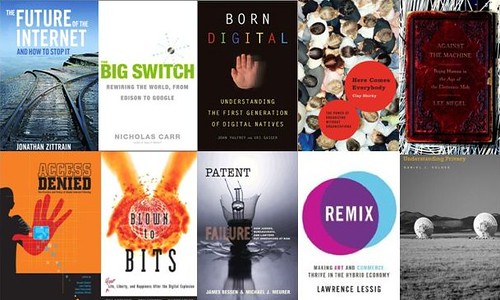
What qualifies as an “important” tech policy book? Basically, it’s a title that many people in this field are currently discussing and that we will likely be talking about for many years to come. I want to make it clear, however, that merely because a book appears on this list it does not necessarily mean I agree with everything said in it. In fact, I found much with which to disagree in my picks for the two most important books of 2008, as well as many of the other books on the list. [Moreover, after reading all these books, I am more convinced than ever that libertarians are badly losing the intellectual battle of ideas over Internet issues and digital technology policy. There’s just very few people defending a “Hands-Off-the-Net” approach anymore. But that’s a subject for another day!]
Another caveat: Narrowly focused titles lose a few points on my list. For example, as was the case in past years, a number of important IP-related books have come out this year. If a book deals exclusively with copyright or patent issues, it does not exactly qualify as the same sort of “tech policy book” as other titles found on this list since it is a narrow exploration of just one set of issues that have a bearing on digital technology policy. The same could be said of a book that deals exclusively with privacy policy, like Solove’s
Understanding Privacy. It’s an important book with implications for the future of tech policy, but I demoted it a bit because of its narrow focus.
With those caveats in mind, here are my Top 10 Most Important Tech Policy Books of 2008 (and please let me know about your picks for book of the year):
Continue reading →
 Earlier this year, I mentioned an outstanding book that John Palfrey of the Berkman Center for Internet & Society at Harvard Law School co-edited entitled Access Denied: The Practice and Policy of Global Internet Filtering. It’s an excellent resource for anyone studying the methods governments are (unfortunately) using to stifle online expression across the globe. It’s one of the most important technology policy books of the year.
Well, it looks like John Palfrey will have a second title on this year’s “Best Tech Books” list. I’ve just finished his new book with his Berkman Center colleague Urs Gasser, Born Digital: Understanding the First Generation of Digital Natives, and it is definitely worthy of your attention. In my book review posted today on the City Journal’s website, I argue that “Palfrey and Gasser’s fine early history of this generation serves as a starting point for any conversation about how to mentor the children of the Web.” It’s a comprehensive and very even-handed discussion about a variety of concerns or Internet pathologies, including: online safety, personal privacy, copyright piracy, offensive content, classroom learning, and much more.
My
City Journal review is down below, but in coming weeks I will be posting some additional thoughts about some specific things in the book worthy of more attention (including a few things I disagreed with). Overall, I’d say Born Digital is a close runner-up in the race for “Tech Book of the Year,” closely trailing Jonathan Zittrain’s Future of the Internet and How to Stop It (which I have reviewed multiple times) and Nick Carr’s The Big Switch. But I found far more to agree with in Born Digital than I did in those two books. Highly recommended.
Continue reading →
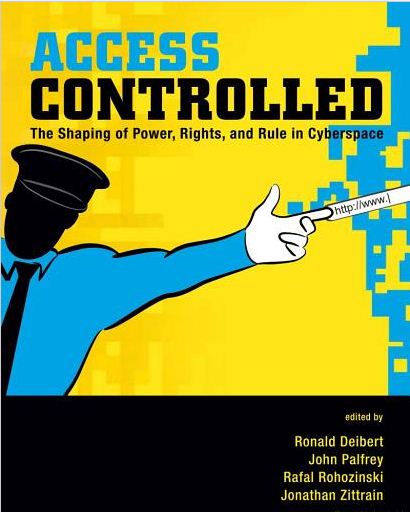 Faithful readers know of my geeky love for tech policy books. I read lots of ’em. There’s a steady stream of Amazon.com boxes that piles up on my doorstop some days because my mailman can’t fit them all in my mailbox. But I go pretty hard on all the books I review. It’s rare for me pen a glowing review. Occasionally, however, a book will come along that I think is both worthy of your time and which demands a place on your bookshelf because it is such an indispensable resource. Access Controlled: The Shaping of Power, Rights, and Rule in Cyberspace is one of those books.
 The Technology Liberation Front is the tech policy blog dedicated to keeping politicians' hands off the 'net and everything else related to technology.