George Will’s weekly Washington Post column focuses on the Fairness Doctrine and calls out those on the Left who would support its reinstatement:
Because liberals have been even less successful in competing with conservatives on talk radio than Detroit has been in competing with its rivals, liberals are seeking intellectual protectionism in the form of regulations that suppress ideological rivals. If liberals advertise their illiberalism by reimposing the fairness doctrine, the Supreme Court might revisit its 1969 ruling that the fairness doctrine is constitutional. The court probably would dismay reactionary liberals by reversing that decision on the ground that the world has changed vastly, pertinently and for the better.
Mr. Will was kind enough to cite my new book with Brian Anderson, A Manifesto for Media Freedom [more info here] on the explosion of media outlets and options since the Supreme Court’s disastrous 1969 Red Lion decision, which blessed the Fairness Doctrine. Some of those stats: today there are about 14,000 radio stations, twice as many as in 1969; 18.9 million subscribers to satellite radio, up 17 percent in 12 months; and that 86 percent of households with either cable or satellite television receive an average of 102 of the 500 available channels.
No need to be putting the “Unfairness Doctrine” back on the books with unprecedented abundance like that.
Back in the mid- and even late 1990s, I was engaged in a lot of dreadfully boring telecom policy debates in which the proponents of regulation flatly refused to accept the argument that the hegemony of wireline communications systems would ever be seriously challenged by wireless networks. Well, we all know how that story is playing out today. People are increasingly “cutting the cord” and opting to live a wireless-only existence. For example, this recent Nielsen Mobile study on wireless substitution reports that, although only 4.2% of homes were wireless-only at the end of 2003…
At the end of 2007, 16.4 percent of U.S. households had abandoned their landline phone for their wireless phone, but by the end of June 2008, just 6 months later, that number had increased to 17.1 percent. Overall, this percentage has grown by 3-4 percentage points per year, and the trend doesn’t seem to be slowing. In fact, a Q4 2007 study by Nielsen Mobile showed that an additional 5 percent of households indicated that they were “likely” to disconnect their landline service in the next 12 months, potentially increasing the overall percentage of wireless-only households to nearly 1 in 5 by year’s end.
And one wonders about how many homes are like mine — we just keep the landline for emergency purposes or to redirect phone spam to that number instead of giving out our mobile numbers. Beyond that, my wife and I are pretty much wireless-only people and I’m sure there’s a lot of others like us out there.
Anyway, I’ve been having a strange feeling of deva vu lately as I’ve been engaging in policy debates about the future of the video marketplace. Like those old telecom debates of the last decade, we are now witnessing a similar debate — and set of denials — playing out in the video arena. Many lawmakers and regulatory advocates (and even some industry folks) are acting as if the old ways of doing business are the only ways that still count. In reality, things are changing rapidly as video content continues to migrate online.
I was reminded of that again this weekend when I was reading Nick Wingfield’s brilliant piece in the
Wall Street Journal entitled “Turn On, Tune Out, Click Here.” It is must-reading for anyone following development in this field. As Wingfield notes:
Continue reading →
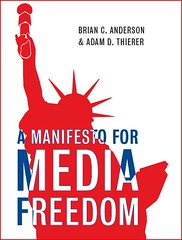 I’m pleased to announce the publication of A Manifesto for Media Freedom, which I co-authored with Brian C. Anderson of the Manhattan Institute. Brian serves as editor of Manhattan Institute’s excellent City Journal and he is the author of best-selling books like South Park Conservatives and Democratic Capitalism and Its Discontents.
In this little manifesto, we highlight one of the central ironies of the Information Age. Namely, that despite “the breathtaking abundance of new and old media outlets for obtaining news, information, and entertainment…”
many people hate this profusion, and never more than when it involves political speech. The current media market, they charge, doesn’t represent true diversity, or isn’t fair, or is subject to manipulation by a small and shrinking group of media barons. They want the government to regulate it into better shape, which just happens to be a shape that benefits them. Doing so… would be a disaster, a kind of soft or not-so-soft tyranny that would wipe out whole sectors of media, curtailing free speech and impoverishing our democracy.
In other words, instead of celebrating the unprecedented cornucopia of media choices at our collective disposal, many policymakers and media critics are calling for just as much media regulation as ever. We itemize these threats in our chapters and they include: efforts to revive the “Fairness Doctrine”, media ownership regulations, “localism” requirements, Net neutrality mandates, a la carte regulations, cable and satellite censorship, video game censorship, regulation of social networking sites, campaign finance-related speech restrictions, and so on.
In each case, we advance a pro-freedom paradigm to counter the advocates of media control. What do we mean by the “media freedom” that we advocate as the alternative to these new regulatory crusades? Here’s how we put it in the book:
Continue reading →

 The Technology Liberation Front is the tech policy blog dedicated to keeping politicians' hands off the 'net and everything else related to technology.