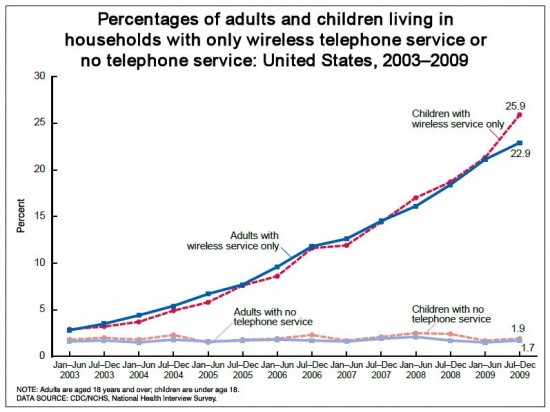
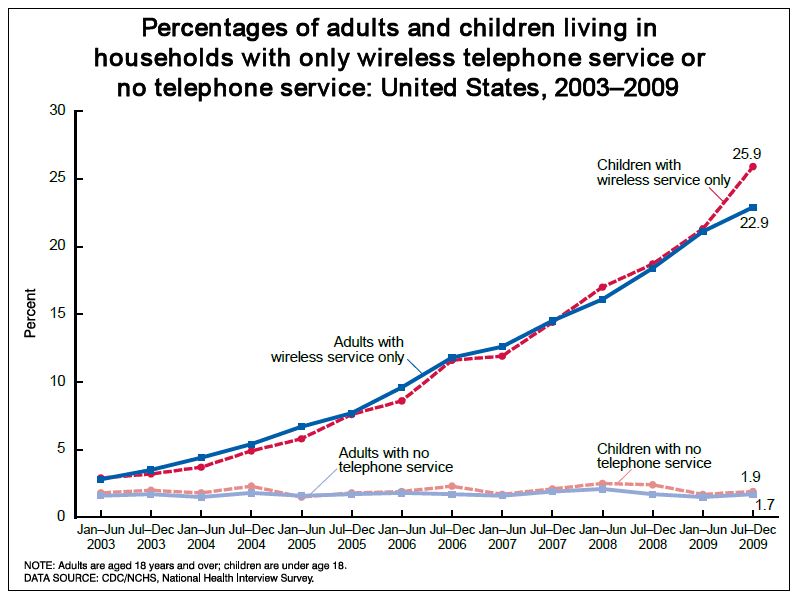
The Center for Disease Control and Prevention (CDC) has released it’s latest report on “Wireless Substitution: Early Release of Estimates From the National Health Interview Survey.” For many years, this CDC report has shown a steady rise in “cord-cutting” with a gradual rise in the number of wireless-only homes. But we’ve now reached an important milestone of sorts with fully one-quarter of all U.S. homes now in the wireless-only camp. According to CDC:
One of every four American homes (24.5%) had only wireless telephones (also known as cellular telephones, cell phones, or mobile phones) during the last half of 2009—an increase of 1.8 percentage points since the first half of 2009. In addition, one of every seven American homes (14.9%) had a landline yet received all or almost all calls on wireless telephones.
Pretty stunning when you think about the fact that just a decade ago few of us even carried phones around in our pockets or purses. Despite what all the worry-warts and wanna-be regulators in Washington say, this is one hell of a dynamic marketplace.
Today, President Bush signed S. 602, “The Child Safe Viewing Act.”(CNet story here). The measure requires the Federal Communications Commission (FCC) to conduct an inquiry to examine the availability of, and methods of encouraging the use of, advanced blocking technologies that help parents protect their children from transmitted video and audio programming that the parents determine to be indecent or objectionable. The FCC has 270 days to complete the report.
I wrote about the measure more extensively when it passed the Senate back in October. As I noted in then, the measure was modified slightly when it passed through the Commerce Committee last year, but it still contains some provision that could be problematic. Specifically, as part of the FCC’s required study, the bill commands the FCC to “consider advanced blocking technologies” that:
- may be appropriate across a wide variety of distribution platforms, including wired, wireless, and Internet platforms;
- operate independently of ratings pre-assigned by the creator of such video or audio programming.
Those two provisions are cause for concern since they raise the specter of what I referred to as “convergence-era content regulation” in a PFF paper about the bill last year. It does so in two ways. First, it opens the door to FCC bureaucrats investigating media content controls for wireless and Internet platforms, something it has never been empowered to do before. Second, by specifying that these new advanced content blocking technologies should “operate independently of ratings pre-assigned by the creator,” the law seems to imply that existing voluntary rating and labeling systems cannot be trusted. That is a dangerous presumption that suggests the FCC might be able to come up with better media ratings on its own.
Continue reading →
Just FYI, the latest update of my booklet on “Parental Controls and Online Child Protection: A Survey of Tools & Methods” is now live. The new version, Version 3.1, provides minor updates to all sections of the book and a new appendix of relevant research in the field. I issue major updates early each year and 1 or 2 tweaks during the course of the year to reflect the evolution of the parental control and online child safety market and debate. 
For those not familiar with the report, it explores the market for parental control tools, rating schemes, education efforts, and initiatives aimed at promoting online child safety. I believe that the parental controls and content management tools cataloged in the report represent a better, less restrictive alternative to government regulation. As I conclude after evaluating that state of the market: “There has never been a time in our nation’s history when parents have had more tools and methods at their disposal to help them decide what constitutes acceptable media content in their homes and in the lives of their children.”
The report is available free-of-charge on the PFF website, and the previous editions of the report are housed there too in case you want to see how it has evolved over the past two years. For those interested in taking a quick look at the report, I have embedded it down below the fold as a Scribd file. Finally, as is always the case, I encourage readers to send me updates and suggestions for how to improve the report and I will incorporate them into future versions.
Continue reading →
PFF has just releasing an updated edition of my booklet on “Parental Controls and Online Child Protection: A Survey of Tools & Methods.” The new version, Version 3.0, includes two new appendixes and updates to each section to reflect new parental control tools and programs developed in the last nine months.
The updated report is timely as it comes on the heels of the recently-announced Internet Safety Technical Task Force, which is being chaired by the Berkman Center for Internet & Society at Harvard Law School. I am privileged to serve as a member of the Task Force, which is evaluating various online safety technologies and strategies and then reporting back to state attorneys general with our findings.
Those issues and much more are covered in the latest edition of my report. The report explores the market for parental control tools, rating schemes, education efforts, and initiatives aimed at promoting online child safety. I believe that the parental controls and content management tools cataloged in the report represent a better, less restrictive alternative to government regulation. As I conclude after evaluating that state of the market: “There has never been a time in our nation’s history when parents have had more tools and methods at their disposal to help them decide what constitutes acceptable media content in their homes and in the lives of their children.”
Version 3.0 of the special report, now over 200 pages, contains over fifty exhibits and numerous updates in all five sections of the book. Major updates have been made to the Internet, social networking, and mobile media sections, reflecting the growing importance of those sectors and issues. A greatly expanded section on video empowerment technologies has also been included. Finally, two appendices have also been added: a comprehensive legislative index cataloging over thirty bills introduced in Congress on these issues (complied with John Morris of Center for Democracy & Technology), and a glossary of 35 relevant terms and cases.
The report is available free-of-charge on the PFF website, as are the previous editions. And I am happy to provide hard copies to those who are interested.
http://documents.scribd.com/ScribdViewer.swf?document_id=2887320&access_key=key-um5xjvf98bfnuu8811v&page=&version=1&auto_size=true
PFF has just released my latest paper entitled “Parental Control Perfection? The Impact of the DVR and VOD Boom on the Debate over TV Content Regulation.” In the report, I focus on the extent to which new video technologies, such as digital video recorders (DVRs) and video on demand (VOD) services, are changing the way households consume media and are helping parents better tailor viewing experiences to their tastes and values. I provide evidence showing the rapid spread of these technologies and discuss how parents are using these tools in their homes. Finally, I argue that these developments will have profound implications for debates over the regulation of video programming. As parents are given the ability to more effectively manage their family’s viewing habits and experiences, it will lessen—if not completely undercut—the need for government intervention on their behalf.
This 16-page report can be found at: http://www.pff.org/issues-pubs/pops/pop14.20DVRboomcontentreg.pdf

 The Technology Liberation Front is the tech policy blog dedicated to keeping politicians' hands off the 'net and everything else related to technology.