This week I will again be attending the Family Online Safety Institute’s excellent annual summit. The 2-day affair brings together some of the world’s leading experts on online safety and privacy issues. It’s a great chance to learn about major developments in the field. As I was preparing for the session I am moderating on Thursday, I thought back to the first FOSI annual conference, which took place back in 2007. What is remarkable about that period compared to now is that there was a flurry of legislative and regulatory activity related to online child safety then that we simply do not see today.
In fact, just 3 1/2 years ago, John Morris of the Center for Democracy and Technology and I compile a legislative index [summary here] that cataloged the more than 30 legislative proposals that had been introduced in the the 110th session of Congress. There was also a great deal of interest in these issues within the regulatory community. Finally, countless state and local measures related to online safety and speech issues had been floated. Today, by contrast, it is hard for me to find any legislative measures focused on online safety regulation at the federal level, and I don’t see much activity at the agency level either. I haven’t surveyed state and local activity, but it seems like it has also died down.
Generally speaking, I think this is a good development since I am opposed to most proposals to regulate online speech, expression, or conduct. But let’s ignore the particular wisdom of such measures and ask a simple question:
What explains the decline in Internet safety legislation and online content regulation? I believe there are three possible explanations: Continue reading →
On June 29th, The Progress & Freedom Foundation (PFF) and the Family Online Safety Institute (FOSI) will co-host a National Press Club briefing entitled “Sending an Online Safety Message to Congress.” This event will feature a discussion about the recently released report of the Online Safety and Technology Working Group (OSTWG), “Youth Safety on a Living Internet.” OSTWG — a congressionally-mandated blue ribbon working group — analyzed the state of online child safety and offered policymakers and parents a wide array of recommendations for how to keep kids safe and secure in today’s “always-on,” interconnected world. [For more background on OSTWG and our final report, see this post.] Several OSTWG leaders will be on hand to discuss the report and outline the next steps that need to be taken on this front. Here are the details.
| What: |
Sending an Online Safety Message to Congress — A discussion about the OSTWG final report and the future of childrens’ online safety and public policy. |
| When: |
Tuesday, June 29
9:00 a.m. – 10:45 p.m. (breakfast provided) |
| Where: |
National Press Club
First Amendment Lounge, 13th Floor 529 14th Street NW Washington, D.C. 20515 |
| Who: |
Hemanshu Nigam, Founder, SSP Blue, and Co-Chair of OSTWG
Larry Magid, Co-Director, ConnectSafety.org
Michael McKeehan, Executive Director, Internet & Technology Policy, Verizon
Adam Thierer President, The Progress & Freedom Foundation
Stephen Balkam Chief Executive Officer, Family Online Safety Institute, (moderator) |
To Register: Space is limited, so an RSVP is required to attend. Please register here.
Emerson once said that we should do the thing we fear, and then death of fear is certain. Similarly, parents that fear their child’s use of technology can use technology themselves to monitor, filter and block their children’s Internet use.
I’m a member of the NTIA Online Safety and Technology Working Group (OSTWG) along with TLF’s Adam Thierer (Mr. President of PFF). Adam organized our third meeting was on parental controls, child protection technologies and content rating methods. He organized a wealth of speakers to discuss tools available from ISPs, tools existing in operating systems, browsers, and search, and settings that exist in some social networking websites.
Here are the highlights:
- Safety experts praised AOL’s parental tools that don’t report to parents every site that a child visits. Child abuse, contraception, and other sites are the kinds that many people feel children have legitimate privacy (and in abusive situations even safety concerns for their lives) surrounding the sites they visit.
- A representative from the Department of Education asked about “best practices” — a good idea in concept but given the diversity of online sites and services easier said then done.
- It is common to categorize children into age groups for parental controls but there’s data lacking about how children understand advertising and what is the harm, if any.
- Age groups: 7 and below–white list only. 7-12–no white list only but lots of restrictions. 13-17–very permissive, lots of sites accessible. 17+–only porn images blocked.
- Google will soon be launching a national media digital literacy citizenship campaign. Continue reading →
This video from a puppet maker in Australia has an interesting take on the fear-mongering that often drives public policy for Internet safety. The video does a good job of putting into perspective the real risk to kids of online predation.
For instance, we often hear the scary statistic that “1 in 5 children are sexually solicited online.” This was based on data originally released by the National Center for Missing and Exploited Children (NCMEC). It’s since been updated to 1 in 7, which still sounds bad, but not so bad in perspective — what does solicitation mean, and by whom? Well, “solicitation” is broadly defined to mean “unwanted contact.” In the study, it encompasses
any unwanted discussion of a sexual nature. But the real perspective comes from learning 90% of this unwanted contact comes from other peers or young adults! So, it’s rarely the creepy perverted middle-age man in a wife beater t-shirt — even though the messaging from many policymakers focuses almost entirely on this scenario.
http://www.youtube.com/v/9lsnC-iWHJ0
 The latest edition (Version 4.0) of my PFF special report on “Parental Controls and Online Child Protection: A Survey of Tools & Methods” is now up. For those not familiar with the report, it explores the market for parental control tools, rating schemes, education and media literacy efforts, and various other tools, methods, and initiatives aimed at promoting online child safety. After evaluating that state of this market, I conclude: “There has never been a time in our nation’s history when parents have had more tools and methods at their disposal to help them decide what constitutes acceptable media content in their homes and in the lives of their children.” Moreover, I believe that the parental controls and content management tools cataloged in the report represent a better, less restrictive alternative to government regulation.
Version 4.0 of the report is now over 250 pages long (up from 200 pages in Version 3.0) and it contains almost 70 exhibits (up from 50), 725 references (up from roughly 500), and numerous updates in all five sections of the book. Major updates have been made to the Internet, social networking, and mobile media sections, reflecting the growing importance of those sectors and issues. Other new sections or appendices have also been added to the report, including:
- a new section examining how many households really need parental control tools;
- a new appendix on the downsides of mandatory parental controls and restrictive default settings;
- a new section on the dangers of “deputizing the online middleman” solution as an approach to solving child safety concerns;
- a new appendix reviewing the findings of 5 past online safety task forces;
- … and much more.
I issue major updates once a year and 1 or 2 minor tweaks during the course of the year to reflect the evolution of the parental control and online child safety marketplace and debate. The report is available free-of-charge on the PFF website, and the previous editions of the report are housed there too in case you want to see how it has evolved over the past couple of years. For those interested in taking a quick look at the report, I have embedded it down below the fold as a Scribd file. Finally, as is always the case, I encourage readers to send me updates and suggestions for how to improve the report and I will incorporate them into future versions.
Continue reading →
Maine has just enacted a law severely restricting marketing to kids: the Act To Prevent Predatory Marketing Practices against Minors, summarized by Covington & Burling. Adam and I released a major paper in June about such laws: COPPA 2.0: The New Battle over Privacy, Age Verification, Online Safety & Free Speech. Maine is following the lead of several other states that have tried to expand the Children’s Online Privacy Protection Act (COPPA) of 1998 to cover nost just kids under 13 but adolescents as well and potentially all social networking sites. We discussed at length the problems such laws create, particularly the possibility that large numbers of adults would, for the first time, be subject to age verification mandates before accessing (or participating in) the growing range of sites with social networking capabilities. This, in turn, would significantly “chill” free speech online by undermining anonymity.
Like COPPA 2.0 proposals in New Jersey (simply extending COPPA to cover adolescents) and Illinois (applying COPPA to most social networking sites), the Maine law tries to build on COPPA’s “verifiable parental consent” requirement for the 13-17 audience as well as those under 13.
On the one hand, the Maine law goes much further than these other COPPA 2.0 proposals. While the original bill was limited to the Internet and wireless communications, the final bill’s scope applies to all communications. The bill also covers “health-related” information (HRI) as well as “personal information” (PI). On the other hand, the Maine law is thus somewhat narrower than other COPPA 2.0 proposals and COPPA itself in that it applies only to “marketing or advertising products, goods or services.” While COPPA is commonly misunderstood to cover only marketing, it actually covers essentially any “collection” (broadly defined) of personal information from kids for any purpose—including merely giving kids access to communications functionality that might let them share personal information with other users (even if the site itself is not “collecting” that information in the commonly understood sense).
Continue reading →
Today, the U.S. Department of Commerce’s National Telecommunications and Information Administration (NTIA) announced the members of the new Online Safety and Technology Working Group (OSTWG). I am honored to be among those chosen to participate in this new task force and I look forward to continuing the work started last year with the Harvard Berkman Center’s Internet Safety Technical Task Force (ISTTF), which I also served on. I was very proud of the work done by the ISTTF and the impressive final report that Prof. John Palfrey crafted to reflect our findings. I am eager to investigate these issues further and take a look at the latest research and technologies that can help us better understand how to protect our kids online while also protecting the free speech and privacy rights of Netizens.
The new NTIA working group, which was established under the “Protecting Children in the 21st Century Act,” will report to the Assistant Secretary of Commerce for Communications and Information on industry-implemented online child safety tools and efforts. Within a year of convening its first meeting, the group will submit a report of its findings and make recommendations on how to increase online safety measures.
Below the fold I have listed the complete roster of OSTWG task force members. I very much looking forward to working with this outstanding group. And I’m happy to report that my TLF blogging colleague Braden Cox will be joining me on this task force!
Continue reading →
Just wanted draw everyone’s attention to a couple of great podcasts about online safety issues that include comments from members of the Internet Safety Technical Task Force (ISTTF). As I mentioned a few weeks ago, the ISTTF project and final report represent a major milestone in the discussion about online safety in America, and I was honored to serve as a member of this task force.
This in-depth “Radio Berkman” podcast featuring ISTTF director John Palfrey and co-director Dena Sacco is a really excellent (but lengthy!) overview of the ISTTF’s word. Here’s a shorter podcast that Prof. Palfrey did with Larry Magid of CNet. And I also recommend this excellent NPR “On the Media” podcast featuring my friend Stephen Balkam of the Family Online Safety Institute (FOSI).
For those interested, down below you will find a running list I have been keeping of coverage of the ISTTF. (I will try to keep updating this list here).
Continue reading →
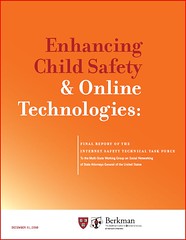 The Internet Safety Technical Task Force (ISTTF), which was formed a year ago to study online safety concerns and technologies, today issued its final report to the U.S. Attorneys General who authorized its creation. It was a great honor for me to serve as a member of the ISTTF and I believe this Task Force and its report represent a major step forward in the discussion about online child safety in this country.
The ISTTF was very ably chaired by John Palfrey, co-director of Harvard University’s Berkman Center for Internet & Society, and I just want to express my profound thanks here to John and his team at Harvard for doing a great job herding cats and overseeing a very challenging process. I encourage everyone to examine the full ISTTF report and all the submissions, presentations, and academic literature that we collected. [It’s all here.] It was a comprehensive undertaking that left no stone unturned.
Importantly, the ISTTF convened (1) a Research Advisory Board (RAB),which brought together some of the best and brightest academic researchers in the field of child safety and child development and (2) a Technical Advisory Board (TAB), which included some of America’s leading technologists, who reviewed child safety technologies submitted to the ISTTF. I strongly recommend you closely examine the RAB literature review and TAB assessment of technologies because those reports provide very detailed assessments of the issues. They both represent amazing achievements in their respective arenas.
There are a couple of key takeaways from the ISTTF’s research and final 278-page report that I want to highlight here. Most importantly, like past blue-ribbon commissions that have studied this issue, the ISTTF has generally concluded
there is no silver-bullet technical solution to online child safety concerns. The better way forward is a “layered approach” to online child protection. Here’s how we put it on page 6 of the final report:
The Task Force remains optimistic about the development of technologies to enhance protections for minors online and to support institutions and individuals involved in protecting minors, but cautions against overreliance on technology in isolation or on a single technological approach. Technology can play a helpful role, but there is no one technological solution or specific combination of technological solutions to the problem of online safety for minors. Instead, a combination of technologies, in concert with parental oversight, education, social services, law enforcement, and sound policies by social network sites and service providers may assist in addressing specific problems that minors face online. All stakeholders must continue to work in a cooperative and collaborative manner, sharing information and ideas to achieve the common goal of making the Internet as safe as possible for minors.
Continue reading →
My friend Larry Magid, one of America’s leading Internet safety experts, has an outstanding column over at the Yahoo Kids “Connected Parent” site entitled “Is the Internet as Dangerous as Drunk Driving?” In it, he discusses the surprising results of a recent survey of 1,000 moms of teenagers commissioned by McAfee and conducted by Harris Interactive which found that “about two-thirds of mothers of teens in the United States are just as, or more, concerned about their teenagers’ online safety, such as from threatening emails or solicitation by online sexual predators, as they are about drunk driving (62 per cent) and experimenting with drugs (65 per cent).”
Like Larry, I was a bit shocked that so many mothers would equate online safety with the dangers of drunk driving. After all, as Larry proves, the relative risks aren’t even close:
While moms have good reason to be concerned about how their teens use the Internet, online dangers pale compared to the risks of drunk driving. In 2007, 6,552 people were killed in auto accidents involving young drivers (16-20), according to the National Highway Transportation Safety Administration (NHTSA). In 2006, nearly a fifth (18%) of the 7,643 15- to 20-year-old drivers involved in fatal traffic crashes had a blood had a blood alcohol concentration of .08 or higher.
Perception of Internet danger has been heightened thanks to the TV show “To Catch a Predator” and inaccurate reports such as “one in five children have been sexually solicited by a predator.” That statistic is a misquote from a 2000 study by the Crimes Against Children Research Center. The data (which, based on a 2005 follow-up study was revised to one in seven) is based on a survey that asked teens if they had in the last year received an unwanted sexual solicitation.
But many (possibly most) of those solicitations were from other teens, not from adult predators. What’s more most recipients didn’t view them as serious or threatening, “almost all youth handled the solicitations easily and effectively” and “extremely few youth (two out of 1500 interviewed) were actually sexually victimized by someone they met online,” reported the authors of the study. Other studies have shown that “the stereotype of the Internet child molester who uses trickery and violence to assault children is largely inaccurate” (Wolak, Finkelhor & Mitchell, 2004). In a survey of law enforcement investigators of Internet sex crimes, it was reported that only 5% of offenders pretended to be teens when trying to meet potential victims online.
Those of us who work on Internet policy issues need to do a better job of helping the press and public put online safety risks in proper perspective. Misguided Internet legislation is often premised upon irrational or conjectural fears. Unfortunately, a lot of average moms have been swayed by misperceptions, many of which have been driven by the press or public interest groups that favor more regulation of the Net.

 The Technology Liberation Front is the tech policy blog dedicated to keeping politicians' hands off the 'net and everything else related to technology.