Listening to this morning’s House Judiciary Committee hearing on H.R. 3261, the “Stop Online Piracy Act” (SOPA) was painful for many reasons, including the fact that the first hour of the Committee’s video stream was practically inaudible and unwatchable. That led to a barrage of snarky jokes on Twitter about whether we should trust these same folks to regulate the Internet in the way SOPA envisions if they can’t even get their own tech act together.
The snark-casm went into overdrive, however, once the lawmakers starting discussing DNS issues and the underlying architectural concerns raised by SOPA’s sweeping solution to the problem of online piracy. At that point, the techno-ignorance of Congress was on full display. Member after member admitted that they really didn’t have any idea what impact SOPA’s regulatory provisions would have on the DNS, online security, or much of anything else. This led to some terrifically entertaining commentary from the Twittersphere, including the two below.
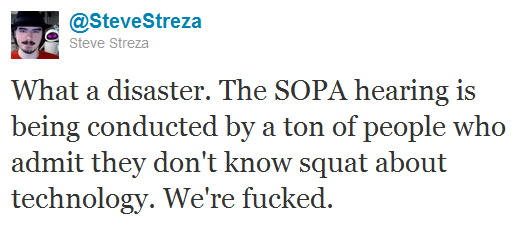
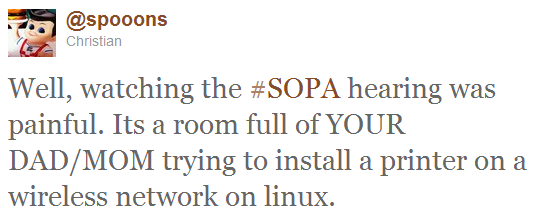 I’m highly sympathetic to such concerns, but here’s my question: Where the heck were all these people when we were debating Net neutrality regulation, new privacy mandates, cybersecurity restrictions, Net gambling, and more? It strikes me that there’s a selective memory (or selective morality?) problem at work in these cyberlaw debates: When critics hate a particular bill, they’ll go out of their way to point out how technologically incompetent Congress is and why we should be skeptical of whatever it is they are up to. But if the critics are sympathetic to the regulatory cause du jour, well then, we should just trust that those crusty Congress critters will get it right!
I wrote about this selective morality problem at greater length in my essays,”When It Comes to Information Control, Everybody Has a Pet Issue & Everyone Will Be Disappointed,”and “And so the IP & Porn Wars Give Way to the Privacy & Cybersecurity Wars.” Put simply, people hate Internet regulation… until they love it.
For example, the conservatives rush out and breathlessly denounce each and every effort to impose Net neutrality regulation because of the danger of empowering an already over-zealous bunch of bumbling bureaucrats at the FCC. (And I agree with them.) Yet, with their next breath many conservatives praise SOPA even though it also empowers government to muck with the inner workings of the Internet. Some of those conservatives are also turning a blind eye to the growing appetite of the defense/security community to meddle with the Net’s architecture in the name of avoiding any number of non-catastrophes.
Meanwhile, the liberals decry SOPA and want it stopped at all costs. There’s never been a copyright protection measure they liked, of course, but each time one pops up we hear them claim that our analog era Congress is not well-positioned to be designing industrial policy schemes for the Internet. (And I generally agree with them.) But most liberals do a complete 180 whenever online privacy or Net neutrality regulations are the subject of congressional inquiry. Suddenly, the cyber-oafs in Congress are considered veritable technocratic philosopher kings who we should trust to guard our cyber-freedoms to lead us to the digital promised land.
Oh, the hypocrisy of it all! Is there no one who stands for real Internet freedom? I guess not. But I hope all these people lambasting congressional and bureaucratic techno-incompetence today will have that same script handy at the next Internet policy hearing. Because if they aren’t willing to use it consistently, I will.


 The Technology Liberation Front is the tech policy blog dedicated to keeping politicians' hands off the 'net and everything else related to technology.