Useful Chart Showing International Wireless Comparisons

by on August 18, 2011 · 6 comments

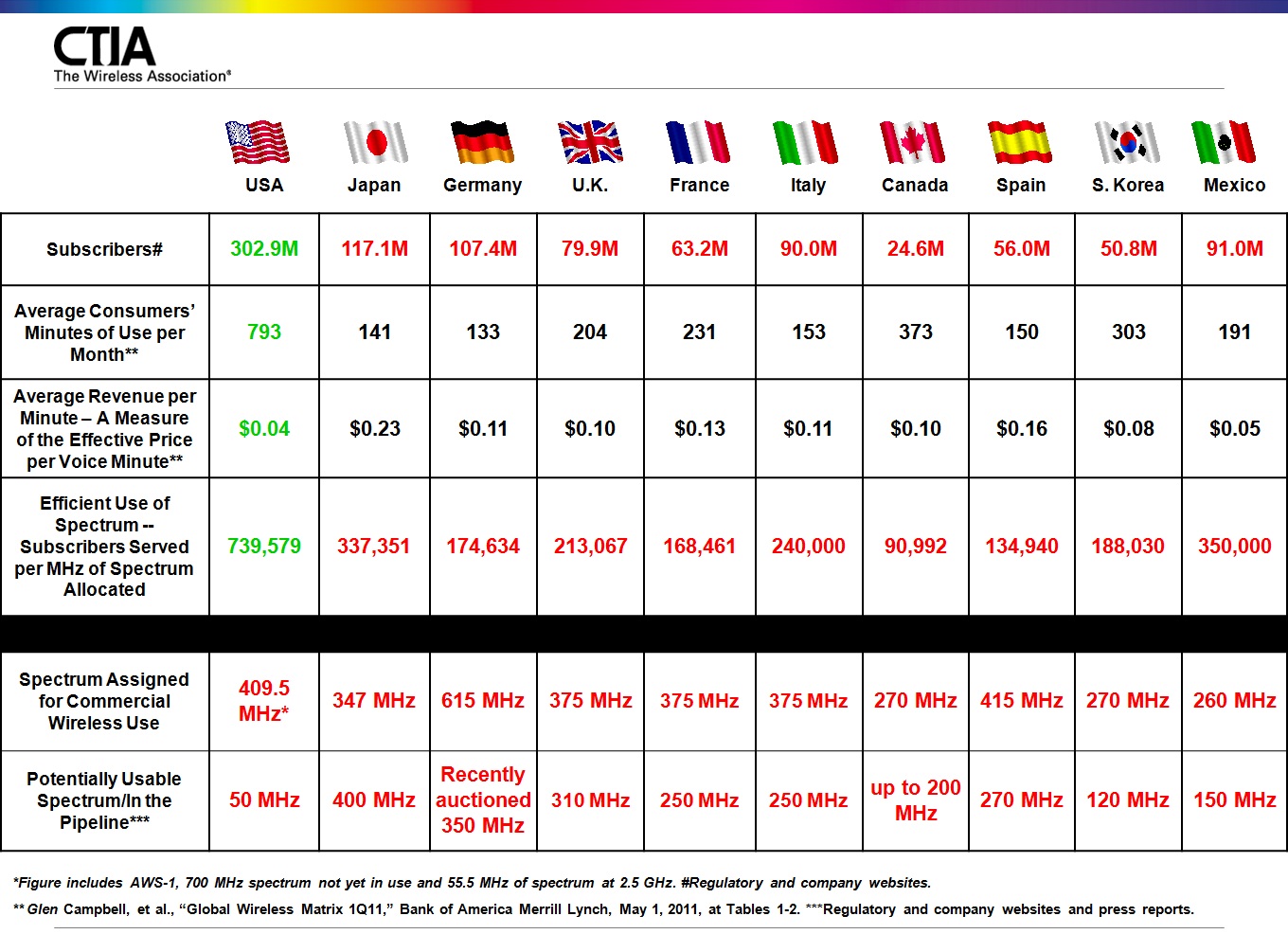
Here’s a terrifically useful chart from CTIA that offers some international wireless use and spectrum availability comparisons. [Click on chart to expand.] The average minutes of use and average revenue per minute differences are fairly staggering. But the really important takeaway from this chart is the last line, which depicts how little spectrum is dripping out of the faucet right now. Having just 50 MHz of “potentially usable spectrum in the pipeline” is troubling and needs to be addressed by policymakers immediately. America’s wireless demands continue to explode, but supply isn’t keeping up.
  • Michael Thomas

    Correct me if I am reading the chart incorrectly.    My interpretation is that US providers are averaging four cents a minute.  Japanese providers are averaging 23 cents per minute.  The Japanese providers who are getting 23 cents per minute are pretty well incentivised to build out more spectrum.  US providers, earning a meager four cents are not.  I see a pretty simple interaction of supply and demand.  I would not be in any rush to add more suppy if prices were so depressed as they are in the US.  It also appears as though the US is the most efficient in its spectrum use. No mean feat considering how varied the US is.   This chart does not appear to address any of the qualitative aspects of spectrum, 2g, 3g, 4g, dense urban areas vs rural or along highways.  Spectrum buildout varies enormously according to geograghy and urban layout.

  • Steve Crowley

    I agree with the point about policymakers getting going on spectrum. That said, I have a few criticisms of the chart…

    – The cited “Global Wireless Matrix” report is not publicly available.

    – I’m not sure what the “effective price for voice minute” is. Does it take into account unused portions of monthly minute allocations? As the other commenter said, it seems to undermine the argument for more spectrum. I’d suggest data cost is a more important measure than voice cost, and the US lags there. (There. They have the argument back.)

    – The subscribers served per MHz of spectrum allocated, if I am interpreting it right, has no significance since spectrum is reused. It is not as if the total spectrum pie is divided among all subscribers. It produces a big, cool, number, but that is about it.

    – Japan and South Korea arguably have the most advanced wireless ecosystems in the world, and they do it with less spectrum.

    – The spectrum in the “pipeline” does not take into account NTIA initiatives underway to free up hundreds of MHz of fallow government spectrum for mobile broadband use. In September we should see some significant reporting from NTIA on its progress.

  • Pingback: Tech at Night: One great idea and two bad ideas in the House | We The Conservatives

  • Pingback: Tech at Night: One great idea and two bad ideas in the House

  • Pingback: Do Exclusionary Theories of the AT&T / T-Mobile Transaction Better Explain the Market’s Reaction to the DOJ’s Decision to Challenge the Merger? « Truth on the Market

  • Pingback: Do Exclusionary Theories of the AT&T / T-Mobile Transaction Better Explain the Market’s Reaction to the DOJ’s Decision to Challenge the Merger?

Previous post:

Next post: