There’s much to discuss as Obama shapes his administration (more on this at OpenMarket.org) but arguably one of the most important unanswered questions is who Obama will pick to staff the Federal Communications Commission.
CNET reports that Henry Rivera, a lawyer and former FCC Commissioner, has been selected to head the transition team tasked with reshaping the FCC. This selection gives us a glimpse of what the FCC’s agenda will look like under Obama, and it’s quite troubling.
Rivera has embraced a media “reform” agenda aimed at promoting minority ownership of broadcast media outlets. A couple weeks ago, Rivera sent a letter to the FCC that backed rules originally conceived by the Media Access Project to create a new class of stations to which only “small and distressed businesses” (SDB) could belong. The S-Class stations would be authorized to sublease digital spectrum and formulate must-carry programming, with the caveat that only half of the content can be “commercial”. To avoid the Constitutional issues surrounding racial quotas, eligibility for SDB classification would be based on economic status, rather than the racial composition of would-be station owners.
The S-Class proposal, like other media reform proposals, falsely assumes that current owners of media outlets are failing to meet the demands of their audience for a diverse range of content. The proposal also ignores the fact that consumers already enjoy an abundance of voices from all viewpoints, as we’ve discussed extensively here on TLF.
Continue reading →
The conventional Beltway wisdom would be that net neutrality legislation should have a real chance now with the election of President-Elect Barack Obama and strengthened Democratic majorities in the Senate and House.
But there are two recent developments which make the case for net neutrality regulation less compelling.
Free Airwaves
The Federal Communications Commission approved the use of unlicensed wireless devices to operate in broadcast television spectrum on a secondary basis at locations where that spectrum is open, i.e., the television “white spaces.” In other words, a vast amount of spectrum will soon be available to provide broadband data and other services, and the spectrum will be free.
George Mason University Professor Thomas W. Hazlett notes that
[S]ome 250 million mobile subscribers in the US paid about $140 billion to make 2 trillion minutes’ worth of phone calls in 2007, accessing just 190MHz of radio spectrum. The digital TV band, in contrast, is allocated some 294MHz—and it’s more productive bandwidth. Tapping into this mother lode would unleash powerful waves of rivalry and innovation.
Continue reading →
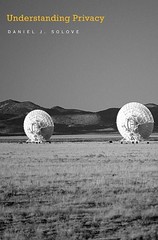 With the publication of Understanding Privacy (Harvard University Press 2008), George Washington University Law School professor Daniel J. Solove has firmly established himself as one of America’s leading intellectuals in the field of information policy and cyberlaw. Solove had already made himself a force to be reckoned with in this field with the publication of important books like The Future of Reputation: Gossip, Rumor, and Privacy on the Internet (Yale University Press 2007), The Digital Person: Technology and Privacy in the Information Age (NYU Press 2004) and his treatise on Information Privacy Law with Paul M. Schwartz of the Berkeley School of Law (Aspen Publishing, 2d ed. 2006). But with Understanding Privacy, Solove has now elevated himself to that rarefied air of “people worth watching” in the cyberlaw field; an intellectual — like Lawrence Lessig or Jonathan Zittrain — whose every publication becomes something of an event in the field to which all eyes turn upon release.
Like those other intellectuals, however, my respect for their stature should not be confused with agreement with their positions. In fact, my disagreements with Lessig and Zittrain are frequently on display here and, we have been critical of Solove here in the past as well. [Here’s Jim Harper’s review of Solove’s last book, with which I am in wholehearted agreement.] In a similar vein, although I greatly appreciate what Prof. Solove attempts to accomplish in Understanding Privacy — and I am sure it will change the way we conceptualize and debate privacy policy in the future — I found his approach and conclusions highly problematic.
Continue reading →
Good editorial in the Boston Globe today about “The Dangers of Internet Censorship” by Harry Lewis, a professor of computer science at Harvard and fellow at Harvard’s Berkman Center for Internet and Society. Lewis argues that:
Determining which ideas are “harmful” is not the government’s job. Parents should judge what information their children should see – and should expect that older children will, as they always have, find ways around restrictive rules.
Worth reading the whole thing. Incidentally, Harry Lewis is the co-author of an interesting new book I am reading right now,
Blown to Bits: Your Life, Liberty, and Happiness After the Digital Explosion. I’m going to try to review it here eventually.
Great post over on the Tor blog about how “anonymity on the Internet is not going away.” This is a subject I care about deeply. Here, for example, is an essay I wrote about mandatory age verification and the threat it poses to online anonymity. I love this paragraph from the Tor essay, and agree with it wholeheartedly:
Anonymity is a defense against the tyranny of the majority. There are many, many valid uses of anonymity tools, such as Tor. The belief that anonymous tools exist only for the edges of societies is narrow-minded. The tools exist and are used by all. Much like the Internet, the tools can be used for good or bad. The negative uses of such tools typically generate huge headlines, but not the positive uses. Raising the profile of the positive uses of anonymity tools, such as Tor, is one of our challenges.
Amen brother.
