The folks at Reason magazine were kind enough to invite me to submit a review of Tim Wu’s new book, The Master Switch: The Rise and Fall of Information Empires based on my 6-part series on the book that I posted here on the TLF late last year. (Parts 1, 2, 3, 4, 5, 6) My new essay, which is entitled “The Rise of Cybercollectivism,” has now been posted on the Reason website.
I realize that title will give some readers heartburn, even those who are inclined to agree with me much the time. After all, “collectivism” is a term that packs some rhetorical punch and leads to quick accusations of red-baiting. I addressed that concern in a Cato Unbound debate with Lawrence Lessig a couple of years ago after he strenuously objected to my use of that term to describe his worldview (and that of Tim Wu, Jonathan Zittrain, and their many colleagues and followers). As I noted then, however, the “collectivism” of which I speak is a more generic type, not the hard-edged Marxist brand of collectivism of modern times. For example, I do not believe that Professors Lessig, Zittrain, or Wu are out to socialize all the information means of production and send us all to digital gulags or anything silly like that. Rather, their “collectivism” is rooted in a more general desire to have–as Declan McCullagh eloquently stated in a critique of Lessig’s Code–rule by “technocratic philosopher kings.” Here’s a passage from my Reason review of Wu’s Master Switch in which I expand upon that notion:
Continue reading →
This is the second of two essays making “The Case for Internet Optimism.” This essay was included in the book, The Next Digital Decade: Essays on the Future of the Internet (2011), which was edited by Berin Szoka and Adam Marcus of TechFreedom. In my previous essay, which I discussed here yesterday, I examined the first variant of Internet pessimism: “Net Skeptics,” who are pessimistic about the Internet improving the lot of mankind. In this second essay, I take on a very different breed of Net pessimists: “Net Lovers” who, though they embrace the Net and digital technologies, argue that they are “dying” due to a lack of sufficient care or collective oversight. In particular, they fear that the “open” Internet and “generative” digital systems are giving way to closed, proprietary systems, typically run by villainous corporations out to erect walled gardens and quash our digital liberties. Thus, they are pessimistic about the long-term survival of the Internet that we currently know and love.
Leading exponents of this theory include noted cyberlaw scholars Lawrence Lessig, Jonathan Zittrain, and Tim Wu. I argue that these scholars tend to significantly overstate the severity of this problem (the supposed decline of openness or generativity, that is) and seem to have very little faith in the ability of such systems to win out in a free market. Moreover, there’s nothing wrong with a hybrid world in which some “closed” devices and platforms remain (or even thrive) alongside “open” ones. Importantly, “openness” is a highly subjective term, and a constantly evolving one. And many “open” systems or devices are as perfectly open as these advocates suggest.
Finally, I argue that it’s likely that the “openness” advocated by these advocates will devolve into expanded government control of cyberspace and digital systems than that unregulated systems will become subject to “perfect control” by the private sector, as they fear. Indeed, the implicit message in the work of all these hyper-pessimistic critics is that markets must be steered in a more sensible direction by those technocratic philosopher kings (although the details of their blueprint for digital salvation are often scarce). Thus, I conclude that the dour, depressing “the-Net-is-about-to-die” fear that seems to fuel this worldview is almost completely unfounded and should be rejected before serious damage is done to the evolutionary Internet through misguided government action.
I’ve embedded the entire essay down below in Scribd reader, but it can also be found on TechFreedom’s Next Digital Decade book website and SSRN.
Continue reading →
Tim Wu was kind enough to comment on my general overview and critique of his new book, The Master Switch:
The Rise and Fall of Information Empires. That essay will be the first of many I plan to pen about Wu’s important book. I appreciate Prof. Wu being willing to engage me in a debate over some of these issues since I’m sure he has better things to do with his time. Some of the points he raised in his comment will be addressed in subsequent posts.
In this post, I want to respond briefly to his assertion that I was “missing the point of the book” which is “to describe the world we live in.” He says that his book, “suggests that we tend to go through open and closed cycles in the Information Industries, and that, roughly, both have their strengths and weaknesses, and both become popular at different times for various reasons.” But he fears there are “greater risks in the closed periods.”
Contrary to what he suggests, I certainly understand that’s the point of his book, it’s just that I don’t fully agree with his analysis or conclusions. Let me be clear about a crucial point, however: I accept that almost every industry goes through “cycles” of some sort and that, typically, after a “Wild West” period of greater “openness” and more atomistic competition, some degree of “consolidation” or more “closed” (or proprietary) models often sets in. (A somewhat different and far more descriptive interpretation of such cycles can be found in Deborah Spar’s 2001 book, Ruling the Waves: Cycles of Discovery, Chaos, and Wealth from Compass to the Internet. She outlines a more refined 4-part cycle of: Innovation, Commercialization, Creative Anarchy, and Rules.)
My primary beef with Prof. Wu is that, contrary to his assertion yesterday in commenting on my post, his book seems to regard the progression of “the Cycle” as mostly linear and one-directional: straight down toward a perfectly closed, corporate-controlled, anti-consumer Hell. By my reading of his book – much like Lessig and Zittrain’s work – Wu is painting an overly pessimistic portrait of technologies being subjected to the “perfect control” of largely unfettered markets.
I believe history – especially recent history — teaches us something very different. Continue reading →
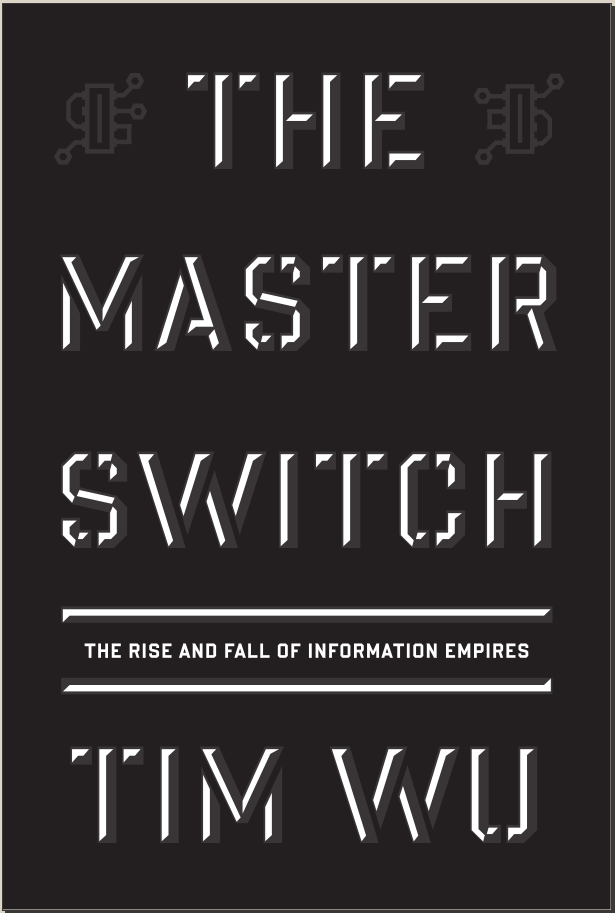
 Tim Wu’s new book, The Master Switch: The Rise and Fall of Information Empires, will be released next week and it promises to make quite a splash in cyberlaw circles. It will almost certainly go down as one of the most important info-tech policy books of 2010 and will probably win the top slot in my next end-of-year list.
Of course, that doesn’t mean I agree with everything in it. In fact, I disagree vehemently with Wu’s general worldview and recommendations, and even much of his retelling of the history of information sectors and policy. Nonetheless, for reasons I will discuss in this first of many critiques, the book’s impact will be significant because Wu is a rock star in this academic arena as well as a committed activist in his role as chair of the radical regulatory activist group, Free Press. Through his work at Free Press as well as the New America Foundation, Professor Wu is attempting to craft a plan of action to reshape the Internet and cyberspace.
I stand in opposition to almost everything that Wu and those groups stand for, thus, I will be spending quite a bit of time addressing his perspectives and proposals here in coming months, just as I did when Jonathan Zittrain’s hugely important The Future of the Internet & How to Stop It was released two years ago (my first review is here and my latest critique is here). In today’s essay, I’ll provide a general overview and foreshadow my critiques to come. (Note: Tim was kind enough to have his publisher send me an advance uncorrected proof of the book a few months ago, so I’ll be using that version to construct these critiques. Please consult the final version for cited material and page numbers.) Continue reading →
TLF readers will definitely want to check out the online symposium underway over at the Concurring Opinions blog debating the thesis set forth in Jonathan Zittrain’s important 2008 book, The Future of the Internet and How to Stop It. The symposium will feature a terrific cast of thinkers, including: Steven Bellovin, Ryan Calo, Laura DeNardis, James Grimmelmann, Orin Kerr, Lawrence Lessig, Harry Lewis,Daithí Mac Síthigh, Betsy Masiello, Salil Mehra, Quinn Norton, Alejandro Pisanty, Joel Reidenberg, Barbara van Schewick and me! Regular contributors to the Concurring Opinions blog, such as Frank Pasquale, are also taking part.
Faithful readers will recall that I named Zittrain’s book the most important Internet policy book of 2008 and one of the most important books of the past decade. It’s impact has already been enormous. But I’ve also been unrelenting in my criticism of the book and Zittrain’s dour forecast for the future of Internet “openness” and digital “generativity.” Down below I have reproduced my contribution to the Concurring Opinions symposium, but I encourage you to hop over there to check out all the essays that are pouring in on this topic.


 In his opening essay in this symposium, Jonathan Zittrain ensures us that he is “not exactly a pessimist.” “I recognize, and celebrate,” he says, “the fact that the digital environment of 2010 is the coolest, most interesting, most option-filled it’s ever been.” Terrific! I am glad to hear that because the crux of my repeated critiques of his book, The Future of the Internet, over the past two years has been focused on its unrelenting – and largely unwarranted – pessimism about our possible cyber-futures. Alas, his essay on these pages still displays much of that underlying techno-pessimism and begs me to ask: Will the real Jonathan Zittrain please stand up? Continue reading →
[I am currently helping Berin Szoka edit a collection of essays from various Internet policy scholars for a new PFF book called “The Next Digital Decade: Essays about the Internet’s Future.” I plan on including two chapters of my own in the book responding to the two distinct flavors of Internet pessimism that I increasingly find are dominating discussions about Internet policy. Below you will see how the first of these two chapters begins. I welcome input as I refine this draft. ]
Surveying the prevailing mood surrounding cyberlaw and Internet policy circa 2010, one is struck by the overwhelming sense of pessimism about our long-term prospects for a better future. “Internet pessimism,” however, comes in two very distinct flavors:
- Net Skeptics, Pessimistic about the Internet Improving the Lot of Mankind: The first variant of Internet pessimism is rooted in general skepticism regarding the supposed benefits of cyberspace, digital technologies, and information abundance. The proponents of this pessimistic view often wax nostalgic about some supposed “good ‘ol days” when life was much better (although they can’t seem to agree when those were). At a minimum, they want us to slow down and think twice about life in the Information Age and how it is personally affecting each of us. Other times, however, their pessimism borders on neo-Ludditism, with proponents recommending steps be taken to curtail what they feel is the destructive impact of the Net or digital technologies on culture or the economy. Leading proponents of this variant of Internet pessimism include: Neil Postman (Technopoly: The Surrender of Culture to Technology), Andrew Keen, (The Cult of the Amateur: How Today’s Internet is Killing our Culture), Lee Siegel, (Against the Machine: Being Human in the Age of the Electronic Mob), Mark Helprin, (Digital Barbarism) and, to a lesser degree, Jaron Lanier (You Are Not a Gadget) and Nicholas Carr (The Big Switch and The Shallows).
- Net Lovers, Pessimistic about the Future of Openness: A different type of Internet pessimism is on display in the work of many leading cyberlaw scholars today. Noted academics such as Lawrence Lessig, (Code and Other Laws of Cyberspace), Jonathan Zittrain (The Future of the Internet & How to Stop It), and Tim Wu (The Master Switch The Rise and Fall of Information Empires), embrace the Internet and digital technologies, but argue that they are “dying” due to a lack of sufficient care or collective oversight. In particular, they fear that the “open” Internet and “generative” digital systems are giving way to closed, proprietary systems, typically run by villainous corporations out to erect walled gardens and quash our digital liberties. Thus, they are pessimistic about the long-term survival of the wondrous Internet that we currently know and love.
Despite their different concerns, two things unite these two schools of techno-pessimism. Continue reading →
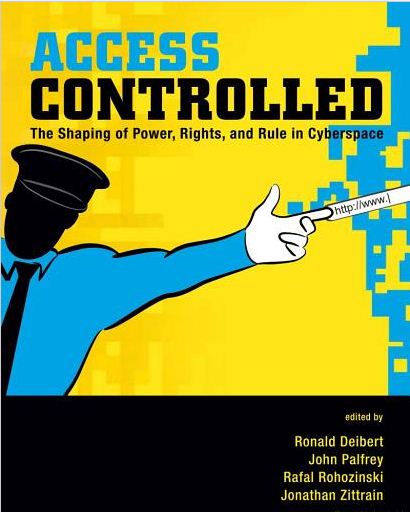
 Faithful readers know of my geeky love for tech policy books. I read lots of ’em. There’s a steady stream of Amazon.com boxes that piles up on my doorstop some days because my mailman can’t fit them all in my mailbox. But I go pretty hard on all the books I review. It’s rare for me pen a glowing review. Occasionally, however, a book will come along that I think is both worthy of your time and which demands a place on your bookshelf because it is such an indispensable resource. Access Controlled: The Shaping of Power, Rights, and Rule in Cyberspace is one of those books.
Smartly organized and edited by Ronald J. Deibert, John G. Palfrey, Rafal Rohozinski, and Jonathan Zittrain, Access Controlled is essential reading for anyone studying the methods governments are using globally to stifle online expression and dissent. As I noted of their previous edition, Access Denied: The Practice and Policy of Global Internet Filtering, there is simply no other resource out there like this; it should be required reading in every cyberlaw or information policy program.
The book, which is a project of the OpenNet Initiative (ONI), is divided into two parts. Part 1 of the book includes six chapters on “Theory and Analysis.” They are terrifically informative essays, and the editors have made them all available online here (I’ve listed them down below with links embedded). The beefy second part of the book provides a whopping 480 pages(!) of detailed regional and country-by-country overviews of the global state of online speech controls and discuss the long-term ramifications of increasing government meddling with online networks.
In their interesting chapter on “Control and Subversion in Russian Cyberspace,” Deibert and Rohozinski create a useful taxonomy to illustrate the three general types of speech and information controls that states are deploying today. What I find most interesting is how, throughout the book, various authors document the increasing movement away from “first generation controls,” which are epitomized by “Great Firewall of China”-like filtering methods, and toward second- and third-generation controls, which are more refined and difficult to monitor. Here’s how Deibert and Rohozinski define those three classes (or “generations”) of controls: Continue reading →
Since Jonathan Zittrain’s ideas about the “generativity” have permeated the intellectual climate of technology policy almost as thoroughly as those of Larry Lessig, scarcely a month passes without a new Chicken Little shouting about how the digital sky is falling in a major publication. The NYT has had not one, but two such articles in the course of a week: first, Brad Stone’s piece about Google, Sure, It’s Big. But Is That Bad? (his answer? an unequivocal yes! as I noted), followed by Virginia Heffernan’s piece “The Death of the Open Web,” which bemoans the growing popularity of smart phone apps—which she analogizes to “white flight” (a stretched analogy that, I suppose, would make Steve Jobs the digital Bull Connor).
What really ticks me off about these arguments (besides the fact that Apple critics like Zittrain use iPhones themselves without a hint of bourgeois irony) is Heffernan’s suggestion that, “By choosing machines that come to life only when tricked out with apps from the App Store, users of Apple’s radical mobile devices increasingly commit themselves to a more remote and inevitably antagonistic relationship with the Web.” To hear people like Heffernan (and others who have complained about Apple’s policies for its app store) talk, you might think that modern smart phones don’t come with a web browser at all, or that browser software is next to useless, so the fact that browsers can access any content on the web (subject to certain specific technical limitations, such as sites that use Flash) is irrelevant, and users are simply at the mercy of the “gatekeepers” that control access to app stores.
In fact, the iPhone and Android mobile browsers are amazingly agile, generally rendering pages originally designed for desktop reading in a way that makes them very easy to read on the phone—such as by wrapping text into a single column maximized to fit either the landscape or portrait view of the phone, depending on which way it’s pointed. In fact, I do most of my news reading on my Droid, and using its browser rather than through any app—although there are a few good news apps to choose from. In fact, I probably spend about 10 times as much time using my phone’s browser as I spend using all other 3rd party apps (i.e., not counting the phone, e-mail, calendar, camera and map “native” apps). So I can get any content I want using the phone’s browser, I certainly don’t lose any sleep at night over what I can or can’t do in apps I get through the app store. I’d love to see actual statistics on the percent of time that smartphone users spend using their mobile browser, as compared to third-party apps. Do they exist?
But however high that percentage might be, the important thing is that the smartphone browser offers an uncontrolled tool for accessing content, even if apps on that mobile OS do not. Continue reading →
Faithful readers know of my geeky love of tech policy books [here are my “best of” lists for 2008 & 2009], and the intriguing battle taking place today between Internet optimists and pessimists in particular. One of the things that I noticed when I was putting together my compendium, “The Digital Decade’s Definitive Reading List: Internet & Info-Tech Policy Books of the 2000s,” is that there are up years and down years. For example, there weren’t a lot of big tech policy titles in 2000 or 2005. By contrast, 2001, 2006 and 2008 were monster years. I suppose that’s the case with any genre, of course.
Anyway, I was beginning to think that 2010 was shaping up to be one of those slow years, with Jaron Lanier’s
You Are Not a Gadget being the only major release so far this year. [See my review of it here.] But there are some very important titles on the way that are worth picking up. I’ve already pre-ordered most of these and am looking forward to reviewing them all soon:
Please let me know others that I may be missing. [Note: Most of the books I’ve been reading this year have more to do with the future of media, the press, journalism, etc. It’s been a big year for books like that. For example, McChesney & Nichols’ The Death and Life of American Journalism; Lee Bollinger’s Uninhibited, Robust, and Wide-Open: A Free Press for a New Century; and Bob Garfield’s The Chaos Scenario. But it’s not clear any of these books belong in the “info-tech policy” genre, although they all have something to say about the impact of the Internet and digital technology on the media and journalism. So, who knows, maybe I will add them to my end of year list.]
So, do I need to remind everyone of my ongoing rants about Jonathan Zittrain’s misguided theory about the death of digital generativity because of the supposed rise of “sterile, tethered” devices? I hope not, because even I am getting sick of hearing myself talk about it. But here again anyway is the obligatory listing of all my tirades: 1, 2, 3, 4, 5, 6, 7, 8 + video and my 2-part debate with Lessig and him last year.
You will recall that the central villain in Zittrain’s drama
The Future of the Internet and How to Stop It is big bad Steve Jobs and his wicked little iPhone. And then, more recently, Jonathan has fretted over those supposed fiends at Facebook. Zittrain’s worries that “we can get locked into these platforms” and that “markets [will] coalesce [around] these tamer gated communities,” making it easier for both corporations and governments to control us. More generally, Zittrain just doesn’t seem to like that some people don’t always opt for the same wide open general purpose PC experience that he exalts as the ideal. As I noted in my original review of his book, Jonathan doesn’t seem to appreciate that it may be perfectly rational for some people to seek stability and security in digital devices and their networking experiences—even if they find those solutions in the form of “tethered appliances” or “sterile” networks, to use his parlance.
Every once and awhile I find a sharp piece by someone out there who is willing to admit that they see nothing wrong with such “closed”
platforms or devices, or they even argue that those approaches can be superior to the more “open” devices and platforms out there. That’s the case with this Harry McCracken rant over at Technologizer today with the entertaining title, “The Verizon Droid is a Loaf of Day-Old Bread.” McCracken goes really hard on the Droid — which hurts because I own one! — and I’m not sure I entirely agree with his complaint about it, but what’s striking is how it represents the antithesis of Zittrainianism: Continue reading →

 The Technology Liberation Front is the tech policy blog dedicated to keeping politicians' hands off the 'net and everything else related to technology.