Posts tagged as:

This is Part IV of a five-part commentary on the FCC’s Dec. 23, 2010 “Open Internet” Report and Order.
Part I looked at the remarkably weak justification the majority gave for issuing the new rules.

Part II explored the likely costs of the rules, particularly the undiscussed costs of enforcement that will be borne by the agency and accused broadband access providers, regardless of the merits.  (See Adam Thierer’s post on the first attenuated claim of violation, raised before the rules even take effect.)

Part III compared the final text of the rules to earlier drafts and alternative proposals, tracing the Commission’s changing and sometimes contradictory reasoning over the last year.

Part IV, (this part), looks at the many exceptions and carve-outs from the rules, and what,  taken together, they say about the majority’s dogged determination to see the Internet as it was and not as it is or will become.

Part V will review the legal basis on which the majority rests its authority for the rules, likely to be challenged in court.

What does an Open Internet mean?

The idea of the “open Internet” is relatively simple:  consumers of broadband Internet access should have the ability to surf the web as they please and enjoy the content of their choice, without interference by access providers who may have financial or other anti-competitive reasons to shape or limit that access. Continue reading →

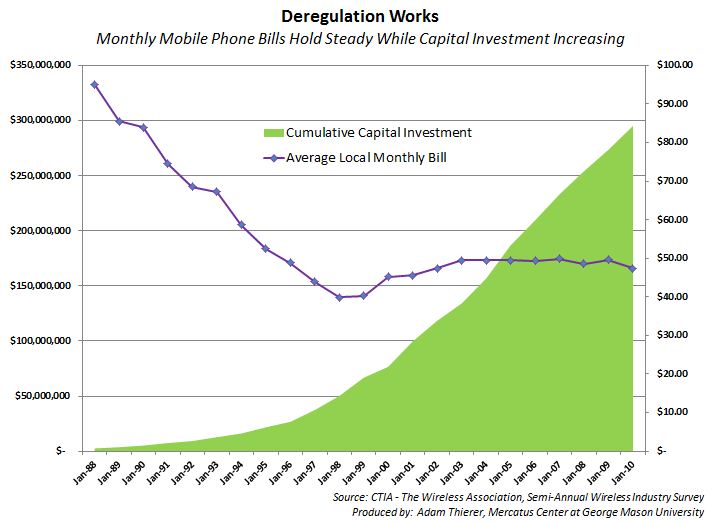
Richard Bennett brought to my attention the release of the latest CTIA Semi-Annual Wireless Industry Survey. Lots of interesting facts worth examining.  I took two of the charts that appeared in the report and mashed them up to created this chart for the Mercatus Center depicting what has been happening with prices and investment in this sector.  Down below, I note why this is important.

Continue reading →

The FCC proposed new rules today aimed at combating wireless “bill shock,” a term that describes mobile subscribers getting hit with overage charges they didn’t anticipate. The proposed rules would require wireless providers to create a system for alerting customers when they are about to incur extra usage charges for voice, text, data, or roaming.

I can certainly see why some consumers may be frustrated with wireless pricing practices. But this frustration hardly constitutes evidence that the mobile marketplace is actually failing. Yes, mobile carriers sometimes make mistakes, and they probably need to do more to ensure their customers understand how overage charges work.

Competitive forces, however, are far better equipped than federal regulators to punish providers that engage in
genuinely harmful practices. And if the federal government must “do something” about bill shock, educating mobile subscribers about where to locate and track their usage information is a far better approach than prescriptive, burdensome federal regulation.

Hypocritically, even as the FCC tries to reign in bill shock, its own policies are harming consumers far more than any wireless industry practices. The FCC has again and again put off spectrum auctions that would enable mobile providers to offer better services at lower prices. As a result, consumers are suffering to the tune of billions of dollars each year. Economists Thomas Hazlett and Roberto Munoz published a study last year in which they concluded that U.S. wireless prices would decline by 8% if the FCC were to allocate an additional 60mhz of spectrum to mobile telephony.

If the FCC truly cares about wireless subscribers, rather than simply grandstanding against competitive (if imperfect) mobile carriers, the Commission’s top priority should be to aggressively free up the airwaves.

But analysts at the Competitive Enterprise Institute urged the FCC not to interfere with market disputes and to instead turn its focus to the real obstacle to the wireless marketplace – the FCC’s own anti-consumer approach to spectrum allocation. “Educating mobile subscribers about where to locate their up-to-date usage information – which all major wireless providers make available – is a far better solution to ‘bill shock’ than prescriptive federal regulation,” argued Ryan Radia, CEI Associate Director of Technology Studies. Radia pointed out that some consumers’ frustration with current wireless pricing practices is hardly evidence that the mobile marketplace is failing. “To be sure, mobile carriers make occasional mistakes, and they need to work harder to ensure their customers stay well-informed,” Radia said. “But competitive forces are far better equipped than federal regulators to punish providers that engage in genuinely harmful practices or fail to satisfy consumers’ evolving preferences.” In its efforts to address wireless bill disputes, the FCC purports to represent consumers’ interests; yet, Radia argued, the agency is harming consumers by delaying action to free up radio spectrum — the lifeblood of wireless communications. “Consumers are suffering to the tune of billions of dollars each year on account of the FCC’s failure to free up radio spectrum for mobile communications,” Radia said. “Economists Thomas Hazlett and Roberto Munoz recently published a study finding that U.S. wireless prices would decline by 8% if the FCC were to allocate an additional 60mhz of spectrum to mobile telephony.” “If the FCC genuinely cares about wireless subscribers, it should focus on aggressively freeing up the airwaves instead of comparatively trivial issues like bill shock.”

My article for CNET News.com this morning analyzes the “leaked” net neutrality bill from Rep. Henry Waxman, chair of the House Energy and Commerce Committee.  I put leaked in quotes because so many sources came up with this document yesterday that its escape from the secrecy of the legislative process hardly seems dramatic.  Reporters with sources inside Waxman’s office, including The Hill and The Washington Post, expect Waxman to introduce the bill sometime this week.

The CNET article goes through the bill in some detail, and I won’t duplicate the analysis here.  It is a relatively short piece of legislation that makes limited changes to Title I of the Communications Act, giving the FCC only the authority it needs to implement “core” regulations that would allow the agency to enforce violations of the open Internet principles. Continue reading →

So, the GAO recently released a report on the wireless industry and found that:

The biggest changes in the wireless industry since 2000 have been consolidation among wireless carriers and increased use of wireless services by consumers. Industry consolidation has made it more difficult for small and regional carriers to be competitive. Difficulties for these carriers include securing subscribers, making network investments, and offering the latest wireless phones necessary to compete in this dynamic industry. Nevertheless, consumers have also seen benefits, such as generally lower prices, which are approximately 50 percent less than 1999 prices, and better coverage.

Now, if you are a self-described “consumer advocate,” I would hope the bottom line here is pretty straightforward and refreshing: Prices fell by 50% in 10 years. That alone is an amazing success story. But that’s not the end of the story. The more important fact is that prices fell by that much while innovation in this sector was also flourishing.  Do you remember the phone you carried in your pocket — if you could fit it in your pocket at all — ten years ago?  It was a pretty rudimentary device.  It made calls and… well… it made calls.  Now, think about the mini-computer that sits in your pocket right now.  Stunning little piece of kit. It can text. It can do email. It can get Internet access. You can Twitter on it. Oh, and you can still make calls on it (but who wants to do that anymore!)

The point is, this is a great American capitalist success story that everyone — especially “consumer advocates” — should be celebrating.  So, what does Public Knowledge president Gigi Sohn have to say?

“These trends do not bode well for consumers, despite any benefits of the moment,” she told Ars Technica.

Wait, what?  Continue reading →

National Economic Council Director Lawrence Summers made a major policy speech yesterday at the New America Foundation, announcing the adminstration’s plan to find an additional 500 megaherz of spectrum for wireless broadband service by the end of the decade. The spectrum will come from two places: federal agencies who currently under-utilize their spectrum, and commercial users who volunteer to participate in “incentive auctions.”

In an incentive auction, the current spectrum user receives part of the proceeds in exchange for making the spectrum available for reallocation. Within the current US system of spectrum allocation, it’s about as close as we can come to allowing spectrum holders to sell their spectrum licenses to someone else who can put the spectrum to a more valuable use. 

Summers even mentioned broadcasters specifically, noting that a local television station with a few hundred millions of dollars of revenue may currently control spectrum worth hundreds of millions of dollars. Federal agencies would get to use some of the proceeds to adopt “state-of-the-art communications.” Presumably this would include new equipment that doesn’t use so much spectrum.

In his speech, Summers gave appropriate credit to the Federal Communications Commission, which surfaced many of these ideas in its National Broadband Plan. Even more appropriately, the former Harvard University president and academic economist assigned proper credit for the original source of the idea: 

Most of the freed-up spectrum will be auctioned off for use by mobile broadband providers. As the great law and economics scholar Ronald Coase originally pointed out, auctions ensure that spectrum is devoted to its most productive uses because it is determined by investors’ willingness to pay for it.

There are, of course, a few unanswered questions. How much of the spectrum will actually get auctioned for mobile broadband, rather than reserved for unlicensed use? Will the buyers have to use the spectrum for mobile broadband, or will the license be sufficiently broad that they could use it for other forms of personal communication that perhaps haven’t even been invented yet? Do we really have to wait ten years for this? Will the Ronald Coase Institute get any royalties for the government’s use of its namesake’s intellectual property? (Academics will recognize the joke in the last question.)

For now I’ll just say, “Bravo, Dr. Summers!”

I’ve been wading through the FCC’s latest Mobile Wireless Competition Report, and articles about it trying to make sense of what the the agency might be up to on this front.  It’s hard to get a read on where the agency may be going here. As my PFF colleague Mike Wendy suggested in his post on the FCC’s report, “far from press reports which state the FCC clearly determined the market is not ‘effectively competitive,’ well, that’s wrong. In fact, the FCC fails to make any such determination whatsoever.”  Moreover, just flipping through the charts and tables of the 237-page report, one is struck by how dynamic this marketplace is, and how crazy it would be for the FCC to declare it anything other than effectively competitive and highly innovative.

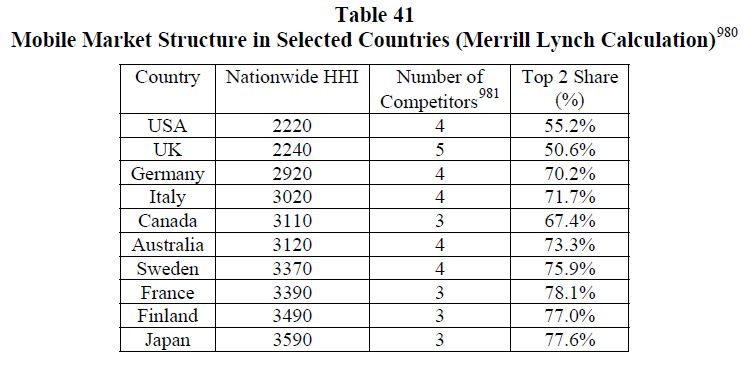
Yet, the FCC and many others seem hung up on industry structure. In particular, there seems to be a lot of hand-wringing about increasing consolidation among the sector’s top players.  But the data the FCC reproduces in the report seem to undermine that concern. For example, here’s a snapshot of the “Mobile Market Structure in Selected Countries,” which appears on pg. 197 of the FCC report.  It shows how much more consolidated foreign mobile markets are relative to the U.S., which is true of wireline markets too.  And you can find much more evidence of how competitive the marketplace is in these two reports.

Continue reading →

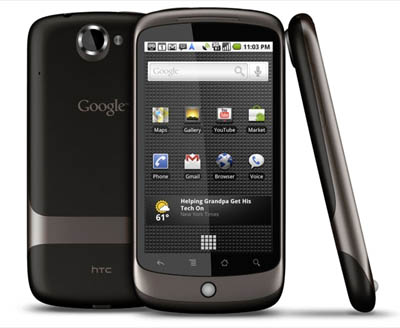
Google has just announced that it is ending web-only sales of its unsubsidized Nexus One smartphone. The company had hoped to created a very different kind of business model for mobile phone retailing, but it just didn’t work and so they are ending the experiment.

There are a couple of reasons that it probably didn’t work, but the one thing that just about everyone is pointing back to is the difficulty of acclimating Americans to the actual cost of an unsubsidized handset. Over at Ars Technica, Peter Bright points out:

A one-off payment of $529 is hard to stomach. In many countries, we’re not accustomed to paying so much for mobile phones, as normally their true cost is hidden—we pay less up front and commit to paying a monthly fee for 12-24 months. Only those brave souls who were willing to stump up for the early termination fee would get any idea of the true cost of their handset. In a world of subsidized handsets, then, the Nexus one felt very expensive. It’s true that SIM-only contracts are cheaper than with-handset ones, but the difference rarely feels significant enough to justify buying a full-price phone—much better to pay a little bit more each month and avoid the up-front cost. Even if you do the math and work out that the Google way is cheaper, there’s still the unpleasant prospect of spending so much at once.

And Kevin C. Tofel of GigaOm concludes:

Continue reading →

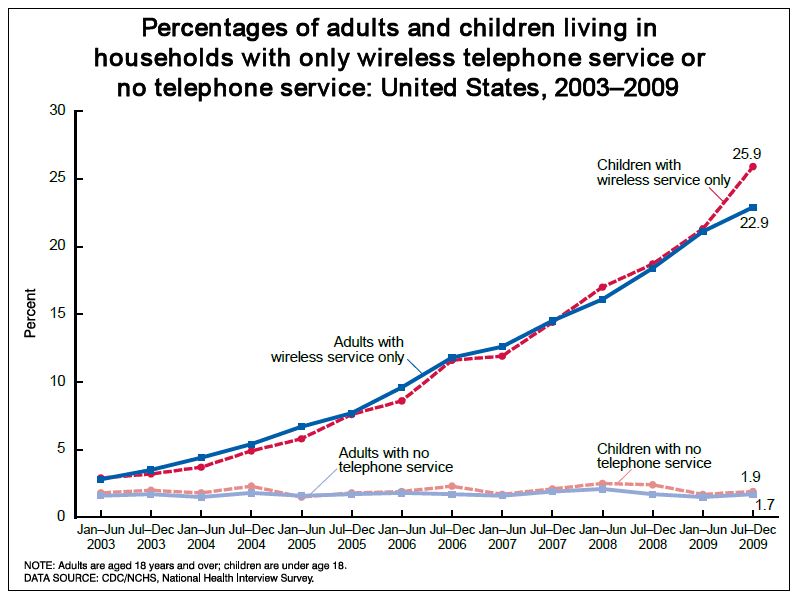
The Center for Disease Control and Prevention (CDC) has released it’s latest report on “Wireless Substitution: Early Release of Estimates From the National Health Interview Survey.”   For many years, this CDC report has shown a steady rise in “cord-cutting” with a gradual rise in the number of wireless-only homes. But we’ve now reached an important milestone of sorts with fully one-quarter of all U.S. homes now in the wireless-only camp. According to CDC:

One of every four American homes (24.5%) had only wireless telephones (also known as cellular telephones, cell phones, or mobile phones) during the last half of 2009—an increase of 1.8 percentage points since the first half of 2009. In addition, one of every seven American homes (14.9%) had a landline yet received all or almost all calls on wireless telephones.

Pretty stunning when you think about the fact that just a decade ago few of us even carried phones around in our pockets or purses.  Despite what all the worry-warts and wanna-be regulators in Washington say, this is one hell of a dynamic marketplace.

Broadband Baselines

by on April 1, 2010 · 0 comments

The national broadband plan drafted by Federal Communications Commission staff has a lot of goals in it. Goals for broadband infrastructure deployment include:

  1. Make broadband with 4 Mbps download speeds available to every American
  2. Over the long term, have broadband with 100 Mbps download and 50 Mbps upload speeds available to 100 million American homes, with 50 Mbps downloads available to 100 million homes by 2015
  3. Have the fastest and most extensive wireless broadband networks in the world
  4. Ensure that no state lags significantly behind in 3G wireless coverage
  5. Ensure that every community has access to 1 Gbps broadband service in institutions like schools, libraries, and hospitals

The plan also outlines a number of policy steps that the FCC and other federal agencies could take to help accomplish these goals.

So far, so good. But to truly hold federal agencies accountable for achieving these objectives, we need more than goals, measures, and a list of policy proposals. We also need a realistic baseline that tells us how the market is likely to progress toward these goals in the absence of new federal action, and some way to determine how much the specific policy initiatives affect the amount of the goal achieved.

Here’s what will happen in the absence of a well-defined baseline and analysis that shows how much improvement in the goals is actually caused by federal policies: The broadband plan announces goals. The government will take some actions. Measurement will show that broadband deployment improved, moving the nation closer to achieving the goals. The FCC and other decisionmakers will then claim that their chosen policies have succeeded, because broadband deployment improved.

But in the absence of proof that the policies cause a measurable change in outcomes, this is like the rooster claiming that his crowing makes the sun rise. Scientists call this the ” post hoc, ergo propter hoc” fallacy: “B happened after A, therefore A must have caused B.” (Brush up on your Latin a little more, and you’ll even find out what Mercatus means. But I digress.)

Enough abstractions. Let me give a few examples.

The first goal listed above is to ensure that all Americans have access to broadband with 4 Mbps download speeds. In his second comment on my March 17 “Broadband Funding Gap” post, James Riso notes that the plan acknowledges that 5 out of the 7 million households that currently lack access to 4 Mbps broadband will soon be covered by 4th generation wireless. That means coverage for 83 percent of the households that lack 4 Mbps broadband is already “baked into the cake.” 

Accurate accountability must avoid giving future policy changes credit for this increase in deployment, because it was going to happen anyway.  (Of course, policymakers need to avoid taking steps that would discourage this deployment, such as levying the 15 percent universal service fee on 4th generation wireless.) The relevant question for evaluating future policy changes is, “How do they affect deployment to the remaining 2 million households?”

Similarly, the goal of 50 Mbps to 100 million households by 2015 seems to have been chosen because cable and fiber broadband providers indicate that they plan to cover more than that many homes by 2013 with broadband capable of delivering those speeds (pp. 21-22). Future policy initiatives should get zero credit for contributing toward this goal unless analysis demonstrates that the initiatives increased deployment of very high speed broadband over and above what the companies were already planning.

If you think this point is so basic that it’s not worth mentioning, you haven’t read enough government reports. Post hoc, ergo propter hoc is endemic, and not just on technology-related topics. For example, both sides regularly display this fallacy whenever the unemployment figures get released: “Unemployment increased after Obama’s election, therefore his administration caused the unemployment.” “The recession started when Bush was president, therefore his administration caused the unemployment.” These are at best hypotheses whose truth, untruth, and quantititive significance needs to be established by analysis that controls for other factors affecting the results.

Just take this as an advance warning on reporting results of the national broadband plan: Tone down the triumphalism.  

Note: For those of you who just can’t get enough discussion of the national broadband plan, Jerry Brito and I will have a dialog on other aspects of the plan in a future podcast that will be available here on Surprisingilyfree.com.