On CNET this morning, I argue that delay in approving FCC authority for voluntary incentive auctions is largely the fault of last year’s embarrassing net neutrality rulemaking.
While most of the public advocates and many of the industry participants have moved on to other proxy battles (which for most was all net neutrality ever was), Congress has remained steadfast in expressing its great displeasure with the Commission and how it conducted itself for most of 2010.
In the teeth of strong and often bi-partisan opposition, the Commission granted itself new jurisdiction over broadband Internet on Christmas Eve last year. Understandably, many in Congress are outraged by Chairman Julius Genachowski’s chutzpah.
So now the equation is simple: while the Open Internet rules remain on the books, Congress is unlikely to give the Chairman any new powers.
House Oversight Committee Chairman Darrell Issa has made the connection explicit, telling reporters in April that incentive auction authority will not come while net neutrality hangs in the air. There’s plenty of indirect evidence as well.
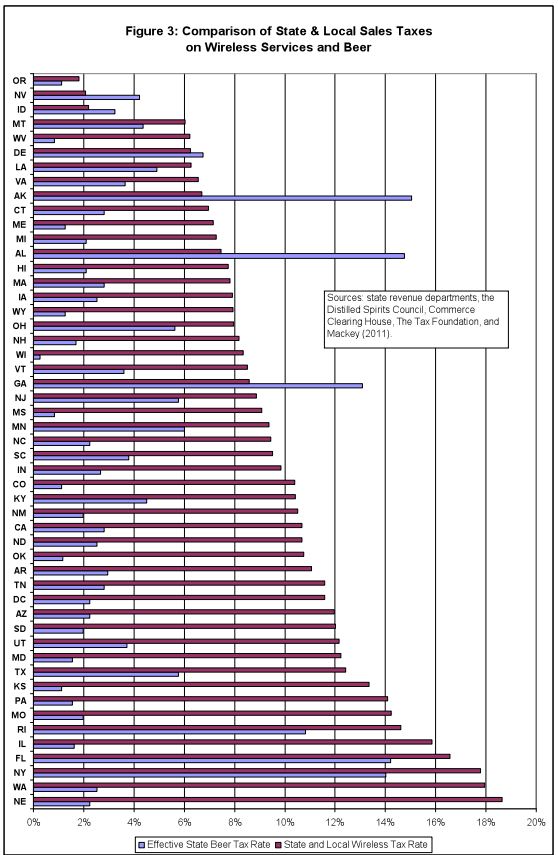
As we’ve noted herebefore, state and local politicians just love wireless taxes. They are going up, up, up. Dan Rothschild outlined this disturbing trend in his recent Mercatus Center paper making “The Case Against Taxing Cell Phone Subscribers,” and I discussed it in my recent Forbes essay lambasting the “Talking Tax.” Another new study by Glenn Woroch of the Georgetown University School of Business notes how “The ‘Wireless Tax Premium’ Harms American Consumers and Squanders the Potential of the Mobile Economy.” Woroch estimates that “the American consumer forgoes over $15 billion in surplus annually compared to when cell phones receive the
same tax treatment as other goods and service.” Read the entire study but I want to draw everyone’s attention to this chart that appears on page 7 of the report comparing state and local wireless taxes burdens to beer taxes. It really makes you realize just how drunk on wireless taxes are local lawmakers have become! [Click to enlarge. Red bar = wireless taxes.]
My latest Forbes column notes how “Taxes On Talking Are On the Rise Across the U.S.” with levies on mobile phones and devices skyrocketing. I build my argument around data and arguments found in Dan Rothschild’s excellent recent Mercatus Center paper, which makes “The Case Against Taxing Cell Phone Subscribers,” as well as an important recent study by Scott Mackey, an economist and partner at KSE Partners LLP, which documents the growing burden of these wireless taxes and fees.
“Wireless users now face a combined federal, state, and local tax and fee burden of 16.3%, a rate two times higher than the average retail sales tax rate and the highest wireless rate since 2005,” Mackey finds. Mobile tax rates range from a high of 23.7% in Nebraska to a low of 6.9% in Oregon. 48 states have an average combined wireless tax rate above 11%. These burdensome taxes on talking just don’t make any sense, argues Rothschild. “There is no economic justification for these high tax rates: reducing cell phone ownership is not a public policy goal, cell phone use by one customer does not affect other customers or other people, and these taxes fall disproportionately on lower-income households.”
You can read my entire essay here, but also make sure to re-read Dan Rothschild’s guest post here at the TLF on the issue. It’s much better than my own treatment. For me, the key point is this: If the primary policy goal in this arena is to build out a first-class communications and data infrastructure and make sure all Americans have access to it, discriminatory taxes on wireless services and networks are highly counter-productive. Policymakers should hang up on the Talking Tax.
Last week the Senate Commerce Committee passed–with deep bi-partisan support–the Public Safety Spectrum and Wireless Innovation Act.
The bill, co-sponsored by Committee Chairman Jay Rockefeller and Ranking Member Kay Bailey Hutchison, is a comprehensive effort to resolve several long-standing stalemates and impending crises having to do with one of the most critical 21st century resources: radio spectrum.
The proposed legislation is impressive in scope; it offers new and in some cases novel solutions to more than half-a-dozen spectrum-related problems, including: Continue reading →
[The following essay is a guest post from Dan Rothschild, Managing Director of the State and Local Policy Project at the Mercatus Center at George Mason University.]
Policy makers may be tempted to hike taxes on cell phones, or to create (or “equalize”) taxes on untaxed (or “under taxed”) parts of wireless telephony, such as cell phone data plans or e-readers with cellular connections. As I argue in a recent issue of Mercatus on Policy, this is a bad idea for a number of reasons. Continue reading →
For CNET this morning, I write about the latest tempest in the AT&T/T-Mobile USA merger teapot: cellular backhaul or “special access” as its known in the industry.
Like a child sitting on Santa’s lap at the mall, Sprint CEO Dan Hesse included backhaul in his wish list of conditions he’d like to see attached to the deal. Yesterday, Public Knowledge duly confirmed that yes, backhaul is a “multiplier” problem for the deal.
(Sprint says they would like the deal blocked, but that is mere posturing. What they really want is to use the FCC’s bloated and unprincipled merger review process to sneak in as many private concessions for themselves as they can get. And who can blame them for trying? More on that in a moment.)
For those who don’t know, backhaul is the process of moving cellular traffic (voice and data) to other high-speed networks (traditionally landline copper but now including cable, fiber, microwave and local Ethernet) to transport them to their ultimate destination. As mobile use increases, of course, the necessity of reliable, high-speed backhaul to keep overall performance up becomes more critical than ever.
Following AT&T’s announcement last month of its planned acquisition of T-Mobile USA, pundits and other oddsmakers have settled in for a long tour of duty. Speculation, much of it uninformed, is already clogging the media about the chances the $39 billion deal—larger even than last year’s merger of Comcast and NBC Universal—will be approved.
Both the size of the deal and previous consolidation in the communications industry lead some analysts and advocates to doubt the transaction will or ought to survive the regulatory process.
Though the complex review process could take a year or perhaps even longer, I’m confident that the deal will go through—as it should. To see why, one need only look to previous merger reviews by the Department of Justice and the Federal Communications Commission, both of which must approve the AT&T deal. Continue reading →
In the rush of ink that flowed yesterday over AT&T’s announced merger with T-Mobile USA, I posted a long piece on CNET calling for calm, reasoned analysis of the deal by regulators, chiefly the Department of Justice and the FCC.
Since the details of the deal have yet to be fleshed out, it’s hard to say much about the specifics of how customers will be affected in the short or long term. My CNET colleague Maggie Reardon, however, does an excellent job laying out both the technical and likely regulatory issues in a piece posted today from the CTIA conference. Continue reading →
Video is now available for all of the excellent programming at this year’s State of The Net 2011 conference. (Programming will also be available over time on C-SPAN’s video library.) The Conference, organized by the Advisory Committee to the Congressional Internet Caucus, featured Members of Congress, leading academics, Administration, agency, and Congressional staff and other provocateurs. Topics this year ranged from social networking, Wikileaks, COICA, copyright, privacy, security, broadband policy and, of course, the end-of-the-year vote by the FCC to approve new rules for network management by broadband providers, aka net neutrality. Continue reading →
In this final post on the FCC’s Dev. 23, 2010 Open Internet Report and Order, I’ll look briefly at the problematic legal foundation on which the FCC has built its new regulations on broadband Internet access. That discussion need only be brief largely because the extended legal analysis has already been admirably detailed by FCC Commissioner Robert McDowell. His dissent (see pages 145-177 of the Report and Order) calmly and systematically dismantles the case made by the majority (See ¶¶ 115-150).
This is no theoretical discussion of statutory interpretation. Even before the rules have been published on the Federal Register, two broadband providers—Verizon and then MetroPCS—have already filed lawsuits in the D.C. Circuit Court of Appeals challenging the FCC’s authority to regulate. (See Jim DeLong’s definitive deciphering of Verizon’s efforts to secure exclusive jurisdiction in the D.C. Circuit) The arguments sketched out in Commissioner McDowell’s dissent are likely to mirror the complainants’ briefs in these and likely other Petitions for Review of the Order.
The Technology Liberation Front is the tech policy blog dedicated to keeping politicians' hands off the 'net and everything else related to technology. Learn more about TLF →
 On CNET this morning, I argue that delay in approving FCC authority for voluntary incentive auctions is largely the fault of last year’s embarrassing net neutrality rulemaking.



 The Technology Liberation Front is the tech policy blog dedicated to keeping politicians' hands off the 'net and everything else related to technology.