Yesterday POLITICO Pro said both political parties are on the verge of declaring support for some version of Internet freedom in their 2012 platforms. The Democratic platform contained a lengthy statement in 2008, but according to Politico, its 2012 platform will consist of a simple sentence about protecting the open Internet. Politico also noted that, though Republicans hardly mentioned the Internet in 2008, they are expected to consider several Internet proposals during their platform meeting early next week. Will the new Republican platform address Internet freedom? If so, what is the platform likely to say? Continue reading →
The Communications Liberty and Innovation Project (CLIP) recently filed comments at the Federal Communications Commission (FCC) opposing an interoperability mandate in the 700 MHz band. CLIP argued that the proposed interoperability mandate would be manifestly unjust. The Supreme Court’s holding in the healthcare opinion issued last week indicates that the mandate could be more than merely unjust: it might be unconstitutional. Continue reading →
(Adapted from Bloomberg BNA Daily Report for Executives, May 16th, 2012.)
Two years ago, the Federal Communications Commission’s National Broadband Plan raised alarms about the future of mobile broadband. Given unprecedented increases in consumer demand for new devices and new services, the agency said, network operators would need far more radio frequency assigned to them, and soon. Without additional spectrum, the report noted ominously, mobile networks could grind to a halt, hitting a wall as soon as 2015.
That’s one reason President Obama used last year’s State of the Union address to renew calls for the FCC and the National Telecommunications and Information Administration (NTIA) to take bold action, and to do so quickly. The White House, after all, had set an ambitious goal of making mobile broadband available to 98 percent of all Americans by 2016. To support that objective, the president told the agencies to identify quickly an additional 500 MHz of spectrum for mobile networks.
By auctioning that spectrum to network operators, the president noted, the deficit could be reduced by nearly $10 billion. That way, the Internet economy could not only be accelerated, but taxpayers would actually save money in the process.
A good plan. So how is it working out?
Unfortunately, the short answer is: Not well. Speaking this week at the annual meeting of the mobile trade group CTIA, FCC Chairman Julius Genachowski had to acknowledge the sad truth: “the overall amount of spectrum available has not changed, except for steps we’re taking to
add new spectrum on the market.” Continue reading →

Frederick Jackson Turner (1861-1932)
On
Fierce Mobile IT, I’ve posted a detailed analysis of the NTIA’s recent report on government spectrum holdings in the 1755-1850 MHz. range and the possibility of freeing up some or all of it for mobile broadband users.
The report follows from a 2010 White House directive issued shortly after the FCC’s National Broadband Plan was published, in which the FCC raised the alarm of an imminent “spectrum crunch” for mobile users.
By the FCC’s estimates, mobile broadband will need an additional 300 MHz. of spectrum by 2015 and 500 MHz. by 2020, in order to satisfy increases in demand that have only amped up since the report was issued. So far, only a small amount of additional spectrum has been allocated. Increasingly, the FCC appears rudderless in efforts to supply the rest, and to do so in time. Continue reading →
 After three years of politicking, it now looks like Congress may actually give the FCC authority to conduct incentive auctions for mobile spectrum, and soon. That, at least, is what the FCC seems to think.
At CES last week, FCC Chairman Julius Genachowski largely repeated the speech he has now given three years in a row. But there was a subtle twist this time, one echoed by comments from Wireless Bureau Chief Rick Kaplan at a separate panel.
Instead of simply warning of a spectrum crunch and touting the benefits of the incentive auction idea, the Chairman took aim at a House Republican bill that would authorize the auctions but limit the agency’s “flexibility” in designing and conducting them. “My message on incentive auctions today is simple,” he said, “we need to get it done now, and we need to get it done right.” Continue reading →
The National Transportation Safety Board recommended yesterday that states ban all non-emergency use of portable electronic devices while driving, except for devices that assist the driver in driving (such as GPS). The recommendation followed the NTSB’s investigation of a tragic accident in Missouri triggered by a driver who was texting.
Personally I don’t see how someone can pay attention to the road while texting. (I’m having a hard enough time paying attention to a conference presentation while I’m typing this!) But the National Transportation Safety Board’s recommendation is a classic example of regulatory overreach based on anecdote. The NTSB wants to use one tired driver’s indefensible and extreme texting (which led to horrific results) as an excuse to ban all use of portable electronic devices while driving – including hands-free phone conversations. Before states act on this recommendation, they should carefully examine systematic evidence – not just anecdotes — to determine whether different uses of handheld devices pose different risks. They should also consider whether bans on some uses would expose drivers to risks greater than the risk the ban would prevent.
 I’ve written several articles in the last few weeks critical of the dangerously unprincipled turn at the Federal Communications Commission toward a quixotic, political agenda. But as I reflect more broadly on the agency’s behavior over the last few years, I find something deeper and even more disturbing is at work. The agency’s unreconstructed view of communications, embedded deep in the Communications Act and codified in every one of hundreds of color changes on the spectrum map, has become dangerously anachronistic.
The FCC is required by law to see separate communications technologies delivering specific kinds of content over incompatible channels requiring distinct bands of protected spectrum. But that world ceased to exist, and it’s not coming back. It is as if regulators from the Victorian Age were deciding the future of communications in the 21
st century. The FCC is moving from rogue to steampunk.
With the unprecedented release of the staff’s draft report on the AT&T/T-Mobile merger, a turning point seems to have been reached. I wrote on
CNET (see “FCC: Ready for Reform Yet?”) that the clumsy decision to release the draft report without the Commissioners having reviewed or voted on it, for a deal that had been withdrawn, was at the very least ill-timed, coming in the midst of Congressional debate on reforming the agency. Pending bills in the House and Senate, for example, are especially critical of how the agency has recently handled its reports, records, and merger reviews. And each new draft of a spectrum auction bill expresses increased concern about giving the agency “flexibility” to define conditions and terms for the auctions.
The release of the draft report, which edges the independent agency that much closer to doing the unconstitutional bidding not of Congress but the White House, won’t help the agency convince anyone that it can be trusted with any new powers. Let alone the novel authority to hold voluntary incentive auctions to free up underutilized broadcast spectrum.
 Continue reading →
 For CNET this morning, I have a long article reviewing the sad recent history of how local governments determine the quality of mobile services.
As it turns out, the correlation is deeply negative. In places with the highest level of user complaints (San Francisco, Washington, D.C.), it turns out that endless delays or outright denials for applications to add towers and other sites as well as new and upgraded equipment is also high. Who’d have thought?
Despite a late 2009 ruling by the FCC that put a modest “shot clock” on local governments to approve or deny applications, data from CTIA and PCIA included in recent comments on the FCC’s Broadband Acceleration NOI suggests the clock has had little to no effect. This is in part because the few courts that have been asked to enforce it have demurred or refused.
Much of the dithering by local zoning boards is unprincipled and pointless, a sign not so much of legitimate concerns over safety and aesthetics but of incompetence, corruption, and the insidious influence of outside “consultants” whose fees are often levied against the applicant, adding insult to injury. Continue reading →
I can’t help but think that there might be a big advantage of having the AT&T-T-Mobile merger go to court. For once, the high-profile action everyone pays attention to will occur in an antitrust forum where the decision criterion is the effects of the merger on consumer welfare, period. Regardless of what one thinks about the merger, it’s nice to see that we’ll finally have a knock-down, drag-out fight based on whether a big telecommunications merger harms consumers and competition. That’s the antitrust standard the Department of Justice has to satisfy in order to prevent the merger.
This will be a refreshing change from the Federal Communications Commission’s “public interest” standard, which allows the commission to object on grounds other than consumer welfare and demand all manner of concessions that have nothing to do with remedying anticompetitive effects of a deal. Case in point: Comcast must now offer broadband service for $9.95 per month to low-income households as a condition for getting approval to buy 51 percent of NBCUniversal. Now, I’m all for seeing low-income households get access to broadband, but subsidizing one subset of customers has little to do with mitigating any possible anticompetitive effects of allowing a cable company to own NBCUniversal. As FCC Commissioners McDowell and Baker said in their statement on that transaction, “Any proposed remedies should be narrow and transaction specific, tailored to address particular anti-competitive harms. License transfer approvals should not serve as vehicles to extract from petitioners far-reaching and non-merger specific policy concessions that are best left to broader rulemaking or legislative processes.”
In short, if AT&T wins in court, the FCC should approve the merger promptly without additional conditions.
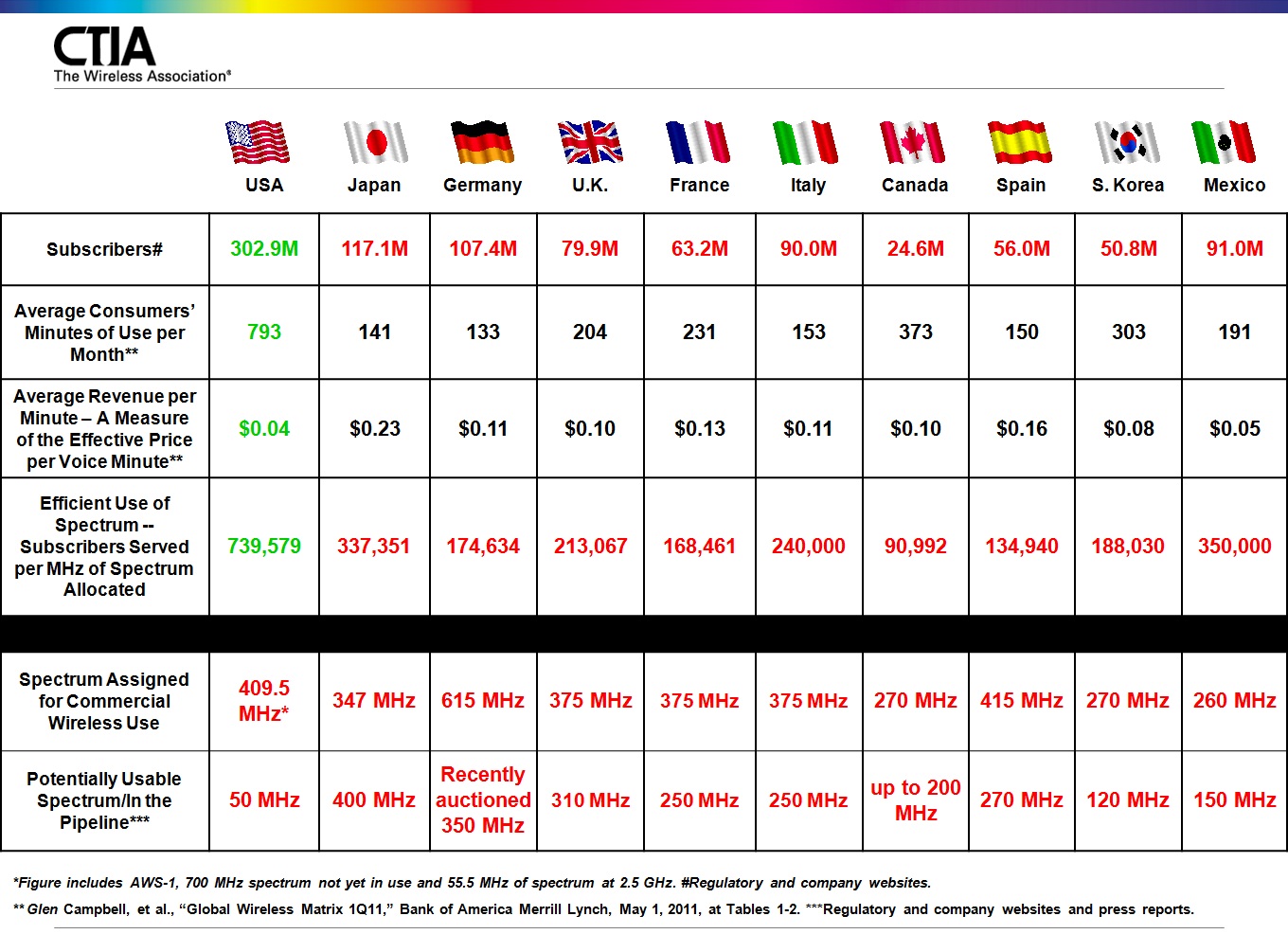
Here’s a terrifically useful chart from CTIA that offers some international wireless use and spectrum availability comparisons. [Click on chart to expand.] The average minutes of use and average revenue per minute differences are fairly staggering. But the really important takeaway from this chart is the last line, which depicts how little spectrum is dripping out of the faucet right now. Having just 50 MHz of “potentially usable spectrum in the pipeline” is troubling and needs to be addressed by policymakers immediately. America’s wireless demands continue to explode, but supply isn’t keeping up.

 The Technology Liberation Front is the tech policy blog dedicated to keeping politicians' hands off the 'net and everything else related to technology.