I’m intrigued by this new bill that Rep. Peter King has introduced to prevent video voyeurism. H.R. 414, the “Camera Phone Predator Alert Act” finds that “children and adolescents have been exploited by photographs taken in dressing rooms and public places with the use of a camera phone.” To remedy this problem, King’s “Phone Predator Alert” bill would require that:
any mobile phone containing a digital camera that is manufactured for sale in the United States shall sound a tone or other sound audible within a reasonable radius of the phone whenever a photograph is taken with the camera in such phone. A mobile phone manufactured after such date shall not be equipped with a means of disabling or silencing such tone or sound.
In other words, cameras would have to get noisy again! Old timers will recall the days when our cameras were noisier than a box of rocks. Today’s digital cameras and camera phones, by contrast, are increasingly silent, but that also opens up the door to potential abuse by some creeps out there. While I don’t believe there’s evidence pointing to a national epidemic of digital voyeurism, there’s no doubt that some people — including many youngsters — are having their privacy invaded in this fashion.
I find King’s solution at once to be both ingenious and futile. It’s ingenious in that, if we could truly force it upon everyone, it might actually go along way towards solving this problem. The noisy camera would again act as the prime deterrent to such an act.
Continue reading →
Jack Shafer, editor at large of Slate, is my favorite media pundit. Everything he does is worth reading, and his column this week is no different. It’s entitled “The Digital Slay-Ride: What’s killing newspapers is the same thing that killed the slide rule,” and in it he notes how “Hardly a day goes by, it seems, without some laid-off or bought-out journalist writing a letter of condolence to himself and his profession.” “The underlying cause of their grief,” Shafer argues, “can be traced to the same force that has destroyed other professions and industries: digital technology.” He recalls how people scoffed back in 1993 when Wired founder Louis Rossetto’s said that the “digital revolution is whipping through our lives like a Bengali typhoon” and destroying the old order. But no one is laughing anymore. As I noted in my Media Metrics report, digital disruption and disintermediation has completely upended the media marketplace, as well as countless others. Toward that end, Shafer actually starts a list of professions or technologies that have been “typhooned” by the digital revolution. It’s a pretty amazing (and entertaining) list for those of us old enough to remember when all these things were dominate in our society and economy. Can you think of others?
• Bank tellers
• Typewriters
• Typesetting
• Carburetors
• Vacuum tubes
• Slide rules
• Disc jockeys
• Stockbrokers
• Telephone operators
• Yellow pages
• Repair guys
• Bookbinders
• Pimps (displaced by the cell phone and the Web)
• Cassette and reel-to-reel recorders
• VCRs
• Turntables
• Video stores
• Record stores
• Bookstores
• Recording industry
• Courier/messenger services
• Travel agencies
• Print and cinematic porn
• Porn actors
• Stenographers
• Wired telcos
• Drummers
• Toll collectors (slayed by the E-ZPass)
• Book publishing (especially reference works)
• Conventional-watch makers
• “Browse” shopping
• U.S. Postal Service
• Printing-press makers
• Film cameras
• Kodak (and other film-stock makers)
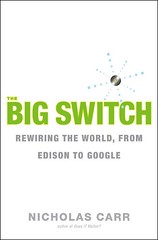 I just finished reading through The Economist’s new 14-page special report on cloud computing, “Let It Rise” in which Ludwig Siegele provides an outstanding overview of cloud computing and why it is so important:
The rise of the cloud is more than just another platform shift that gets geeks excited. It will undoubtedly transform the information technology (IT) industry, but it will also profoundly change the way people work and companies operate. It will allow digital technology to penetrate every nook and cranny of the economy and of society, creating some tricky political problems along the way.
Even if you are very familiar with cloud computing, I recommend you take a look at the article. Anyway, while I was reading it, I was unsurprised to come across some comments from Nicholas Carr, whose new book
The Big Switch: Rewiring the World, from Edison to Google, is essentially an early history of cloud computing and an investigation into its effects on our economy, culture, and society. And that also reminded me that, even though I have mentioned Carr’s book here several times since it was released earlier this year, I have failed to give it a dedicated review. And it certain deserves one because “The Big Switch” is easily one of the most important technology policy books of 2008.
Continue reading →
[Note: I updated this discussion and chart in a subsequent essay. See: “Are You An Internet Optimist or Pessimist? The Great Debate over Technology’s Impact on Society.”]
A number of very interesting books have been released over the past year or two which debate how the Internet is reshaping our culture and the economy. I’ve reviewed a couple of them here but I have been waiting to compile a sort of mega-book review once I found a sensible way to conceptually group them together. I’m not going to have time to cover each of them here in the detail they deserve, but I think I have at least found a sensible way to categorize them. For lack of better descriptors, I’ve divided these books and thinkers into two camps: “Internet optimists” versus “Internet Pessimists.” Here’s a list of some of the individuals and books (or other articles and blogs) that I believe epitomize these two camps of thinking:
Adherents & Their Books / Writings
|
Internet Optimists
|
Internet Pessimists
|
|
Yochai Benkler, The Wealth of Networks
|
Andrew Keen, The Cult of the Amateur
|
|
Chris Anderson, The Long Tail and “Free!”
|
Lee Siegel, Against the Machine
|
|
Clay Shirky, Here Comes Everybody
|
Nick Carr, The Big Switch
|
|
Cass Sunstein, Infotopia
|
Cass Sunstein, Republic.com
|
|
Don Tapscott, Wikinomics
|
Todd Gitlin, Media Unlimited
|
|
Kevin Kelly & Wired mag in general
|
Alex Iskold, “The Danger of Free”
|
|
Mike Masnick & TechDirt blog
|
Mark Cuban
|
And here’s a rough sketch of the major beliefs or key themes that separate these two schools of thinking about the impact of the Internet on our culture and economy:
Beliefs / Themes
|
Internet Optimists
|
Internet Pessimists
|
|
Culture / Social
|
|
Net is Participatory
|
Net is Polarizing
|
|
Net yields Personalization
|
Net yields Fragmentation
|
|
a “Global village”
|
Balkanization
|
|
Heterogeneity
/ Diversity of Thought
|
Homogeneity
/ Close-mindedness
|
|
Net breeds pro-democratic tendencies
|
Net breeds anti-democratic tendencies
|
|
Tool of liberation & empowerment
|
Tool of frequent misuse & abuse
|
|
|
|
Economics / Business
|
|
Benefits of “free”
(“Free” = future of media / business)
|
Costs of “free”
(“Free” = end of media / business)
|
|
Increasing importance of “Gift economy”
|
Continuing importance of property rights, profits, firms
|
|
“Wiki” model = wisdom of crowds; power of collective intelligence
|
“Wiki” model = stupidity of crowds; errors of collective intelligence
|
|
Mass collaboration
|
Individual effort
|
So, what to make of this intellectual war? Who’s got the story right?
Continue reading →
[Note: You might want to first read my review of Jonathan Zittrain’s book to give this essay some context.]
Jonathan Zittrain must have been smiling as he read Leander Kahney’s excellent Wired cover story this month, “How Apple Got Everything Right By Doing Everything Wrong.” In a sense, the article vindicates Zittrain’s thesis in The Future of the Internet–And How to Stop It.
 Again, in his provocative book, Zittrain argues that, for a variety of reasons, the glorious days of the generative, open Internet and general-purpose PCs are supposedly giving way to closed networks and a world of what he contemptuously calls “sterile, tethered devices.” And Apple products such as the iPhone, the iPod, and iTunes serve as prime examples of the troubling world that await us. And Kahney’s article confirms that Apple is every bit as closed and insular as Zittrain suggests. Kahney nicely contrasts Apple with Google, a company that “embraces openness,” trusts “the wisdom of crowds,” and has its famous “Don’t be evil” philosophy:
It’s ironic, then, that one of the Valley’s most successful companies ignored all of these tenets. Google and Apple may have a friendly relationship — Google CEO Eric Schmidt sits on Apple’s board, after all — but by Google’s definition, Apple is irredeemably evil, behaving more like an old-fashioned industrial titan than a different-thinking business of the future. Apple operates with a level of secrecy that makes Thomas Pynchon look like Paris Hilton. It locks consumers into a proprietary ecosystem. And as for treating employees like gods? Yeah, Apple doesn’t do that either.
Continue reading →

 The Technology Liberation Front is the tech policy blog dedicated to keeping politicians' hands off the 'net and everything else related to technology.