A few months ago, I penned a mega book review about the growing divide between “Internet optimists and pessimists.” I noted that the Internet optimists — people like Chris Anderson, Clay Shirky, Yochai Benkler, Kevin Kelly, and others — believe that the Internet is generally improving our culture, economy, and society for the better. They believe the Net has empowered and liberated the masses, sparked unparalleled human creativity and communication, provided greater personalization and customization of media content, and created greater diversity of thought and a more deliberative democracy. By contrast, the Internet pessimists — including Nick Carr, Andrew Keen, Lee Siegel, and others — argue that the Internet is destroying popular culture and professional media, calling “truth” and “authority” into question by over-glamorizing amateurism and user-generated content, and that increased personalization is damaging deliberative democracy by leading to homogenization, close-mindedness, and an online echo-chamber. Needless to say, it’s a very heated debate!
I am currently working on a greatly expanded version of my “Net optimists vs. pessimists” essay for a magazine in which I will draw out more of these distinctions and weigh the arguments made by those in both camps. I plan on concluding that article by arguing that the optimists generally have the better of the argument, but that the pessimists make some fair points about the downsides of the Net’s radically disintermediating role on culture and economy.
So, this got me thinking that I needed to come up with some sort of a label for my middle-of-the-road position as well as a statement of my personal beliefs. As far as labels go, I guess I would call myself a “pragmatic optimist” since I generally side with the optimists in most of these debates, but not without some occasional reservations. Specifically, I don’t always subscribe to the Pollyanna-ish, rose-colored view of the world that some optimists seem to adopt. But the outright Chicken Little-like Ludditism of some Internet pessimists is even more over-the-top at times. Anyway, what follows is my “Pragmatic (Internet) Optimist’s Creed” which better explains my views. (Again, read my old essay first for some context about the relevant battle lines in this intellectual war).
Continue reading →
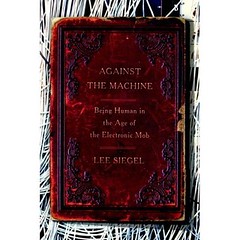 Of the titles I included in a mega-book review about Internet optimists and pessimists that I posted here a few months ago, I mentioned Lee Siegel’s new book, Against the Machine: Being Human in the Age of the Electronic Mob. It is certainly the dourest of the recent books that have adopted a pessimistic view of the impact the Internet is having on our culture, society, and economy. Because Siegel’s book is one of the most important technology policy books of 2008, however, I decided to give it a closer look here.
Siegel’s book essentially picks up where Andrew Keen’s leaves off in
Cult of the Amateur: How Today’s Internet is Killing our Culture (2007). I posted a two-part review of Keen’s book here last year [Part 1, Part 2], but here’s a quick taste of Keen’s take on things. He argues “the moral fabric of our society is being unraveled by Web 2.0” and that “our cultural standards and moral values are not all that are at stake. Gravest of all,” Keen continues, “the very traditional institutions that have helped to foster and create our news, our music, our literature, our television shows, and our movies are under assault as well.”
As I noted in my earlier “Net optimists vs. pessimists” essay, after reading
Cult of the Amateur, I didn’t think anyone else could ever be quite as over-the-top and Chicken Little-ish as Keen. But after working my way through Siegel’s Against the Machine, I realized I was wrong. It made Keen seem downright reasonable and cheery by comparison! Keen and Siegel seem to be in heated competition for the title “High Prophet of Internet Doom,” but Siegel is currently a nose ahead in that race.
Continue reading →
[Note: I updated this discussion and chart in a subsequent essay. See: “Are You An Internet Optimist or Pessimist? The Great Debate over Technology’s Impact on Society.”]
A number of very interesting books have been released over the past year or two which debate how the Internet is reshaping our culture and the economy. I’ve reviewed a couple of them here but I have been waiting to compile a sort of mega-book review once I found a sensible way to conceptually group them together. I’m not going to have time to cover each of them here in the detail they deserve, but I think I have at least found a sensible way to categorize them. For lack of better descriptors, I’ve divided these books and thinkers into two camps: “Internet optimists” versus “Internet Pessimists.” Here’s a list of some of the individuals and books (or other articles and blogs) that I believe epitomize these two camps of thinking:
Adherents & Their Books / Writings
|
Internet Optimists
|
Internet Pessimists
|
|
Yochai Benkler, The Wealth of Networks
|
Andrew Keen, The Cult of the Amateur
|
|
Chris Anderson, The Long Tail and “Free!”
|
Lee Siegel, Against the Machine
|
|
Clay Shirky, Here Comes Everybody
|
Nick Carr, The Big Switch
|
|
Cass Sunstein, Infotopia
|
Cass Sunstein, Republic.com
|
|
Don Tapscott, Wikinomics
|
Todd Gitlin, Media Unlimited
|
|
Kevin Kelly & Wired mag in general
|
Alex Iskold, “The Danger of Free”
|
|
Mike Masnick & TechDirt blog
|
Mark Cuban
|
And here’s a rough sketch of the major beliefs or key themes that separate these two schools of thinking about the impact of the Internet on our culture and economy:
Beliefs / Themes
|
Internet Optimists
|
Internet Pessimists
|
|
Culture / Social
|
|
Net is Participatory
|
Net is Polarizing
|
|
Net yields Personalization
|
Net yields Fragmentation
|
|
a “Global village”
|
Balkanization
|
|
Heterogeneity
/ Diversity of Thought
|
Homogeneity
/ Close-mindedness
|
|
Net breeds pro-democratic tendencies
|
Net breeds anti-democratic tendencies
|
|
Tool of liberation & empowerment
|
Tool of frequent misuse & abuse
|
|
|
|
Economics / Business
|
|
Benefits of “free”
(“Free” = future of media / business)
|
Costs of “free”
(“Free” = end of media / business)
|
|
Increasing importance of “Gift economy”
|
Continuing importance of property rights, profits, firms
|
|
“Wiki” model = wisdom of crowds; power of collective intelligence
|
“Wiki” model = stupidity of crowds; errors of collective intelligence
|
|
Mass collaboration
|
Individual effort
|
So, what to make of this intellectual war? Who’s got the story right?
Continue reading →
 Over at Techdirt (and here on TLF), Tim Lee takes issue with my post suggesting that Wikipedia should consider selling ads instead of asking for donations. He has a good point, which is that right now the only reason to volunteer to work for Wikipedia is because you’re passionate about it, but that might change if money became involved. But I think Tim overstates his case:
Being a member of the Wikipedia board would no longer be a thankless exercise in public service, but would be a relatively glamorous opportunity to direct hundreds of thousands of dollars to one’s pet causes. Over time, the senior leadership positions would be sought out by people who are more excited about doling out largesse than editing an encyclopedia.
I’m not sure why that would be the case. By that rationale we could never have large philanthropic foundations because they would attract self-interested directors. As long as their actions are transparent and they are accountable to the wikipedians, I don’t see why the money couldn’t be directed for the benefit of Wikipedia. And if the directors enjoy some vicarious “glamour” as a result, then I think that’s a fine reward for hard work—it might even attract better candidates than are interested today.
Since it’s Sunshine Week I’ll stress that the key is transparency. And Tim is right on this point, too: institutions matter. Right now Jimmy Wales is taking some heat for conducting his Wikipedia business in a less than transparent manner. If that’s how Wkipedia is going to operate, them perhaps money will corrupt it and Tim is right that “there’s no reason to think an institution built to edit an encyclopedia is going to have any special competence to oversee the spending of millions of dollars.” Still, I guess I’m just more optimistic about what the Wikipedia community is capable of.
P.S. Yeah, I love Twitter! Check me out at twitter.com/jerrybrito.
In a previous essay, I critiqued Andrew Keen’s thesis that our culture was better off in the age of scarcity than it is in today’s world of media and cultural abundance. In this essay, I want to make a few comments about his latest anti-Web 2.0 rant regarding how, in addition to destroying art and culture, the age of abundance and “amateur” content creation is going to result in the death of advertising.
In an AdWeek guest editorial this week, Keen argues that:
Web 2.0 is, in truth, the very worst piece of news for the advertising industry since the birth of mass media. In the short term, the Web 2.0 hysteria marks the end of the golden age of advertising; in the long term, it might even mark the end of advertising itself.
[…]
[F]or the advertiser, media content is indeed losing its value, a value historically derived from its scarcity. This devaluation of media isn’t hard to quantify: It can be measured everywhere, in falling CPM and the failure of social networks to develop viable business models. No new technology—neither the false dawn of mobile, nor the holy grail of personalized, targeted advertising—is going to save the advertising business now. No, the truth is that advertising can only be saved if we can re-create media scarcity. That means less user-generated content and more professionally created information and entertainment, less technology and more creativity. The advertising community desperately needs more gatekeepers, more professional creative authorities, more so-called media “elites” who will curate, filter and organize content. That’s the way to re-establish the value of the message. It’s the one commercial antidote to Web 2.0’s radically destructive cultural democracy.
Oh my, where to begin…
Continue reading →
Andrew Keen is the web’s favorite whipping boy these days, and in some ways he has it coming. His latest book, The Cult of the Amateur: How Today’s Internet is Killing Our Culture, is an anti-all-things-Web 2.0 screed. Keen lambastes “Internet democracy” (specifically the Wiki model of collaborative creation) and decries the rising tide of user-generated everything. When you get right down to it, Keen’s view of the world is unapologetically techno-conservative and culturally elitist. He’s angry that there are fewer intermediaries minding the culture. As a result, he argues, “professional” media (by which he means to say “better” media) is giving way to “amateur” media (which he regards as synonymous with, well… crap).
Unsurprisingly, the blogosphere has fought back with a vengeance and called Keen every nasty name in the book. But the best and most level-headed critique of Keen’s work is still this old essay by the ever-insightful Clay Shirky. Clay’s response rightly concedes that Keen in correct in pointing out that some important things have been lost with the rise of the Internet. There certainly are fewer intermediaries filtering our culture for us, and that will sound like a great thing to many of us. But it’s important to realize that some of those mediating forces serve a valuable role. Editors, for example, play an important, but often overlooked, role in terms of improving the quality of great deal of media content of all varieties (journalism, books, movies, music, etc). The blogosphere is becoming an editor-free zone, and at times it really shows. There are times when some particularly insulting things are said or silly mistakes are made that probably would have been corrected had a good editor been responsible for overseeing the final product.
On the other hand, the unfiltered Web 2.0 experience is wonderfully refreshing. Sometimes it’s nice to see what the uninhibited exchange of ideas results in. Regardless, the bottom line is that the editing profession (broadly defined) is changing because of the Internet. That is undeniable. And other mediating forces or institutions are seeing their power or relative importance in the cultural creation process diminished as the Internet-spawned disintermediation continues unabated.
Will that create short term problems? Undeniably. But Keen thinks these developments are contributing to a sort of cultural catastrophe and that we are collectively much worse off because of this disintermediation and empowerment of the “amateur.” This goes much too far in my opinion.
Continue reading →

 The Technology Liberation Front is the tech policy blog dedicated to keeping politicians' hands off the 'net and everything else related to technology.