Posts tagged as:

I have a piece on Internet privacy in the Wall Street Journal today. It’s one side of a “debate” on Internet privacy and tracking. I say be careful what you give up if you thwart online tracking—personalization, free content, and other goodies may go by the wayside.

My “opponent” is Nicholas Carr, whose identity and arguments I didn’t know as I wrote, nor likely did he mine. His is a good piece that lays out the many legitimate concerns with online tracking. Must be nice to be the maximal-privacy “good guy”!

For the sake of making it interesting I’ll pick out one important point that highlights the nub of the issue.

Privacy tradeoffs have always been a part of life, Carr says, “But now, thanks to the Net, we’re losing our ability to understand and control those tradeoffs—to choose, consciously and with awareness of the consequences, what information about ourselves we disclose and what we don’t.”

This sentence brought back to me a memorable moment from law school. In a seminar course, the professor called upon a fellow student who rather dopily apologized, “Sorry, I didn’t have time to do the reading.”

“In fact you did have time to do the reading,” replied the teacher, “but you just didn’t take it. Isn’t that correct?”

It was funny, if embarrassing for my colleague, and a great illustration of precision with language.

Holding to that standard of precision, I’ll disagree with Carr’s statement: The Net is not affecting our ability to understand and control privacy tradeoffs. Its development has outstripped that capacity. Developing consumers’ understanding of information flows, information uses, and consequences will position them to restore privacy.

I don’t think Carr would disagree with that sentiment in the main. Later he says, agreeably to me, “We need to take personal responsibility for the information we share whenever we log on.”

And I do think that’s the heart of the problem: “Education is the hard way, and it is the only way, to get consumers’ privacy interests balanced with their other interests.”

Reliable national security reporter Siobhan Gorman at the Wall Street Journal has broken a story about an Internet surveillance program called “Perfect Citizen” to be managed by the National Security Agency.

Reading about it is frustrating, and for me blame quickly settles on Congress. Our legislature is utterly supine before the national security bureaucracy, which exaggerates cybersecurity threats and consistently uses the secrecy trump card to defy oversight.

If there is to be a federal government role in securing the Internet from cyberattacks, there is no good reason why its main components should not be publicly known and openly debated. Small parts, like threat signatures and such—the unique characteristics of new attacks—might be appropriately kept secret, but no favor is done to any potential attackers by revealing that there is a system for detecting their activities.

A cybersecurity effort that is not tested by public oversight will be weaker than ones that are scrutinzed by private-sector experts, academics, security vendors, and watchdog groups.

Benign intentions do not control future results, and governmental surveillance of the Internet for “cybersecurity” purposes may warp over time to surveillance for ideological and political purposes.

These abstract criticisms of “Project Citizen” are all that publicly available information allows. Far better would come from me and others more qualified if Congress were to do its job.

Congress owes it to us, the United States’ true citizens, to have public hearings on “Perfect Citizen.” Congress should reject broad assertions of secrecy so that the whole body politic can participate in securing our country from all threats.

Congressional and public oversight—searching oversight that tests assumptions and asks hard questions—would strenghten any government cybersecurity effort we find warranted. It would also ameliorate the threat of such programs to our civil liberties, democratic processes, and privacy.

I’ve always viewed web traffic numbers with great suspicion, if for no other reason than they are all over the board. But the amazing Carl Bialik, the Wall Street Journal’s “numbers guy,” does us another great service today in his latest column, “The Trouble With Web-Traffic Numbers,” by walking us through exactly how big of a mess these numbers really are. Carl is the closest thing we have to a statistical ombudsman for the Internet as he repeatedly illustrates in his column how numbers can deceive and distort.

In terms of bogus web traffic numbers, there’s plenty of distortion going on. He quotes Erin Pettigrew, marketing director for Gawker Media, as saying that “For an industry that relies so heavily on accurate data and numerical accountability, relying on an estimate is embarrassing, antiquated.” Too true.  Of course, with so many people frequently deleting their cookies and now accessing websites from different machines, it’s not surprising that the numbers are such a jumble.

One of the reasons it’s so important to try to improve web traffic metrics is because it is essential to the advertising business, which powers the web and all the great content and services we consume online. More accurate web traffic metrics can help better direct and target ads across the web. But it won’t be easy.

Anyway, read Carl’s piece for all the details. And thank you Carl for always reminding us that there are “lies, damned lies, and statistics.”

Today I appeared on CNBC [video here and embedded down below] to discuss concerns about emerging “smart-sign” technology, which could give rise to a new generation of interactive retail advertising and marketing efforts. This is in the news because, as Don Clark and Nick Wingfield report today in The Wall Street Journal (“Intel, Microsoft Offer Smart-Sign Technology: Retailers, Product Marketers Could Discern Viewer, Make Choices on What to Display and Transfer Coupons Via Phone“), Intel and Microsoft have announced that:

they will collaborate to help companies create and use new forms of digital signs. By exploiting Intel chips and Microsoft software, the companies hope to bring more interactivity to such devices and help retailers customized marketing offers to consumers. Signs equipped with cameras and specialized software could recognize the age, gender and height of people in front of them, and tell what products and images received the most attention, the companies said. By gathering information about which messages are more effective, they add, traditional retailers could develop marketing approaches that better counter Web-based competitors. “Every year retailers lose more ground to online [sellers], and they have to do something about that,” said Joe Jensen, general manager of Intel’s embedded computing division.

Down below, I have jotted down a couple of thoughts about the rise of “digital signage” and more targeted forms of retail marketing, only a few of which I was able to get across in this short TV spot. I think it’s an exciting new development for both retailers and consumers for the reasons I explain down below:

http://plus.cnbc.com/rssvideosearch/action/player/id/1383744249/code/cnbcplayershare Continue reading →

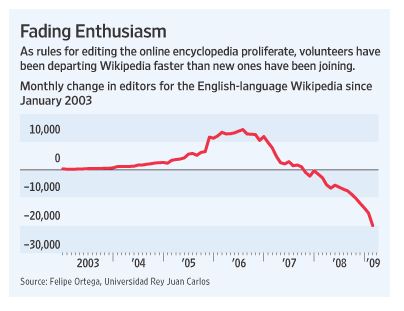
Wikipedia editorsThere was a very interesting front-page article in the Wall Street Journal yesterday by Julia Angwin and Geoffrey Fowler wondering whether Wikipedia, the wildly popular online encyclopedia, was dying because of new posting guidelines which have apparently led to a drop off in the number of volunteers contributing to the site. In their article (“Volunteers Log Off as Wikipedia Ages“), Angwin and Fowler note that:

In the first three months of 2009, the English-language Wikipedia suffered a net loss of more than 49,000 editors, compared to a net loss of 4,900 during the same period a year earlier, according to Spanish researcher Felipe Ortega, who analyzed Wikipedia’s data on the editing histories of its more than three million active contributors in 10 languages. Eight years after Wikipedia began with a goal to provide everyone in the world free access to “the sum of all human knowledge,” the declines in participation have raised questions about the encyclopedia’s ability to continue expanding its breadth and improving its accuracy. Errors and deliberate insertions of false information by vandals have undermined its reliability.

The article suggests that new posting and editing guidelines may have something to do with the drop:

But as it matures, Wikipedia, one of the world’s largest crowdsourcing initiatives, is becoming less freewheeling and more like the organizations it set out to replace. Today, its rules are spelled out across hundreds of Web pages. Increasingly, newcomers who try to edit are informed that they have unwittingly broken a rule — and find their edits deleted, according to a study by researchers at Xerox Corp. “People generally have this idea that the wisdom of crowds is a pixie dust that you sprinkle on a system and magical things happen,” says Aniket Kittur, an assistant professor of human-computer interaction at Carnegie Mellon University who has studied Wikipedia and other large online community projects. “Yet the more people you throw at a problem, the more difficulty you are going to have with coordinating those people. It’s too many cooks in the kitchen.”

Let’s say it’s true that the new guidelines have resulted in fewer people contributing.  Is that that automatically a bad thing?  I suppose it depends on other variables that are harder to measure. Namely, quality metrics. This is where every discussion about Wikipedia gets sticky. Continue reading →

Last Wednesday, Holman Jenkins penned a column in The Wall Street Journal about net neutrality (Adam discussed it here). In response, I have a letter to the editor in today’s The Wall Street Journal:

To the Editor: Mr. Jenkins suggests that Google would likely “shriek” if a startup were to mount its servers inside the network of a telecom provider. Google already does just that. It is called “edge caching,” and it is employed by many content companies to keep costs down. It is puzzling, then, why Google continues to support net neutrality. As long as Google produces content that consumers value, they will demand an unfettered Internet pipe. Political battles aside, content and infrastructure companies have an inherently symbiotic relationship. Fears that Internet providers will, absent new rules, stifle user access to content are overblown. If a provider were to, say, block or degrade YouTube videos, its customers would likely revolt and go elsewhere. Or they would adopt encrypted network tunnels, which route around Internet roadblocks. Not every market dispute warrants a government response. Battling giants like Google and AT&T can resolve network tensions by themselves. Ryan Radia Competitive Enterprise Institute Washington

To be sure, the market for residential Internet service is not all that competitive in some parts of the country — Rochester, New York, for instance — so a provider might in some cases be able to get away with unsavory practices for a sustained period without suffering the consequences. Yet ISP competition is on the rise, and a growing number of Americans have access to three or more providers. This is especially true in big cities like Chicago, Baltimore, and Washington D.C.

Instead of trying to put a band-aid on problems that stem from insufficient ISP competition, the FCC should focus on reforming obsolete government rules that prevent ISP competition from emerging. Massive swaths of valuable spectrum remain unavailable to would-be ISP entrants, and municipal franchising rules make it incredibly difficult to lay new wire in public rights-of-way for the purpose of delivering bundled data and video services.

Holman Jenkins has a stinging editorial in today’s Wall Street Journal entitled, “Neutering the ‘Net,” which borrows a term that my friend Randy May coined long ago to describe what net neutrality regulation will ultimately accomplish. What I like best about the Jenkins essay was the way he exposed Free Press for their hypocrisy over metering as a possible alternative approach to network management, something I documented in this piece and this piece about their new-found love of Internet price controls.  Here’s how Jenkins puts it in his essay today:

The mask really slipped earlier this year when Time Warner Cable began experimenting with usage-based pricing to protect the average broadband customers from the 20% of users who create 80% of the traffic. A lobby called Free Press, the most extreme of the pro-net neutrality interests, went ballistic, calling metered pricing a “price-gouging scheme” and backing a bill in Congress to ban it. Never mind that Free Press had previously argued just the opposite, saying usage-based pricing was a fairer way to deal with congestion than, say, by selectively slowing down file-sharing sites that gobble up disproportionate broadband capacity. Never mind, too, the irony that the net-neut campaign against the selective slowing of non-urgent traffic has left only differential pricing as a way to bring a modicum of efficiency to network usage.

Indeed.  Of course, we should expect nothing less from the neo-Marxist media reformistas as the UnFree Press.

Up in SmokeOver the past couple of years here, I have relentlessly hammered Harvard’s dynamic duo of digital doom, Jonathan Zittrain (see 1, 2, 3, 4, 5, 6) and Lawrence Lessig (see 1, 2, 3), for their extraordinarily gloomy predictions about the Internet creating a world of “perfect control.”  In the hyper-pessimistic Lessig-Zittrain view of things, cyberspace is perpetually haunted by the specter of nefarious corporate schemers out to suffocate innovation, screw consumers, and quash dissent.  In the 1990s, Lessig’s big-bad-bogeyman was AOL.  Today, Zittrain casts Apple in the lead role of Cyber-Big Brother.  The problem with their thesis? In a word: Reality.  As Tim Lee has pointed out before, “Lessig’s specific predictions in Code turned out to be… spectacularly wrong”:

Lessig was absolutely convinced that a system of robust user authentication would put an end to the Internet’s free-wheeling, decentralized nature. Not only has that not happened, but I suspect that few would seriously defend Lessig’s specific prediction will come to pass.

Absolutely correct, and the same is true of the fears and predictions Zittrain tosses around in The Future of the Internet.  And yet, as we saw most recently during my debate with Lessig and Zittrain over at Cato Unbound upon the occasion of the 10th anniversary of the publication Code, neither of them have relented one bit. Indeed, they have actually been escalating their morose rhetoric recently.

The fact that Zittrain casts Apple as the central villain in his drama is particularly interesting because millions upon millions of people absolutely love the company and its amazingly innovative products — even if I’m not one of them.  And there is absolutely no way Zittrain can continue to sell us this story of Apple quashing innovation when, in just one year’s time, there were 1.5 Billion iPhone Store downloads of over 65,000 free and paid apps by consumers in 77 countries.  I mean, seriously, is there any application you cannot get for the iPhone these days?

Apparently not, because over at the Wall Street Journal “Digits” blog,  Andrew LaVallee writes of the latest innovative application to pop up in the Apple iPhone Store, iPot — a tool to help you find dope shops in California!!

Continue reading →

kids_watching_tvThe Senate Commerce Committee held a hearing yesterday where a number of Senators as well as Julius Genachowski, the new Chairman of the Federal Communications Commission, did a lot of fretting about the state of the modern children’s television programming marketplace.  According to the Wall Street Journal, Senate Commerce Committee Chairman Jay Rockefeller (D-WV):

suggested that a “little red button” be required on TVs so that a child could push the button to find out how a show is rated. Democratic Sen. Mark Pryor of Arkansas agreed that a red button might help since parents often have difficulties figuring out which shows are appropriate for their children to watch.

Well, I have some good news for the Senators: There are already quite a few little buttons on every remote control made today, and at least one of those buttons can pull up an on-screen guide to get more program info! (Another of them can turn the TV off!) Moreover, the ratings for just about every program already appear at the beginning of each show, and sometimes in between. And you can find out plenty more online about every TV show under the sun if you care to look.  So, I’m not sure what that fuss is all about, and we certainly don’t need to mandate “little red buttons” on every TV set when program information can be found in so many other ways.

What is more troubling about all the hand-wringing taking place at the hearing, as well as the talk of reopening the Children’s Television Act of 1990 to potentially impose more content mandates on video programmers and distributors, is that: (1) there doesn’t seem to be much appreciation for just how much wonderful children’s programming is out there today compared to the past, and (2) there doesn’t seem to be much recognition of the serious First Amendment issues at stake when government gets involved in the messy business of regulating video programming.

Continue reading →

free-range-coverWhen it comes to theories about how to best raise kids, I’m a big believer in what might be referred to “a resiliency approach” to child-rearing.  That is, instead of endlessly coddling our children and hovering over them like “helicopter parents,” as so many parents do today, I believe it makes more sense to instill some core values and common sense principles and then give them some breathing room to live life and learn lessons from it.  Yes, that includes making mistakes.  And, oh yes, your little darlings might actually gets some bump and bruises along the way — or at least have their egos bruised in the process.  But this is how kids learn lessons and become responsible adults and citizens.  Wrapping them in bubble wrap and filling their heads without nothing but fear about the outside would will ultimately lead to the opposite: sheltered, immature, irresponsible, and unprepared young adults — many of whom expect someone else (the government, their college, their employer, or still their parents!) to be there to take care of them well into their 20’s or even 30’s.  Again, you gotta let kids live a little and learn from their experiences.

This explains why I find Lenore Skenazy’s new book, Free-Range Kids: Giving Our Children the Freedom We Had Without Going Nuts with Worry , to be such a breath of fresh air.  [Here’s her blog of the same name.] She argues that “if we try to prevent every possible danger of difficult in our child’s everyday life, that child never gets a chance to grow up.” (p. 5) As she told Salon recently:

You want kids to feel like the world isn’t so dangerous. You want to teach them how to cross the street safely. You want to teach them that you never go off with a stranger. You teach them what to do in an emergency, and then you assume that generally emergencies don’t happen, but they’re prepared if they do. Then, you let them go out. The fun of childhood is not holding your mom’s hand. The fun of childhood is when you don’t have to hold your mom’s hand, when you’ve done something that you can feel proud of. To take all those possibilities away from our kids seems like saying: “I’m giving you the greatest gift of all, I’m giving you safety. Oh, and by the way I’m taking away your childhood and any sense of self-confidence or pride. I hope you don’t mind.”

Exactly right, in my opinion. Again, let kids live and learn from it.  Teach lessons but then encourage ‘learning by doing’ and let them understand these things for themselves.  That is resiliency theory in a nutshell.

Continue reading →