In an essay I posted here back in October called “Cutting the (Video) Cord: The Shift to Online Video Continues” (part of an ongoing series), I reflected on an interesting piece by the Wall Street Journal’s Nick Wingfield’s entitled “Turn On, Tune Out, Click Here.” Wingfield’s article illustrated how rapidly the online video marketplace is growing and noted that so many shows are now available online that many people are cutting the cord entirely by canceling their cable or satellite subscriptions and just downloading everything they want to watch via sites like Hulu and supplmenting that with services like Netflix. In today’s Washington Post, Mike Musgrove writes about these same trends and developments in a column entitled, “TV Breaks Out of the Box.” Musgrove notes:
This has been a big year for both Netflix and online video services like Hulu.com, where people can watch episodes of popular shows such as “The Office” for free, though users do have to sit through a few commercials. When Tina Fey debuted her impression of Sarah Palin on “Saturday Night Live” last month, more people watched the comedy sketch online at NBC.com or Hulu.com than during the show’s broadcast. Last week, YouTube announced that it would start carrying old TV shows and movies from the film studio MGM.
As for Netflix, it seems that somebody there has been busy this year. While most customers still use the online video rental site mainly for movie deliveries by mail, the company now has a library of online content available for viewing on your TV through a variety of devices. A $99 appliance from Roku that plugs into your TV set and connects to the Web has been popular among some folks dropping their cable subscriptions. A couple of new, Web-connected Blu-ray players from Samsung and LG Electronics also allow Netflix subscribers to instantly watch titles from the company’s online collection.
Musgrove continues and notes that it’s about more than just Hulu and Netflix:
Continue reading →
 GamePolitics.com reports that there are strong signs the protracted legal battle over video game regulation in California might soon be headed to the Supreme Court. The ongoing battle deals with a California law passed in October 2005 (A.B.1179), which would have blocked the sale of “violent” video games to those under 18 and required labels on all games. Offending retailers could have been fined for failure to comply with the law.
The law was immediately challenged by the Video Software Dealers Association and the Entertainment Software Association. In August of last year, a district court decision in the case of
Video Software Dealers Association v. Schwarzenegger [decision here] enforced a permanent injunction against the law. And today in Sacramento, a 3-judge panel of the 9th U.S. Circuit Court of Appeals held a hearing in to hear additional arguments about the law. The San Jose Mercury News reports that judges seemed skeptical about the State’s effort to overturn the lower court ruling and get the law enforced:
While the 9th Circuit judges did lend some support to the state, they were generally skeptical the law can survive. “What you are asking us to do is go where no one has gone before,” Judge Consuelo Callahan said to the state’s lawyer. “Admittedly, they are disgusting. But aren’t you just trying to be the thought police?”
The judges also realize that every other state or circuit court that has considered the constitutionality of similar video games laws has found them unconstitutional. As I noted in my piece last year on the California law, the current legal score is “Gamers 11, Censors 0.” If the Ninth Circuit does keep the injunction in place and California appeals the law up to the Supreme Court as some predict, we could be in for a historic First Amendemt case, and the first to deal with video game speech. Stay tuned!
At first glance, it seems to me that this big settlement announced today between Google and the book publishers regarding Google Book Search sounds a lot like an ASCAP model for online book transactions. Specifically, of the key provisions of the agreement, it’s this last one about the Book Rights Registry that makes me think of ASCAP:
Compensation to Authors and Publishers and Control Over Access to Their Works – Distributing payments earned from online access provided by Google and, prospectively, from similar programs that may be established by other providers, through a newly created independent, not-for-profit Book Rights Registry that will also locate rightsholders, collect and maintain accurate rightsholder information, and provide a way for rightsholders to request inclusion in or exclusion from the project.
That’s basically what ASCAP does today, and I think this sounds like a pretty good plan for books going forward. But I also find myself wondering: Could this be the beginning of a move toward a more comprehensive online collective licensing system for other types of content as
everything moves online. For example, could this model work for music? EFF has argued it could. And some in the music industry appear to be moving in that direction. (Talk about your strange bedfellows… EFF and the RIAA potentially on the same side of an issue!)
Of course, you’d need to get a lot more companies than just Google to play ball to make it work for music — specifically, you’d need all the ISPs on board. For books, by contrast, the reason today’s deal will likely work is because Google has been the only online operator with the scale and interest in putting the entire contents of so many books online. But all music is already online and much video is heading online, too. So, I think it would be much, much more challenging to make collective licensing work for music and video the way it appears it might work for books. (We’d probably need
compulsory licensing instead, which I am no fan of). The key to these voluntary collective licensing systems is large, trusted intermediaries that can clear a massive volume of transactions. Google can do that for books as today’s deal makes clear. It will be interesting to see if others suggest that music and video can and should work the same way. I’m skeptical, and I’m also a bit hung up on some fairness issues about how it would work, which I might touch upon in a future essay.
But I’m no copyright expert so I’d be interested in hearing what my colleagues and others think.
Update: Looks like someone beat me to the punch with the ASCAP comparison. I just starting reading through my RSS feed and finding reaction from others and came across Mathew Ingram’s post arguing that, “In effect, Google is setting up a body that does what ASCAP and similar groups do for musicians.”
Back in the mid- and even late 1990s, I was engaged in a lot of dreadfully boring telecom policy debates in which the proponents of regulation flatly refused to accept the argument that the hegemony of wireline communications systems would ever be seriously challenged by wireless networks. Well, we all know how that story is playing out today. People are increasingly “cutting the cord” and opting to live a wireless-only existence. For example, this recent Nielsen Mobile study on wireless substitution reports that, although only 4.2% of homes were wireless-only at the end of 2003…
At the end of 2007, 16.4 percent of U.S. households had abandoned their landline phone for their wireless phone, but by the end of June 2008, just 6 months later, that number had increased to 17.1 percent. Overall, this percentage has grown by 3-4 percentage points per year, and the trend doesn’t seem to be slowing. In fact, a Q4 2007 study by Nielsen Mobile showed that an additional 5 percent of households indicated that they were “likely” to disconnect their landline service in the next 12 months, potentially increasing the overall percentage of wireless-only households to nearly 1 in 5 by year’s end.
And one wonders about how many homes are like mine — we just keep the landline for emergency purposes or to redirect phone spam to that number instead of giving out our mobile numbers. Beyond that, my wife and I are pretty much wireless-only people and I’m sure there’s a lot of others like us out there.
Anyway, I’ve been having a strange feeling of deva vu lately as I’ve been engaging in policy debates about the future of the video marketplace. Like those old telecom debates of the last decade, we are now witnessing a similar debate — and set of denials — playing out in the video arena. Many lawmakers and regulatory advocates (and even some industry folks) are acting as if the old ways of doing business are the only ways that still count. In reality, things are changing rapidly as video content continues to migrate online.
I was reminded of that again this weekend when I was reading Nick Wingfield’s brilliant piece in the
Wall Street Journal entitled “Turn On, Tune Out, Click Here.” It is must-reading for anyone following development in this field. As Wingfield notes:
Continue reading →
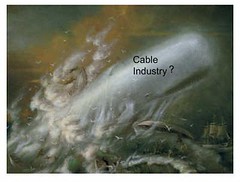 Well, another four months have passed since I last asked this question, but let me pose it again: Where exactly is the FCC’s Video Competition Report and why is it taking so long to get it out the door? It wouldn’t have anything to do with a certain Chairman Ahab still trying to get his cable whale, would it? No, of course not. I’m sure there’s a perfectly rational reason that this 13th Annual report is now something like 18 months past due altogether. Right.
And keep in mind that the data in the 13th report is for a period ending on June 30, 2006, so whenever the report finally comes out the data in it will be well over two years old! That won’t exactly reflect the true state of the video programming market considering the significant changes we have since that time, especially the continued explosive growth of online video, VOD, and DVRs.
The reason that I have been making a big deal out of this issue is because this gets to the question of just how “scientific” and “independent” of an agency the FCC really is. We are talking about facts here. Basic data. This is stuff the FCC should be routinely collecting and reporting on a timely basis — indeed that is what Congress
requires the agency to do in this specific case. And yet the agency can’t do it because its Chairman is on this Moby Dick-like crusade against the cable industry. By the time this 13th annual report finally sees the light of day, the 15th annual report might be due! Outrageous. (And you wonder why many of us here are so skeptical about empowering the FCC regulating the Internet via Net neutrality mandates! If an over-zealous Chairman can politicize this issue, just think what might happen once we give the agency the authority to regulate the Net.)
Anyway, down below you will find the paper that Barbara Esbin and I wrote about the issue four months ago. Perhaps we should place a little ticker somewhere here on the site that counts each day that passes as we wait for the Commission to produce this report. We can take bets on when the agency’s data holdout will end.
Continue reading →
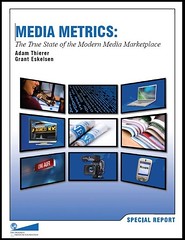 Faithful readers will recall that, several months ago, I penned a 7-part “Media Metrics” series that took a hard look at the health of the media marketplace. Today, the Progress & Freedom Foundation is releasing a greatly expanded version of these essays that I have put together with my PFF colleague Grant Eskelsen. In this 100-page special report, “Media Metrics: The True State of the Modern Media Marketplace,” we begin by noting that heated debates about the state of the media marketplace continue to rage in Washington, and opinions seem to range from grim to outright apocalyptic. As we note on pg. 1:
Many people—including a large number of legislators and regulators—argue that America’s media marketplace is in a miserable state. Some claim that citizens lack choice in media outlets and that options are just as scarce as ever. Others believe that media “localism” is dead or that many groups or niches go underserved because of a lack of true “diversity” in media. Others argue that the market is hopelessly over-concentrated in the hands of a few evil media barons who are hell-bent on force-feeding us corporate propaganda. And still others say that the quality of news and entertainment in our society has deteriorated because of a combination of all of the above. It all sounds quite troubling, but is any of it true?
After taking an objective look at the true state of America’s media marketplace, we conclude that such pessimism is unwarranted. Indeed, a careful review of the facts reveals that—contrary to what those media critics suggest—we have more media choice, more media competition, and more media diversity than ever before. Indeed, to the extent there was ever a “golden age” of media in America, we are living in it today. The media sky has never been brighter and it is getting brighter with each passing year.
Continue reading →
As I mentioned yesterday, James Gattuso and I penned an editorial for National Review this week about the growth of FCC regulation and spending in recent years. In the op-ed, we also noted that, “For whatever reason, a disproportionate number of these [new regulatory proposals] have been aimed at cable television, so much so that press and industry analysts now speak of Chairman Martin’s ongoing ‘war on cable.'”
Today, the editors at
National Review have chimed in with an editorial of their own on the issue entitled, “Pulling the Cable on Martin’s Crusade.” Specifically, the editors address what most pundits believe really motivates the Chairman’s crusade against cable: His desire to force cable companies to offer consumers channels on “a la carte” basis in an effort to “clean up” cable TV. “Martin should abandon this particular crusade,” the NR editors argue. “While we are sympathetic to parents’ desire to get the channels they want without having to buy access to racier fare, using economic regulation to restructure an industry is the wrong approach.” They continue:
Continue reading →
With the release last month of its report on Violent Television Programming and Its Impact on Children, the FCC teed up the issue of regulating televised violence and tossed it over to Congress with a recommendation that lawmakers go ahead and swing for the fences. And Congress appears ready to oblige, although not necessarily in the way some at the FCC had originally envisioned.
You will recall that FCC Chairman Kevin Martin used the FCC’s violence report as another opportunity to engage in his monomaniacal, Moby Dick-like quest to impose a la carte regulation on cable and satellite operators. Martin argued that “Requiring cable and satellite television providers to offer programming in a more a la carte manner would be a more content neutral means for Congress to regulate violent programming and therefore would raise fewer constitutional issues.” But it doesn’t appear that the chairman is going to get his whale this time around.
Continue reading →

 The Technology Liberation Front is the tech policy blog dedicated to keeping politicians' hands off the 'net and everything else related to technology.