 I’m not sure how I missed this, but someone just pointed out to me that in late July, the city of Amherst, NY, “failed to approve a game license for [Chuck E. Cheese’s] the kids-themed food and entertainment venue… citing concerns about violent video games and bad behavior by patrons that require police intervention.” That is according to this article by Sandra Tan in The Buffalo News. Tan reports that the Amherst Town Board deadlocked 3-3 when considering the license for Chuck E. Cheese’s, apparently meaning that the pizza and arcade hot spot for kids will no longer be able to offer games at their Amherst venue. According to her article, game content considerations drove the move:
Council Member Shelly Schratz said she was disturbed by several “action-packed shoot-and-kill games” that were accessible to children as young as 4. “When I see 6-year-olds, 8-year-olds playing those games, when all the time we’re opening the paper and seeing those stories on youth violence, do we need those games to make money?” she said. Schratz was one of three board members who voted against renewing the establishment’s game room license, which is necessary for the business to legally run its arcade games, a major draw for families that patronize the chain’s 500-plus locations from coast to coast.
I find the actions of Amherst in this case to be quite troubling. Here are a few quick thoughts about this incident: Continue reading →
 The Senate Commerce Committee held a hearing yesterday where a number of Senators as well as Julius Genachowski, the new Chairman of the Federal Communications Commission, did a lot of fretting about the state of the modern children’s television programming marketplace. According to the Wall Street Journal, Senate Commerce Committee Chairman Jay Rockefeller (D-WV):
suggested that a “little red button” be required on TVs so that a child could push the button to find out how a show is rated. Democratic Sen. Mark Pryor of Arkansas agreed that a red button might help since parents often have difficulties figuring out which shows are appropriate for their children to watch.
Well, I have some good news for the Senators: There are already quite a few little buttons on every remote control made today, and at least one of those buttons can pull up an on-screen guide to get more program info! (Another of them can turn the TV off!) Moreover, the ratings for just about every program already appear at the beginning of each show, and sometimes in between. And you can find out plenty more online about every TV show under the sun if you care to look. So, I’m not sure what that fuss is all about, and we certainly don’t need to mandate “little red buttons” on every TV set when program information can be found in so many other ways.
What is more troubling about all the hand-wringing taking place at the hearing, as well as the talk of reopening the Children’s Television Act of 1990 to potentially impose more content mandates on video programmers and distributors, is that: (1) there doesn’t seem to be much appreciation for just how much wonderful children’s programming is out there today compared to the past, and (2) there doesn’t seem to be much recognition of the serious First Amendment issues at stake when government gets involved in the messy business of regulating video programming.
Continue reading →
As part of our ongoing series that tracks the gradual transition of video content to the boob tube to online outlets, I want to draw everyone’s attention to two excellent articles in today’s Washington Post about this trend. One is by Paul Fahri (“Click, Change: The Traditional Tube Is Getting Squeezed Out of the Picture“) and the other by Monica Hesse (“Web Series Are Coming Into A Prime Time of Their Own“). I love the way Paul opens his piece with a look forward at how many of us will be explaining the “old days” of TV viewing to our grand kids:
S
it down, kids, and let Grandpa tell you about something we used to call “watching television.”
Why, back when, we had to tune to something called a “channel” to see our favorite programs. And we couldn’t take the television set with us
; we had to go see it!
Ah, those were simpler times.
Oh, sure, we had some technology we thought was pretty fancy then, too, like your TiVo and your cable and your satellite, which gave us a few hundred “channels” of TV at a time. Imagine that — just a few hundred! And we had to pay for it every month! Isn’t the past quaint, children?
Well, it all started to change around aught-eight, or maybe ’09, for sure. That’s when you no longer needed a television to watch all the television you could ever want.
Yes, I still remember it like it was yesterday . . .
Too true. Anyway, Paul goes on to document how some folks have already completely made the jump to an online-online TV existence and are doing just fine, although the idea of us all gathering around the tube to share common experiences may be a causality of the migration to smaller screens, he notes.
Continue reading →
As anyone who has spent time searching for comments on the FCC’s website can tell you, the agency doesn’t exactly have the most user-friendly website. In the interest of making it easier for others to read the comments that came in last week in the agency’s “Child Safe Viewing Act” Notice of Inquiry, I have compiled all the major comments (those over 3 or 4 pages) and provided links to them below the fold.
Again, this proceeding was required under the “Child Safe Viewing Act of 2007,” which Congress passed last year and President Bush signed last December. The goal of the bill and the FCC’s proceeding (MB 09-26) is to study “advanced blocking technologies” that “may be appropriate across a wide variety of distribution platforms, including wired, wireless, and Internet platforms.” I filed 150+ pages worth of comments in this matter last week, and here’s my analysis of why this bill and the FCC’s proceeding are worth monitoring closely.
Continue reading →
Today I filed comments with the Federal Communications Commission (FCC) in its proceeding examining the marketplace for “advanced blocking technologies.” This proceeding was required under the “Child Safe Viewing Act of 2007,” which Congress passed last year and President Bush signed last December. The goal of the bill and the FCC’s proceeding (MB 09-26) is to study “advanced blocking technologies” that “may be appropriate across a wide variety of distribution platforms, including wired, wireless, and Internet platforms.” My colleagues will no doubt laugh about the fact that I have dropped an absurd 150 pages worth of comments on the FCC in this matter, but I had a lot to say on this topic! Parental controls, child safety, and free speech issues have been the focus of much of my research agenda over the past 10 years.
In my filing, I argue that the FCC should tread carefully in this matter since the agency has no authority over most of the media platforms and technologies described in the Commission’s recent Notice of Inquiry. Moreover, any related mandates or regulatory actions in in this area could diminish future innovation in this field and would violate the First Amendment rights of media creators and consumers alike. The other major conclusions of my filing are as follows:
- There exists an unprecedented abundance of parental control tools to help parents decide what constitutes acceptable media content in their homes and in the lives of their children.
- There is a trade-off between complexity and convenience for both tools and ratings, and no parental control tool is completely foolproof.
- Most homes have no need for parental control technologies because parents rely on other methods or there are no children in the home.
- The role of household media rules and methods is underappreciated and those rules have an important bearing on this debate.
- Parental control technologies work best in combination with educational efforts and parental involvement.
- The search for technological silver-bullets and “universal” solutions represent a quixotic, Holy Grail-like quest and it will destroy innovation in this marketplace.
- Enforcement of “household standards” made possible through use of parental controls and other methods negates the need for “community standards”-based content regulation.
My entire filing can be found here and down below in a Scribd reader. All comments in the matter are due tomorrow and then reply comments are due on May 18th.
Continue reading →
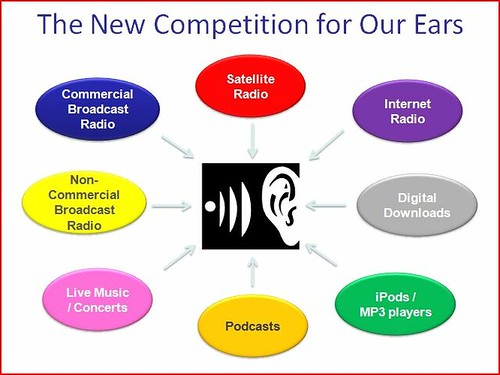
Much ink is spilled over the expanding array of video marketplace choices that are competing for the attention of our eyeballs, but much less is usually written about the competition for our ears. As this excellent new Business Week article by Olga Kharif makes clear, competition and innovation in the audio marketplace has never been more vibrant. It’s something I’ve pointed out here before and here’s a chart I created for my Media Metrics report to highlight all the new competition for our ears. We’ve come a long way since the days of my youth, when transistor radios and vinyl records were the extent of audio competition!
I’m intrigued by this new bill that Rep. Peter King has introduced to prevent video voyeurism. H.R. 414, the “Camera Phone Predator Alert Act” finds that “children and adolescents have been exploited by photographs taken in dressing rooms and public places with the use of a camera phone.” To remedy this problem, King’s “Phone Predator Alert” bill would require that:
any mobile phone containing a digital camera that is manufactured for sale in the United States shall sound a tone or other sound audible within a reasonable radius of the phone whenever a photograph is taken with the camera in such phone. A mobile phone manufactured after such date shall not be equipped with a means of disabling or silencing such tone or sound.
In other words, cameras would have to get noisy again! Old timers will recall the days when our cameras were noisier than a box of rocks. Today’s digital cameras and camera phones, by contrast, are increasingly silent, but that also opens up the door to potential abuse by some creeps out there. While I don’t believe there’s evidence pointing to a national epidemic of digital voyeurism, there’s no doubt that some people — including many youngsters — are having their privacy invaded in this fashion.
I find King’s solution at once to be both ingenious and futile. It’s ingenious in that, if we could truly force it upon everyone, it might actually go along way towards solving this problem. The noisy camera would again act as the prime deterrent to such an act.
Continue reading →
This ongoing series has explored the increasing ability of consumers to “cut the cord” to traditional video distributors (cable, satellite, etc.) and instead receive a mix of “television” programming and other forms of video programming over the Internet. As I’ve argued, this change not only means lower monthly bills for those “early adopter” consumers who actually do “cut the cord”, but, in the coming years, a total revolution in the traditional system of content creation and distribution on which the FCC’s existing media regulatory regime is premised.
This revolution has two key parts:
- Conduits: The growing inventory—and popularity—of sites such as Hulu, Amazon Unboxed and the XBox 360 Marketplace (or software such as Apple’s iTunes store), that allow users to view or download video content. Drawing an analogy to the FCC’s term “Multichannel Video Programming Distibutor” or MVPD (cable, direct broadcast satellite, telco fiber, etc.), I’ve dubbed these sites “Internet Video Programming Distributors” or IVPDs.
- Interface: The hardware and software that allows users to display that content easily on a device of their choice, especially their home televisions.
While much of the conversation about “interface” has focused on special hardware that brings IVPD content to televisions through set-top boxes such as the Roku box or game consoles like the XBox 360, at least one company is making waves with a software solution. From the NYT:
Boxee bills its software as a simple way to access multiple Internet video and music sites, and to bring them to a large monitor or television that one might be watching from a sofa across the room.
Some of Boxee’s fans also think it is much more: a way to euthanize that costly $100-a-month cable or satellite connection.
“Boxee has allowed me to replace cable with no remorse,” said Jef Holbrook, a 27-year-old actor in Columbus, Ga., who recently downloaded the Boxee software to the $600 Mac Mini he has connected to his television. “Most people my age would like to just pay for the channels they want, but cable refuses to give us that option. Services like Boxee, that allow users choice, are the future of television.” ….
Boxee gives users a single interface to access all the photos, video and music on their hard drives, along with a wide range of television shows, movies and songs from sites like Hulu,Netflix, YouTube, CNN.com and CBS.com.
Continue reading →
Continuing the “Cutting the (Video) Cord” series started by my PFF colleague Adam Thierer: The WSJ had two great pieces yesterday about the increasing competitive relevance of television distributed by Internet—a trend that was at the heart of an amicus
brief PFF recently filed in support of C omcast’s challenge of the FCC’s 30% cap on cable ownership. The first WSJ piece declares that:
After more than a decade of disappointment, the goal of marrying television and the Internet seems finally to be picking up steam. A key factor in the push are new TV sets that have networking connections built directly into them, requiring no additional set-top boxes for getting online. Meanwhile, many consumers are finding more attractive entertainment and information choices on the Internet — and have already set up data networks for their PCs and laptops that can also help move that content to their TV sets.
The easier it is for consumers to receive traditional television programming (in addition to other kinds of video content) distributed over the Internet on their television, the less “gatekeeper” or “bottleneck” power cable distributors have over programming. So the Netflix-capable and Yahoo-widget-capable televisions described by the WSJ piece go a long way to increasing the substitutability of what we call Internet Video Programming Distributors (IVPDs) for Multichannel Video Programming Distributors (MVPDs), such as cable, satellite television and fiber services offered by telcos such as Verizon’s FiOS.
While such televisions are only expected to reach 14% of all TV sales by 2012, one must remember that a growing number of set-top boxes (
e.g., the Roku Digitial Video Player, game consoles like the Microsoft XBox 360 and Sony PlayStation 3, and TiVo DVRs) allow users to users to receive IVPD programming on their existing televisions.
As we argued in our amicus brief, the immense competitive importance of IVPDs lies not in the potential for some users to “cut the cord” to cable and other MVPDs (though that will surely happen), but in the immediate impact IVPDs have as an alternative distribution channel for programmers. In the pending D.C. Circuit case, we argue that both the FCC’s 30% cap, issued in December 2007, and the underlying portions of the 1992 Cable Act authorizing such a cap should be struck down as unconstitutional because the ready availability of IVPDs as an alternative distribution channel means that cable no longer has the “special characteristic” of gatekeeper/bottleneck power that would justify imposing such a unique burden on the audience size of cable operators. (Of course, Direct Broadcast Satellite and Telco Fiber are also eating away at cable’s share of the MVPD marketplace.)
The second WSJ piece, an op/ed, illustrates beautifully how cable operators are already losing “market power” (or at least negotiating leverage) in a very tangible way: they’re having to pay more for programming. Specifically, the Journal describes how Viacom plaid chicken with Time Warner—and won. Continue reading →
Wow, I am really blown away by CancelCable.com. Earlier today, I mentioned how I discovered it thanks to Mike Musgrove’s Washington Post story about how more and more people are canceling their cable and satellite subscriptions altogether and using alternative video platforms — Hulu, iTunes, Netflix, XBox, etc. — to watch their favorite shows. Anyway, if you go to CancelCable.com’s “Show Finder” site, you will find a complete inventory of all the major television programs you can find online right now. Go to the site to see the complete list, but down below I cut just the first 15 shows listed to give you a feel for how it works. And that list just continues to grow and grow in both directions — in terms of the number of shows and the number of platforms where you can get them.
OK, so why again do we need to mandate a la carte regulation for cable and satellite?

 The Technology Liberation Front is the tech policy blog dedicated to keeping politicians' hands off the 'net and everything else related to technology.