Posts tagged as:

I’ve grown increasingly tired of the fight over not just retransmission consent, but almost all TV regulation in general.  Seriously, why is our government still spending time fretting over a market that is more competitive, diverse and fragmented than most other economic sectors?  It’s almost impossible to keep track of all the innovation happening on this front, although I’ve tried here before. Every metric — every single one — is not just improving but exploding. Just what’s happening on the kids’ TV front is amazing enough, but the same story is playing out across other programming genres and across multiple distribution platforms.

More proof of just how much more diverse and fragmented content and audiences are today comes in this excellent new guest editorial over at GigaOm, “The Golden Age of Choice and Cannibalization in TV,” by Mike Hudack, CEO of Blip.tv. Hudack notes that, compared to the Scarcity Era, when we had fewer choices and were all forced to watch pretty much the same thing, today’s media cornucopia is overflowing, and audiences are splintering as a result.  “Media naturally trends towards fragmentation,” he notes.  “As capacity increases so does choice. As choice increases audiences fragment. When given a choice people generally prefer media that speaks to them as individuals over media that speaks to the ‘masses.’”

Indeed, he cites Nielsen numbers I’ve used here before illustrating how the top shows of the 50’s (like Texaco Star Theater) netted an astonishing 60-80% of U.S. television households while more recent hits, like American Idol is lucky if it can manage over 15% audience share. He concludes, therefore, that: Continue reading →

PFF today released the fifth installment in our ongoing series on “The Wrong Way to Reinvent Media.” This series of papers explores various tax and regulatory proposals that would have government play an expanded role in supporting the press, journalism, or other media content. In the latest essay, Berin Szoka, Ken Ferree, and I discuss proposals for direct subsidies for failing media outlets and out-of-work journalists.

We argue taxpayer support for failing outlets and unemployed journalists implicates significant First Amendment concerns. On the whole, subsidies can make “journalists and media operators more dependent upon the State; compromise press independence and diminish public trust in the free press; and result in government discrimination in the politically inescapable dilemma of determining eligibility for subsidies.” Such an agenda would also entail huge cost to taxpayers—initially about $35 billion per year according to advocates—and would represent “a massive wealth transfer from one class of speakers to another…”

We warn that calls for seemingly beneficent bailouts “to save” the media and journalism may actually be driven by those who have something more nefarious in mind: a “post-corporate” world shorn of media capitalists, and “such radicalism must be rejected if we hope to sustain a truly free press and uphold America’s proud tradition of keeping a high and tight wall of separation between Press and State.”

The ideas within these and other essays in the series will be worked into a major PFF filing in the Federal Communications Commission’s (FCC) proceeding on the “Future of Media” on May 7. The paper may be viewed online here and I’ve attached it down below in a Scribd reader.

Continue reading →

The potential of streaming video from the House of Representatives is so great that my first impression of the House’s new video offering, HouseLive.gov, has been disappointment. There is much room to improve HouseLive.gov, and I hope it will improve.

At first, I couldn’t find any video that was actually live. (That would inject a bit of irony into the name, eh?) But there is live video: On the homepage, scroll down to the top of the “Most Recent Sessions” chart. If the top of the list has an item called “In Progress,” the House is in session. Clicking the video link will get you live video from the House floor.

(Don’t be fooled by the “Subscribe to Live Feeds” box. Those are RSS feeds, which are “live”—as in regularly updated. They’re not live video or audio.)

Most people will probably access this from the House clerk’s familiar “Floor Summary” page, which has near-real-time updates about House activity. But that page says “Streaming video is not available for this session.” That’s a hiccup that should be easy to fix.

Selecting a past day, one can watch the video of that day, but in my early tests, you had to watch the video from the beginning. I don’t think many people are going to watch 10 hours of video to pick up their representative’s remarks on the bill to congratulate Camp Dudley of Westport, New York, on its 125th anniversary.

I’ve been testing in Firefox. In Internet Explorer, I got some links that do things. It appears you will be able to navigate around a day’s video based on the activity of the House. That is, you can jump to where the House began debate on the Camp Dudley bill.

Hopefully, the system will work in standards-compliant browsers, not only Microsoft’s. I note that the video currently plays only in Windows Media Player or Microsoft’s Silverlight. I’ll leave it to friends better versed in video to critique the selection of formats, but I have doubts about these two as being the best, and most open, available.

Beyond junctures in House debate, there should be more tagging to make the video useful. Not only should you be able to navigate via House activity, you should be able to navigate by bill number, and by member of Congress.

When you do navigate around, I don’t see that the “share” link changes. This needs fixing so that people can direct friends and colleagues to key portions of debates. In fact, you should be able to link to any point in the video. Ideally, there should be an embed function that allows defined segments of video to go into blog posts and such. That latter one is a big ask, but Congress is a big, important institution.

It’s early yet. Maybe these things are in the works or on the drawing board. Rolling HouseLive.go out in “beta,” getting feedback, and fixing it is A-OK. But sometimes government agencies set a course and have a hard time changing after that. The Thomas legislative system, brilliant as it was for 1995, still isn’t publishing bill data in good formats, and a private provider has had to take up the slack.

HouseLive.gov is better than nothing. It can be much, much better than it is.

As I’ve mentioned here previously, PFF has been rolling out a new series of essays examining proposals that would have the government play a greater role in sustaining struggling media enterprises, “saving journalism,” or promoting more “public interest” content. We’re releasing these as we get ready to submit a big filing in the FCC’s “Future of Media” proceeding (deadline is May 7th).  Here’s a podcast Berin Szoka and I did providing an overview of the series and what the FCC is doing.

In the first installment of the series, Berin and I critiqued an old idea that’s suddenly gained new currency: taxing media devices or distribution systems to fund media content. In the second installment, I took a hard look at proposals to impose fees on broadcast spectrum licenses and channeling the proceeds to a “public square channel” or some other type of public media or “public interest” content.

In our latest essay, “The Wrong Way to Reinvent Media, Part 3: Media Vouchers,” Berin and I consider whether it is possible to steer citizens toward so-called “hard news” and get them to financially support it through the use of “news vouchers” or “public interest vouchers”?  We argue that using the tax code to “nudge” people to support media — while less problematic than direct subsidies for the press — will likely raise serious issues regarding eligibility and be prone to political meddling.  Moreover, it’s unlikely the scheme will actually encourage people to direct more resources to hard news but instead just become a method of subsidizing other content they already consume.

I’ve attached the entire essay down below.

Continue reading →

By Adam Thierer & Berin Szoka

As we mentioned yesterday, in a new series of essays, we will be examining proposals being put forward today that would have the government play a greater role in sustaining struggling media enterprises, “saving journalism,” or promoting more “public interest” content. With many traditional media operators struggling, and questions being raised about how journalism in particular will be supported in the future, Washington policymakers are currently considering what role government can and should play in helping media providers reinvent themselves in the face of tumultuous technological change wrought by the Digital Revolution. We will be releasing 6 or 7 essays on this topic leading up to our big filing in the FCC’s “Future of Media” proceeding (deadline is May 7th).

In the first installment of our series, we will critique an old idea that’s suddenly gained new currency: taxing media devices or distribution systems to fund media content. We argue that such media income redistribution is fundamentally inconsistent with American press traditions, highly problematic under the First Amendment, difficult to implement in a world of media abundance and platform convergence, and likely to cause serious negative side effects.  Bottom line: Don’t tax our iPhones or broadband to subsidize media!

We’ve attached the entire text of the piece below. (Installment #2, on broadcast spectrum taxes to subsidize public media, will be released next week.)

Continue reading →

By Adam Thierer & Berin Szoka

In a series of upcoming essays, we will be examining proposals being put forward today that would have the government play a greater role in sustaining struggling media enterprises, “saving journalism,” or promoting more “public interest” content. The reason we’re working up this multi-part series is because, with many traditional media operators struggling, and questions being raised about how journalism in particular will be supported in the future, Washington policymakers are currently considering what role government can and should play in helping media providers reinvent themselves in the face of tumultuous technological change wrought by the Digital Revolution.

For example, the Federal Communications Commission (FCC) recently kicked off a new “Future of Media” effort with a workshop on “Serving the Public Interest in the Digital Era.” (The  filing deadline for the FCC’s “Future of Media” proceeding is May 7th).  Likewise, the Federal Trade Commission (FTC) has hosted two workshops asking “How Will Journalism Survive the Internet Age?”  Meanwhile, the Senate has already held hearings about “the future of journalism,” and Senator Benjamin L. Cardin (D-MD) recently introduced the “Newspaper Revitalization Act,” which would allow newspapers to become tax-exempt non-profits in an effort to help them stay afloat.

Thus, in light of Washington’s sudden interest in the future of media and journalism, we will be taking a hard look at several issues and proposals that are being floated today, including:

  • Taxes on media devices, mobile phones, or broadband bills to channel money to media enterprises / content;
  • Taxes / fees on broadcasters to funnel support to their public sector competitors or to public interest programs;
  • “News vouchers” or “public interest vouchers” that would encourage citizens to channel support to media providers;
  • Taxes on private advertising to subsidize non-commercial / public media content;
  • Expanded postal subsidies for media mail; and
  • Targeted welfare programs for out-of-work journalists or corporate welfare in the form of bailouts for failing media enterprises.

You won’t be surprised to hear that we are generally quite skeptical of most of these ideas, but we promise to give each one serious consideration.  We’ll kick things off tomorrow with our essay on why taxing media devices or distribution systems to fund media content is not a particularly good idea.

I’ve just released a new PFF white paper looking at the hysteria that has often accompanied major media mergers and then taking a look at the marketplace reality years after the fact.  Here‘s the PDF, but I have also pasted the entire thing down below.

_____________________________

A Brief History of Media Merger Hysteria: From AOL-Time Warner to Comcast-NBC

by Adam Thierer

Although the pending union of Comcast and NBC Universal has not yet made it to the altar, Chicken Little-esque wails about the marriage have already begun in earnest. For example, the pro-regulatory media organization Free Press has already set up a website to complain about the deal.[1] And Jeff Chester, executive director of the Center for Digital Democracy, has called it “an unholy marriage.”[2] The fever only promises to spread once the deal is formally announced, and a lengthy fight over the deal is expected at the Federal Communications Commission (FCC) and whichever antitrust agency reviews the deal.[3]

But reality tends to play out somewhat less dramatically than the script penned by the media worrywarts. It’s worth looking back at some of the more prominent examples of media merger hysteria in recent years to understand why such panic is unwarranted, and why a deal between Comcast and NBC Universal is unlikely to lead to the sort of problems that the pessimists suggest.[4] Continue reading →

kids watching TVIn a recent PFF paper I argued that “We Are Living in the Golden Age of Children’s Programming,” and showed how, despite incessant complaints by many policymakers:

the overall market for family and children’s programming options continues to expand quite rapidly. Thirty years ago, families had a limited number of children’s television programming options at their disposal on broadcast TV. Today, by contrast, there exists a broad and growing diversity of children’s television options from which families can choose.

I then documented there and in my book, Parental Controls & Online Child Protection:

  • the many excellent family- or child-oriented networks available on cable, telco, and satellite television today;
  • the growing universe of religious / spiritual television networks;
  • the many family or educational programs that traditional TV broadcasters offer; or
  • the massive market for interactive computer software or Internet websites for children.

And every time I turn around I find another great show, service, or site for families to choose from.  Continue reading →

The D.C. Circuit has struck down as arbitrary and capricious the FCC’s “cable cap.”  The cap prevented a single cable operator from serving more than 30% of U.S. homes—precisely the same percentage limit struck down by the court in 2001.  The court ruled that the FCC had failed to demonstrate that “allowing a cable operator to serve more than 30% of all cable subscribers would threaten to reduce either competition or diversity in programming.”

The court’s decision rested on the two critical charts (both generated by my PFF colleague Adam Thierer in his excellent Media Metrics special report) at the heart of the PFF amicus brief I wrote with our president, Ken Ferree:

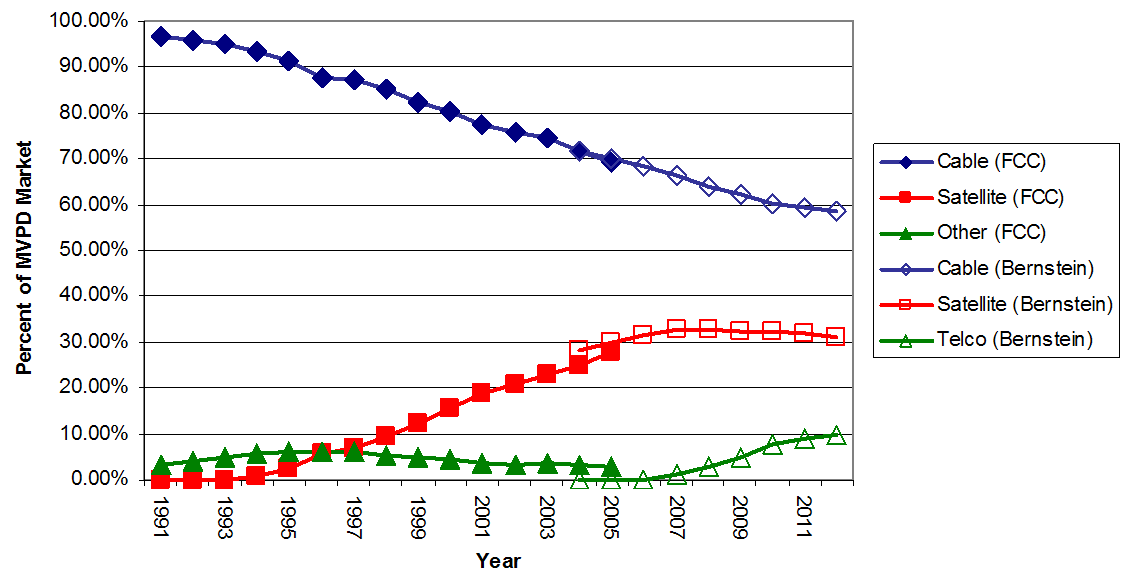
First, the record is replete with evidence of ever increasing competition among video providers: Satellite and fiber optic video providers have entered the market and grown in market share since the Congress passed the 1992 Act, and particularly in recent years. Cable operators, therefore, no longer have the bottleneck power over programming that concerned the Congress in 1992.

Increasing Competition in the MVPD Marketplace

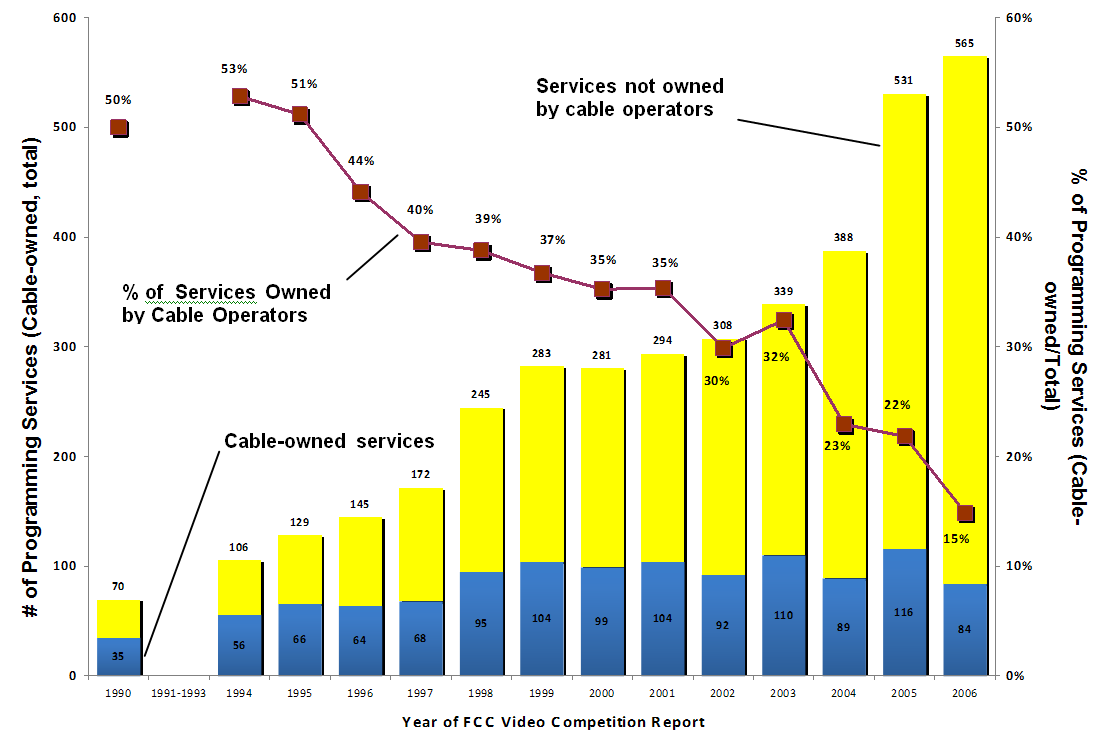
Second, over the same period there has been a dramatic increase both in the number of cable networks and in the programming available to subscribers.

Our chart shows the explosion in the number of programmers (though not the total amount of programming), as well as the falling rate of affiliation between cable operators and programmers, which was among the prime factors motivating Congress when it authorized a cable cap in the 1992 Cable Act:

Video Choices & Vertical Integration in the Multichannel Video Marketplace

Continue reading →

What Unites Advocates of Speech Controls & Privacy Regulation? [pdf]

by Adam Thierer & Berin Szoka The Progress & Freedom Foundation, Progress on Point No. 16.19

Anyone who has spent time following debates about speech and privacy regulation comes to recognize the striking parallels between these two policy arenas. In this paper we will highlight the common rhetoric, proposals, and tactics that unite these regulatory movements. Moreover, we will argue that, at root, what often animates calls for regulation of both speech and privacy are two remarkably elitist beliefs:

  1. People are too ignorant (or simply too busy) to be trusted to make wise decisions for themselves (or their children); and/or,
  2. All or most people share essentially the same values or concerns and, therefore, “community standards” should trump household (or individual) standards.

While our use of the term “elitism” may unduly offend some understandably sensitive to populist demagoguery, our aim here is not to launch a broadside against elitism as Time magazine culture critic William H. Henry once defined it: “The willingness to assert unyieldingly that one idea, contribution or attainment is better than another.”[1] Rather, our aim here is to critique that elitism which rises to the level of political condescension and legal sanction. We attack not so much the beliefs of some leaders, activists, or intellectuals that they have a better idea of what it in the public’s best interest than the public itself does, but rather the imposition of those beliefs through coercive, top-down mandates.

That sort of elitism—elitism enforced by law—is often the objective of speech and privacy regulatory advocates. Our goal is to identify the common themes that unite these regulatory movements, explain why such political elitism is unwarranted, and make it clear how it threatens individual liberty as well as the future of free and open Internet. As an alternative to this elitist vision, we advocate an empowerment agenda: fostering an environment in which users have the tools and information they need to make decisions for themselves and their families. Continue reading →