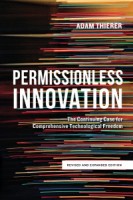
I am pleased to announce the release of the second edition of my book, Permissionless Innovation: The Continuing Case for Comprehensive Technological Freedom. As with the first edition, the book represents a short manifesto that condenses — and attempts to make more accessible — arguments that I have developed in various law review articles, working papers, and blog posts over the past few years. The book attempts to accomplish two major goals.
First, I attempt to show how the central fault line in almost all modern technology policy debates revolves around “the permission question,” which asks:
Must the creators of new technologies seek the blessing of public officials before they develop and deploy their innovations? How that question is answered depends on the disposition one adopts toward new inventions. Two conflicting attitudes are evident.
One disposition is known as the “precautionary principle.” Generally speaking, it refers to the belief that new innovations should be curtailed or disallowed until their developers can prove that they will not cause any harms to individuals, groups, specific entities, cultural norms, or various existing laws, norms, or traditions.
The other vision can be labeled “permissionless innovation.” It refers to the notion that experimentation with new technologies and business models should generally be permitted by default. Unless a compelling case can be made that a new invention will bring serious harm to society, innovation should be allowed to continue unabated and problems, if they develop at all, can be addressed later.
I argue that we are witnessing a grand clash of visions between these two mindsets today in almost all major technology policy discussions today. Continue reading →
The FTC has now posted the videos from their workshop and down below I have embedded my particular panel. My remarks begin around the 5-minute mark of the video.
Congress is considering reforming television laws and solicited comment from the public last month. On Friday, I submitted a letter encouraging the reform effort. I attached the paper Adam and I wrote last year about the current state of video regulations and the need for eliminating the complex rules for television providers.
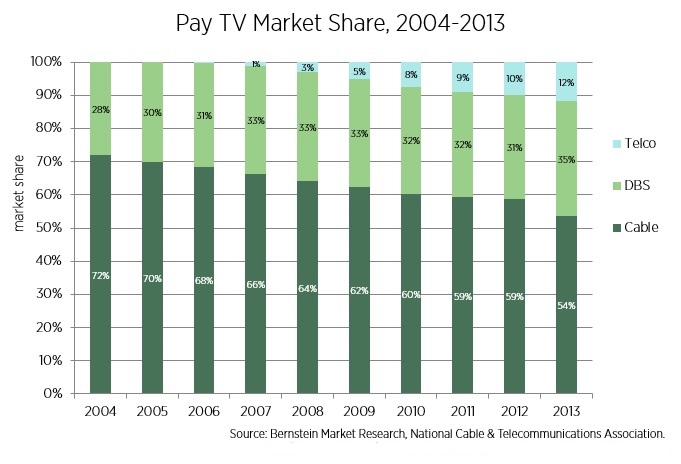
As I say in the letter, excerpted below, pay TV (cable, satellite, and telco-provided) is quite competitive, as this chart of pay TV market share illustrates. In addition to pay TV there is broadcast, Netflix, Sling, and other providers. Consumers have many choices and the old industrial policy for mass media encourages rent-seeking and prevents markets from evolving.
I recently did a presentation for Capitol Hill staffers about emerging technology policy issues (driverless cars, the “Internet of Things,” wearable tech, private drones, “biohacking,” etc) and the various policy issues they would give rise to (privacy, safety, security, economic disruptions, etc.). The talk is derived from my new little book on “Permissionless Innovation,” but in coming months I will be releasing big papers on each of the topics discussed here.
Last December, it was my pleasure to take part in a great event, “The Disruptive Competition Policy Forum,” sponsored by Project DisCo (or The Disruptive Competition Project). It featured several excellent panels and keynotes and they’ve just posted the video of the panel I was on here and I have embedded it below. In my remarks, I discussed:
the contrast between Europe and America’s approach to data & privacy issues (referencing this testimony of mine);
the problem of “technopanics” in information policy debates (building on this law review article);
the difficulty of information control efforts in various tech policy debates (which I wrote about in this law review article and these two blog posts: 1, 2);
the possibility of less-restrictive approaches to privacy & security concerns (which I have written about here as well in those other law review articles);
the rise of the Internet of Things and the unique challenges it creates (see this and this as well as my new book); and,
the possibility of a splintering of the Internet or the rise of “federated Internets.”
The panel was expertly moderated by Ross Schulman, Public Policy & Regulatory Counsel for CCIA, and also included remarks from John Boswell, SVP & Chief Legal Officer at SAS, and Josh Galper, Chief Policy Officer and General Counsel of Personal, Inc. (By the way, you should check out some of the cool things Personal is doing in this space to help consumers. Very innovative stuff.) The video lasts one hour. Here it is:
Last night, I appeared on a short segment on the PBS News Hour discussing, “What’s the future of privacy in a big data world?” I was also joined by Jules Polonetsky, executive director of the Future of Privacy Forum. If you’re interested, here’s the video. Transcript is here. Finally, down below the fold, I’ve listed a few law review articles and other essays of mine on this same subject.
Oh man, I could not stop laughing at this old “Kids Guide to the Internet” video from the 90s. My thanks to my former colleague Amy Smorodin for tweeting it out today. I just had to post it here so that everyone could enjoy.
(Note: You can turn this video into a great drinking game. Just make everyone in the room raise their glass each time the lines “Does your computer have a modem?” and “Not all that cybernet stuff, OK?” are uttered.) And yes, as the opening line of the video notes, “the first thing you need to know about the Internet is that it is amazing.”
There are few things more likely to get constituents to call their representative than TV programming blackouts, and the increase in broadcasting disruptions arising from licensing disputes in recent years means Congress may be forced to once again fix television and copyright laws. As Jerry Brito explains at Reason, the current standoff between CBS and Time Warner Cable is the result of bad regulations, which contribute to more frequent broadcaster blackouts. While each type of TV distributor (cable, satellite, broadcasters, telcos) is both disadvantaged and advantaged through regulation, broadcasters are particularly favored. As the US Copyright Office has said, the rule at issue in CBS-TWC is “part of a thicket of communications law requirements aimed at protecting and supporting the broadcast industry.”
But as we approach a damaging tipping point of rising programming costs and blackouts, Congress’ potential rescuer–Aereo–appears on the horizon, possibly buying more time before a major regulatory rewrite. Aereo, for the uninitiated, is a small online company that sets up tiny antennas in certain cities to capture broadcast television station signals–like CBS, NBC, ABC, Fox, the CW, and Univision–and streams those signals online to paying customers, who can watch live or record the local signals captured by their own “rented” Aereo antenna. Broadcasters hate this because the service deprives them of lucrative retransmission fees and unsuccessfully sued to get Aereo to cease operations. Continue reading →
CBS and Time Warner Cable have been embroiled in a heated contractual battle over the past week that has resulted in viewers in some major markets losing access to CBS programming. When disputes like these go nuclear and signal blackouts occur, it is inevitable that some folks will call for policy interventions since nobody likes it when the content they love goes dark.
While some policy responses are warranted in this matter, policymakers should proceed with caution. Heated contractual negotiations are a normal part of any capitalist marketplace. We shouldn’t expect lawmakers to intervene to speed up negotiations or set content prices because that would disrupt the normal allocation of programming by placing a regulatory thumb too heavily on one side of the scale. This is why I am somewhat sympathetic to CBS in this fight. In an age when content creators struggle to protect their copyrighted content and get compensation for it, the last thing we need is government intervention that undermines the few distribution schemes that actually work well.
On the other hand, Time Warner Cable deserves sympathy here, too, since CBS currently enjoys some preexisting regulatory benefits. As I noted in this 2012
Forbes oped, “Toward a True Free Market in Television Programming,” many layers of red tape still encumber America’s video marketplace and prevent a truly free market in video programming from developing. The battle here revolves around the “retransmission consent” rules that were put in place as part of the Cable Act of 1992 and govern how video distributors carry signals from TV broadcasters, which includes CBS.
But those “retrans” rules are not the only part of the regulatory mess here. Continue reading →
The Internet’s greatest blessing — its general openness to all speech and speakers — is also sometimes its biggest curse. That is, you cannot expect to have the most widely accessible, unrestricted communications platform the world has ever known and not also have some imbeciles who use it to spew insulting, vile, and hateful comments.
It is important to put things in perspective, however. Hate speech is not the norm online. The louts who spew hatred represent a small minority of all online speakers. The vast majority of online speech is of a socially acceptable — even beneficial — nature.
Still, the problem of hate speech remains very real and a diverse array of strategies are needed to deal with it. The sensible path forward in this regard is charted by Abraham H. Foxman and Christopher Wolf in their new book, Viral Hate: Containing Its Spread on the Internet. Their book explains why the best approach to online hate is a combination of education, digital literacy, user empowerment, industry best practices and self-regulation, increased watchdog / press oversight, social pressure and, most importantly, counter-speech. Foxman and Wolf also explain why — no matter how well-intentioned — legal solutions aimed at eradicating online hate will not work and would raise serious unintended consequences if imposed.
In striking this sensible balance, Foxman and Wolf have penned the definitive book on how to constructively combat viral hate in an age of ubiquitous information flows. Continue reading →
The Technology Liberation Front is the tech policy blog dedicated to keeping politicians' hands off the 'net and everything else related to technology. Learn more about TLF →

 There are few things more likely to get constituents to call their representative than TV programming blackouts, and the increase in broadcasting disruptions arising from licensing disputes in recent years means Congress may be forced to once again fix television and copyright laws. As

 The Technology Liberation Front is the tech policy blog dedicated to keeping politicians' hands off the 'net and everything else related to technology.