 By Berin Szoka & Adam Thierer
Yesterday, the Progress & Freedom Foundation (PFF) and Electronic Frontier Foundation (EFF) filed a joint amicus brief with the U.S. Supreme Court urging the Court to protect the free speech rights of videogame creators and users and asking the justices to uphold a ruling throwing out unconstitutional restrictions on violent videogames. At issue is a California law that bans the sale or rental of “violent” videogames to anyone under the age of 18, among other regulations. While the law was passed in 2005, it has never taken effect, as courts have repeatedly ruled it unconstitutional. California appealed its loss at the Ninth Circuit Court of Appeals to the Supreme Court. The case is Schwarzenegger vs. EMA.
This case has profound ramifications for the future of not just videogames, but all media, and the Internet as well. Although we’ve had 15 years of fairly solid Supreme Court case law on new media issues, a loss in the
Schwarzenegger case could reverse that tide. In the amicus brief, we explain how the current videogame content rating system empowers parents to make their own decisions without unconstitutionally restricting this new and evolving form of free speech. Our brief is focused on three major arguments:
- Parental Control Tools, Household Media Control Methods, Self-Regulation and Enforcement of Existing Laws Constitute Less Restrictive Means of Limiting Access to Objectionable Content than Government Regulation of Constitutionally Protected Speech
- Videogame Content is Constitutionally Protected Speech Deserving Strict Scrutiny
- The State Has Not Established a Compelling Government Interest in Restricting the Sale of Videogames to Minors
The filing can be found online here and it is embedded down below. As always, the Media Coalition has done an outstanding job summarizing the case and listing all the major briefs filed with the Court in this matter, so check out their Schwarzenegger v. EMA page for everything you need to know about this case. GamePolitics.com also offers excellent ongoing coverage of the case. Continue reading →
 The Entertainment Software Association, which represents the video game industry, has just released its latest “Essential Facts about the Computer and Video Game Industry” publication. It’s a handy annual resource that I always look forward to reading. There are many interesting facts and figures found in the report, but here a few worth calling out from the data they have aggregated:
- 93% of the time parents are present at the time games are purchased or rented
- 64% of parents believe games are a positive part of their children’s lives
- 86% of the time children receive their parents’ permission before purchasing or renting a game
- 48% of parents play computer and video games with their children at least weekly
- 97% of parents report always or sometimes monitoring the games their children play
- 76% of parents believe that the parental controls available in all new video game consoles are useful
The survey also bolsters the findings of many other polls and reports which have found that parents employ a variety of what I have labeled “household media rules” to monitor or control their children’s media consumption: Continue reading →
 David Leonhardt of The New York Times penned an interesting essay a few days ago entitled, “Do Video Games Equal Less Crime?” reflecting upon the same FBI crime data I wrote about earlier this week, which showed rapid drops in violent crime last year (on top of years of steady declines). Crimes of all sorts plummeted last year despite the serious economic recession we find ourselves in. Downturns in the economy are typically followed by upticks in crime. Not so this time. Which leads Leonhardt to wonder if perhaps exposure to violent media (especially violent video games) could have played a positive role in tempering criminal activity in some fashion:
Video games can not only provide hours of entertainment. They can also give people — especially young men, who play more than their fair share of video games and commit more than their fair share of crimes — an outlet for frustration that doesn’t involve actual violence. Video games obviously have many unfortunate side effects. They can promote obsessive, antisocial behavior and can make violent situations seem ordinary. But might video games also have an upside? I’m willing to consider the idea.
Go Back to the Greeks
What Leonhardt is suggesting here goes by the name “cathartic effect hypothesis” and debates have raged over it for centuries. Seriously, the fight goes all the way back to the great Greek philosophers Plato and Aristotle. And, as with everything else, Aristotle had it right! Well, at least in my opinion he did, but I am a rabid Aristotealian. While Plato thought the media of his day (poetry, plays & music) had a deleterious impact on culture and humanity, Aristotle took a very different view. Indeed, most historians believe it was Aristotle who first used the term
katharsis when discussing the importance of Greek tragedies, which often contained violent overtones and action. He suggested that these tragedies helped the audience, “through pity and fear effecting the proper purgation of these emotions.” (See Part IV of Aristotle’s Poetics,) Aristotle spoke highly of tragedies that used provocative or titillating storytelling to its fullest effect:
Continue reading →
The Supreme Court recently announced that it will review a California law regulating the sale of violently-themed video games to minors. The case under review is Schwarzenegger v. Entertainment Merchants Association. In it, the Ninth Circuit Court of Appeals struck down a California law which prohibited the sale or rental of “violent video games” to minors. I’m inclined to agree with Julie Hilden when she notes that “it seems very unlikely that the Supreme Court took this case in order to proclaim, as the Ninth Circuit panel did, that minors do indeed have First Amendment rights — rights that extend far enough to reach ‘violent’ video games.” I hope that we’re both wrong and that the Court took the case to instead affirm the free speech rights of game creators and users (and yes, even minors), but the justices could have just left the Ninth Circuit ruling be and that would have been settled.
Anyway, let’s think this through here. What if the Supremes took the
Schwarzenegger case to overturn the Ninth Circuit and to uphold the right of state governments to regulate the sale of “violent” video game content, however that’s defined. Let’s consider such a potential holding in light of two other free speech cases handed down over the past few years.
Continue reading →
The Supreme Court announced today that it will review a California law regulating the sale of violently-themed video games to minors. The case is Schwarzenegger v. Entertainment Merchants and I have written about it here before. This will be the first major First Amendment case regarding video game speech rights heard by our nation’s highest court. This afternoon, I issued the following press statement about the case and its importance:
“I hope the Supreme Court is taking this case to affirm the free speech rights of game creators and users, and not to overturn ten years of solid, sensible lower court decisions granting video games the same First Amendment protections as books, film, music and other forms of entertainment. Government regulation of game content is unnecessary because parents have been empowered with sophisticated video game parental controls and a highly descriptive ratings system that is widely recognized and easy to use. Lawmakers should focus their efforts on making sure parents are better aware of existing tools and ratings instead of trying to censor game content in such a plainly unconstitutional fashion. Let’s hope the Supreme Court affirms that educational approach and Ninth Circuit’s decision at the same time.”
Several reporters have already asked me if its a bad sign that the Court took the case at all and wondered if this meant that there are 5 votes for overturning the lower court decision. It’s impossible to read the tea leaves on things like this, but I would generally agree that it’s not a good sign. But I just don’t understand how the Supreme Court could uphold a law like this in light of all their recent Internet jurisprudence (CDA, COPA, etc) which held against the government when various “harm to minors” statutes were tested and found to be unconstitutional. If the Supreme Court goes the opposite direction here, it will mean that our “First Amendment jurisprudential Twilight Zone” will become even more confusing and contorted. Let’s hope that’s not the case.
The website ProCon.org has a new debate online laying out the different perspectives about the question: “Do violent video games contribute to youth violence?” It includes citations for a wide variety of studies that come down on both sides of the question. Simply put, there’s a study for everyone out there. Do you want to find a study suggesting that there’s a strong correlation between violently-themed media and aggression? You can find plenty. Or do you want to hear that there’s no correlation between these things? Well, there’s plenty of studies suggesting that, too.
As someone who briefly flirted with a degree in psychology, I find this an interesting intellectual debate. But here’s the thing I can’t get away from —
lab studies by psychology professors and students are not the real-world. I am consistently shocked and disappointed at the lack of scrutiny these studies receive when they are little more than artificial constructions of reality.
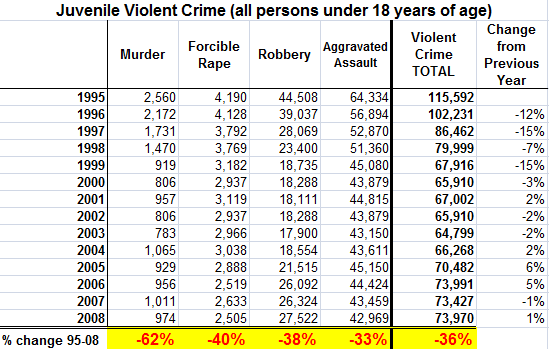
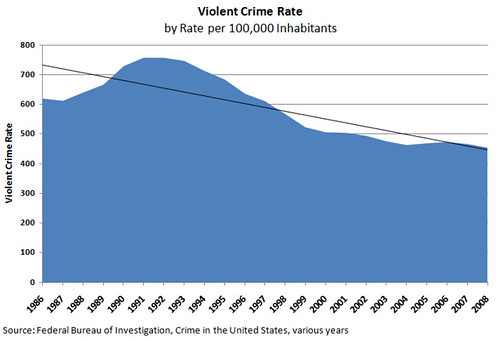
So, how can we determine whether watching depictions of violence will turn us all into killing machines, rapists, robbers, or just plain ol’ desensitized thugs? Well, how about looking at the real world! Whatever lab experiments might suggest, the evidence of a link between depictions of violence in media and the real-world equivalent just does not show up in the data. The FBI produces ongoing Crime in the United States reports that document violent crimes trends. Here’s what the data tells us about overall violent crime, forcible rape, and juvenile violent crime rates over the past two decades: They have all fallen. Perhaps most impressively, the juvenile crime rate has fallen an astonishing 36% since 1995 (and the juvenile murder rate has plummeted by 62%).
Continue reading →
The Parents Television Council (PTC) released a new report today entitled Women in Peril: A Look at TV’s Disturbing New Storyline Trend. The report argues that “by depicting violence against women with increasing frequency, or as a trivial, even humorous matter, the broadcast networks may ultimately be contributing to a desensitized atmosphere in which people view aggression and violence directed at women as normative, even acceptable,” said PTC President Tim Winter. As evidence the report cites… Nicole Kidman. OK, it cites more than Nicole Kidman, but the 7-page report and accompanying press release does seem to place a lot of stock in the fact that, while being questioning by a House Foreign Affairs subcommittee hearing about violence against women overseas, “Ms. Kidman conceded that Hollywood has probably contributed to violence against women by portraying them as weak sex objects, according to the Associated Press.” I’m not sure what Ms. Kidman was doing testifying before Congress on the matter of violence against women overseas — dare I suggest some congressmen were out for another photo-op with a Hollywood celeb? — but the better question is whether Ms. Kidman’s opinion has any bearing on the question of what relationship, if any, there is between televised violence and real-world violence against women. (Incidentally, if she really feels passionately about all this, is she prepared to go back and recut some of her old scenes in “Dead Calm,” “To Die For,” and “Eyes Wide Shut“?)
But let’s not nitpick about the credentials Ms. Kidman brings to the table or whether it makes any sense for PTC to elevate her opinions to proof of theory when it comes to a supposed connection between depictions of violence against women in film or television and real world acts of violence against women. PTC, however, suggests that’s exactly what is going on today. They allude to a few lab studies which are of the “monkey see, monkey do” variety — where the results of artificial lab experiments are used to claim that watching depictions of violence will turn us all into killing machines, rapists, robbers, or just plain ol’ desensitized thugs.
There’s just one problem with such studies, and the PTC report: Reality. Continue reading →
I’ve been meaning to say something about this new paper by Renee Newman Knake of Michigan State University College of Law, which calls for a new paradigm to analyze, and then likely regulate, video game content. Knake’s paper is entitled, “From Research Conclusions to Real Change: Understanding the First Amendment’s (Non)Response to Negative Effects of Mass Media on Children by Looking to the Example of Violent Video Game Regulations.” In it, she proposes to extend an emerging legal philosophy known as “ecogenerism” to the field of video games and the First Amendment treatment thereof. “Ecogenerism” is largely the creation of Barbara Bennett Woodhouse and the theory argues that we should apply lessons or legal frameworks from the field of environmental law to the area of media and children. “Under an ecogenerist model,” states Knake, “media harm decisions should prioritize concern about the level of ‘toxic’ media which children are exposed over free speech interests.” Simply stated, we should treat “toxic media” like toxic chemicals.
There have been other efforts to get courts to relax the legal scrutiny applied to video game content from “strict” to something more relaxed or intermediate in character. For example, there is the “violence as obscenity” approach proposed by Kevin Saunders, who, like Knake, is also with the Michigan State University College of Law. But whereas Saunders has proposed applying an adjacent legal theory or framework (obscenity law) to legal analysis of the constitutionality of regulation of video game content, Woodhouse and now Knake propose a much broader, and more radical, reformulation of First Amendment law along the lines of entirely different body of jurisprudence — again, environment law and regulation.
Of course, this is nuts. The notion that words or images are as “toxic” as chemicals is preposterous, and yet that is exactly what Knake and Woodhouse want us to accept. We can determine with a great deal of certainly the physiological impact of too much mercury or lead on the development of the human brain or body. Generally speaking, we know what dose would kill or deform. The same cannot possibly be said of media, and the very allusion to toxic materials or chemicals is ludicrous to begin with since words and images have never directly killed anyone. EVER! Continue reading →
Yesterday up on Capitol Hill, I hosted a very interesting discussion about “Next-Generation Parental Controls & Child Safety Efforts.” I thought I’d provide a quick recap here for those who couldn’t attend. [Note: audio of the event will be up shortly at the link above and transcript is in the works.] The event featured Steve Crown, Vice President and Deputy General Counsel of Microsoft Corporation’s Entertainment & Devices Division; Dane Snowden, Vice President of External & State Affairs of CTIA – The Wireless Association; and Stephen Balkam, Chief Executive Officer of Family Online Safety Institute.
Steve Crown of Microsoft kicked the show off with a terrific overview of some the current and next-generation parental control tools and awareness efforts that Microsoft is deploying to help empower parents and keep kids safer both online and in gaming environments. Crown outlined Microsoft’s 5-prong strategy regarding how they have approached these issues on the gaming front, and I think it represents an excellent model of how sensible industry self-regulation and “best practices” can go a long way toward addressing concerns that many parents and policymakers have. The five strategies Crown outlined were: (1) Respect both the freedom of game creators and freedom of choice for game consumers; (2) empower parents with ratings, tools, and information; (3) use independent ratings (like the ESRB) to label content; (4) require all games be rated before they can be used on a platform so that parents can implement blocking controls; and (5) respect regional laws and rating systems in different parts of the globe.
In my book on
Parental Controls & Online Child Safety: A Survey of Tools & Methods, I’ve documented many of the empowerment tools that Microsoft has deployed in recent years to make this empowerment vision a reality. One of the most important things MS does on its XBox 360 console is to provide an immediate “out-of-the-box” prompt for parents to set up parental controls and establish other limitations on online chat, spending, or Internet access. Microsoft announced another cool new feature in November 2007, the “Family Timer.” It lets parents limit how and when children play games on the console. This is similar to the time management tools Microsoft offers in its Vista operating system for PCs. Incidentally, my wife has asked me to start using the Family Timer on our XBox — not for our kids, but for me! This particular 40-year-old man is still a big kid at heart.
Continue reading →
 By Berin Szoka & Adam Thierer
 The Technology Liberation Front is the tech policy blog dedicated to keeping politicians' hands off the 'net and everything else related to technology.