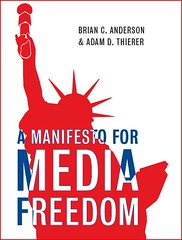
 I’m pleased to announce the publication of A Manifesto for Media Freedom, which I co-authored with Brian C. Anderson of the Manhattan Institute. Brian serves as editor of Manhattan Institute’s excellent City Journal and he is the author of best-selling books like South Park Conservatives and Democratic Capitalism and Its Discontents.
In this little manifesto, we highlight one of the central ironies of the Information Age. Namely, that despite “the breathtaking abundance of new and old media outlets for obtaining news, information, and entertainment…”
many people hate this profusion, and never more than when it involves political speech. The current media market, they charge, doesn’t represent true diversity, or isn’t fair, or is subject to manipulation by a small and shrinking group of media barons. They want the government to regulate it into better shape, which just happens to be a shape that benefits them. Doing so… would be a disaster, a kind of soft or not-so-soft tyranny that would wipe out whole sectors of media, curtailing free speech and impoverishing our democracy.
In other words, instead of celebrating the unprecedented cornucopia of media choices at our collective disposal, many policymakers and media critics are calling for just as much media regulation as ever. We itemize these threats in our chapters and they include: efforts to revive the “Fairness Doctrine”, media ownership regulations, “localism” requirements, Net neutrality mandates, a la carte regulations, cable and satellite censorship, video game censorship, regulation of social networking sites, campaign finance-related speech restrictions, and so on.
In each case, we advance a pro-freedom paradigm to counter the advocates of media control. What do we mean by the “media freedom” that we advocate as the alternative to these new regulatory crusades? Here’s how we put it in the book:
Continue reading →
Just FYI, the latest update of my booklet on “Parental Controls and Online Child Protection: A Survey of Tools & Methods” is now live. The new version, Version 3.1, provides minor updates to all sections of the book and a new appendix of relevant research in the field. I issue major updates early each year and 1 or 2 tweaks during the course of the year to reflect the evolution of the parental control and online child safety market and debate. 
For those not familiar with the report, it explores the market for parental control tools, rating schemes, education efforts, and initiatives aimed at promoting online child safety. I believe that the parental controls and content management tools cataloged in the report represent a better, less restrictive alternative to government regulation. As I conclude after evaluating that state of the market: “There has never been a time in our nation’s history when parents have had more tools and methods at their disposal to help them decide what constitutes acceptable media content in their homes and in the lives of their children.”
The report is available free-of-charge on the PFF website, and the previous editions of the report are housed there too in case you want to see how it has evolved over the past two years. For those interested in taking a quick look at the report, I have embedded it down below the fold as a Scribd file. Finally, as is always the case, I encourage readers to send me updates and suggestions for how to improve the report and I will incorporate them into future versions.
Continue reading →
 The Washington Post reports today on a trend that I thought we all knew about, but one I’m glad the mainstream media is finally realizing. It turns out that people who play video games are not just virginal teenage boys with acne problems. No, even 20-something, attractive women play video games.
The
Post’s
Mike Musgrove reports on the mother and daughters of the Burguieres family of Bethesda, Maryland. Of course in good journalist fashion Musgrove uses the Burguiereses to illustrate a larger point, he even points to the relevant stats:
It used to be that this all-woman crew wouldn’t fit the standard image of the video game consumer. But the perception of gamers as being mostly young guys isn’t so true anymore. Women and girls make up 40 percent of the gamer population, according to the Entertainment Software Association.
The most interesting point brought up in the article on this demographic trend—one that most gamers realize has been happening for quite some time—is Musgrove’s observation that women once were not naturally accepted members of the gaming community. It’s a great point, but one that can be extended to tech community in general.
Continue reading →


 I was a HUGE fan of Mattel handheld games back in the late 70s, and I played “Football I” and “Football II” for countless hours with friends. And now you can get it on the iPhone!
Sure it’s probably still primitive as hell — you could only run the ball in Football I ! — but I bet it’s still a lot of fun.
I still have the old Football II handheld at my house and have been trying to teach my kids how to play it. (Colleco’s handheld Football game was actually better but I don’t have that one anymore). My kids don’t quite get the fun in frantically mashing buttons to move little red LED hashes across the screen. They are spoiled I tell you!
The Battlestar Galactica game was just awesome too. Video games have come a long, long way since then, but these old handheld games were addictive in their own right.
How much platform competition is too much competition? For example, what is the optimal number of mobile operating systems or video game consoles that will spur competition and innovation in those respective sectors?
It is an interesting business question, but it also has some policy implications since some might propose laws or regulations to remedy a perceived lack of platform competition in various sectors. After all, many people would answer the above question by saying that there is
never such a thing as too much competition. The more platforms the better. But there can be costs associated with too much competition. Let’s consider those two case studies mentioned above: mobile operating systems or video game consoles.
Mobile Operating Systems
As my colleague Berin Szoka has pointed out, we are witnessing the rapid proliferation of mobile operating systems, especially on the open source front. So, we’ve got Apple’s iPhone platform, Microsoft’s Windows Mobile, Symbian, Google’s Android, the LiMo platform, and OpenMoko.
One one hand, all this platform competition sounds great. But as Ben Worthen of the
Wall Street Journal’s “Business Tech Blog” points out in a piece today:
Continue reading →
In my July essay on “Understanding The True Cost of Video Game Censorship Efforts,” I pointed out how outrageous it was that politicians continue to burn money on fruitless regulatory measures that are destined to be struck down as unconstitutional. I argued that the nearly $2 million in legal fees and expenses recovered by the video game industry after winning its legal cases against various governments could have been spent much better by public policy makers:
That $2 million in recovered legal fees could have been plowed into educational efforts to help explain to parents how to use the excellent voluntary ratings systems or console-based parental control tools that are at their disposal. Moreover, that $2 million in recovered industry legal fees does not account for the resources that state and local officials put into these regulatory efforts. So, we are talking about a much greater deadweight loss for society and taxpayers.
Well, that opportunity cost / deadweight loss grew even higher today when the state of California reimbursed the Entertainment Software Association (ESA) $282,794 for attorney’s fees after losing a recent legal battle in the case
Video Software Dealers Association v. Schwarzenegger. The ESA sent out a press release about the case today that dramatically points out the opportunity cost of such regulation:
The ESA noted that this payment comes at an especially troubling time for the state, calling to mind other pressing budgetary and legislative priorities and issues, including:
* California is currently facing a $15-billion budget gap
* More than 10,000 California state employees were laid off last week in light of the budget crisis
* Governor Schwarzenegger is seeking to cut wages for nearly 200,000 state employees
* The state already cut 10 percent to its Medicaid reimbursement rate and deferred payments to vendors
“Caregivers are not well-served by court battles and legal fees. Rather, they would have been far better off if state officials worked together with our industry to raise awareness about video game ratings and the parental controls available on all new game consoles — both of which help ensure that the games children play are parent-approved.”
Indeed. And yet, the video game censorship bandwagon rolls on. Will it never end?
A few days ago I posted an open letter to New York Gov. David Patterson about a measure that recently passed through the New York legislature and was awaiting his signature. The bill proposes a new regulatory regime for video games that would include greater state-based oversight of video game labels and console controls as well as an advisory board to monitor the industry. Unfortunately—but quite unsurprisingly—Gov. Patterson signed the bill last night. And so I am certain that another legal battle will ensue regarding the constitutionality of the measure, and it will likely be struck down like every other measure on this front because it violates the First Amendment. Regardless, let’s talk a little more about what animates this specific legislative effort, because I think it is very important and foreshadows the heated debate to come over video games and all media in coming years.
The New York measure is notable in that, unlike most of the other state or local measures that had been stuck down in recent years that proposed penalties for the sale of games to youngsters which were labeled by the ESRB to be intended for an older audience, it simply proposed more “oversight” of the ratings process and parental control technologies by the state. Specifically, it mandated that all games be rated and that all consoles contain screening controls. The response to that proposal has generally been: “So what?” After all, all video games are rated already and all game consoles contain parental controls. The measure also mandated a 16-member oversight board to monitor the industry and this process. Again, that proposal was not regarded by many as a serious threat to the video games or free speech.
But I fear that many are missing the big picture here. The New York bill is actually far more important that many people suspect because of what it foreshadows: A day when politicians will claim that we can make rating systems more “scientific” by putting public health bureaucrats or university social scientists in charge of them. Indeed, last night on Bloomberg TV, this became the focus of a debate between me and Dr. Michael Rich, Director of the Center for Media and Child Health at the Harvard Medical School. After you watch the clip, I’ll have much more to say about this issue down below the fold.
http://eplayer.clipsyndicate.com/cs_api/get_swf/2/&csEnv=p&wpid=0&va_id=649150
Continue reading →
 Each year the Entertainment Software Association (ESA), which represents the video game and computer game industry, produces a great little report entitled “Essential Facts About the Computer and Video Game Industry.” The 2008 edition is out and it has some interesting stats:
- 65 percent of American households play computer and video games;
- 38 percent of American homes have a video game console;
- The average game player is 35 years old;
- One out of four gamers are over age 50;
- Women age 18 or older represent a significantly greater portion of the game-playing population (33 percent) than boys age 17 or younger (18 percent); and,
- 41 percent of Americans expect to purchase one or more games this year.
Those findings make it clear that gaming really has gone mainstream. As I noted in an essay earlier this week, “gaming is now fully integrated into the fabric of my life and the lives of my children. It has become one of the most enjoyable media experiences for my generation and the generation of kids that we are raising.”
Some other important stats that have relevance for debates about public policy:
- 94 percent of parents are present when games are purchased or rented;
- 88 percent of parents report always or sometimes monitoring the games their children play; and,
- 63 percent of parents believe games are a positive part of their children’s lives.
Those are impressive numbers, and it makes it clear, as I have argued before, that parents are parenting! (And that reflects what is going on for television as well).
To: Hon. David Patterson, Governor, State of New York
From: Adam Thierer, life-long gamer and Senior Fellow at the Progress & Freedom Foundation
Date: July 17, 2008
Re: That video game bill (A. 11717/ S. 6401) you have been asked to sign
Dear Gov. Patterson:
I write today to ask a few questions about a measure that is currently sitting on your desk awaiting your signature. The measure (A. 11717/ S. 6401), which recently passed through the New York legislature, proposes a new regulatory regime for video games. It would include greater state-based oversight of video game labels and console controls as well as an advisory board to monitor the industry.
As a life-long gamer—and now the parent of two young gamers—this is a subject I care deeply about. I also come at this topic from an academic perspective as someone who analyzes the intersection of child safety concerns and free speech issues surrounding various types of media and communications technologies. I am the author of a frequently-updated book,
Parental Controls & Online Child Safety: A Survey of Tools & Methods, which provides a comprehensive look at the many tools and methods on the market today that can help parents deal with concerns about objectionable media content.
But mostly I write you today from the perspective of someone who just enjoys games. Actually, let me clarify that: I am utterly infatuated with video games. Gaming has been a life-long passion of mine and something I have enjoyed with friends and family since I owned my very first PONG and Atari 2600 systems in the 1970s. Since then, I have owned virtually every major video game console sold in the United States. Even today, as I approach 40 years of age, I find myself sitting down many nights to enjoy games with my son and daughter on the Xbox 360 and Sony PS3 consoles that we have in our home.
Like millions of other Americans, gaming is now fully integrated into the fabric of my life and the lives of my children. It has become one of the most enjoyable media experiences for my generation and the generation of kids that we are raising. And, although I am certain that the New York legislature had the best of intentions in mind when passing this bill, I believe I speak for a great number of those other American gamers when I say that the measure on your desk is somewhat of an insult to our intelligence. Let me explain by raising a few questions about this bill, which I will argue is unnecessary, unworkable, and unconstitutional:
Continue reading →

 The Technology Liberation Front is the tech policy blog dedicated to keeping politicians' hands off the 'net and everything else related to technology.