FWIW… Just upgraded — at no cost — to Verizon’s 20/5 FIOS plan. Been hitting almost 25 megs pretty consistently today. I was on Verizon’s 10/2 plan beforehand and the 5/2 plan before that. Didn’t notice as much of a difference when I moved from 5 to 10, but jump to 20 is definitely noticeable on big file downloads.
Cox Cable has also been offering nice speed boosts in my neighborhood (McLean, VA) recently, so I suspect that’s why I was offered the free upgrade yesterday when I called Verizon about adding some new HD channels to my FIOS TV package.

Ken Ferree and I just filed an amicus brief with the D.C. Circuit in what could be among the most important First Amendment cases involving economic regulation in years: Comcast’s challenge to the FCC’s cap on the maximum size of a cable operator’s nationwide subscriber-audience. While few may feel righteous indignation at limitations targeted at large corporations such as Comcast or Time Warner, the larger principle at stake here is deeply important: Will the First Amendment provide a meaningful check on what USC law professor Chris Yoo has called “architectural censorship” (i.e., so-called “structural” regulations that “have the unintended consequence of reducing the quantity, quality, and diversity of media content”).
In a nutshell, we argue that that:
- The provisions of the 1992 Cable Act authorizing the FCC to impose a “cable cap” are outdated in world of media abundance and vibrant platform competition.
- Because cable is no longer the unique “bottleneck” or “gatekeeper” that it was in 1992, these statutory provisions (not just the FCC’s 30% rule) must be subject to strict scrutiny under the First Amendment as a limitation on free speech.
- Because there are “less restrictive means” of ensuring cable operators do not impede the flow of video programming to consumers, the court should strike down these provisions.
- Even if the court upholds the statute, it should nonetheless strike down the cap issued by the FCC in December 2007 (30% of all Multichannel Video Programming (MVPD) subscribers as based on an outdated model of the video marketplace.
I encourage you to read our brief (below). I’ve provided a summary below, along with some additional commentary we just couldn’t cover under our 3500 word limit.
Strict Scrutiny. Yoo’s article Architectural Censorship and the FCC is essential reading for anyone who believes that government regulations on the size and shape of the “soapbox” can have huge effects on speech itself. Yoo argues that the First Amendment should check this kind of regulation–however “content-neutral” it might seem–under “strict scrutiny”, which requires that the government show that a regulation is the “least restrictive means” available for advancing a “compelling government interest.” But Yoo ultimately concludes (pp. 713-718, PDF pp. 45-50) that, under existing precedent, most “architectural censorship will be effectively insulated from meaningful judicial review.” Continue reading →
When people ask me why I do what I do for a living — and, more specifically, why I focus all my attention on digital media and technology policy — I often respond by showing them the new gadgets or software I am playing with at any given time. I just love digital technology. I am swimming in a sea of digital gadgets, consumer electronics, online applications, computing software, video games, and all sorts of cyber-stuff.
Anyway, even though this is a technology
policy blog, I sometimes highlight new digital toys or applications that have changed my life for the better. As the year winds down, therefore, I thought I would share with you five technologies that improved my life and productivity in 2008. I’d also love to hear from all of you about the technologies that you fell in love with this year in case I might have missed them. Here’s my list:
#1) Naturally Speaking 10:
 Thanks to Nate Anderson’s outstanding review over at Ars Technica, I finally made the plunge and bought Dragon Naturally Speaking 10 earlier this month. Wow, what a life-changer. I had played around with an earlier version of this market-leading speech recognition technology and found it somewhat clunky and unreliable. But Ver. 10, has ironed out almost all the old problems and become an incredibly sophisticated piece of software in the process. I love the way I can use simple voice commands to navigate menus in Microsoft Word and in Firefox. Perhaps best of all, I can dictate random rants into a pocket recording device and then upload them to Naturally Speaking (via a USB connection) and have them instantly transcribed. I’m even composing blog entries like this using it! Only problem is inserting HTML code; that’s still a hassle. Also, I find that switching from one input device to another definitely affects the quality of the transcription. Once you “train” Naturally Speaking using one device, it makes sense to stick with it. It’s not just the quality of the microphone; it’s also the proximity to your mouth that makes a difference. Regardless, this is one great product and, best of all, it’s should help save my rapidly-aging hands from becoming prematurely arthritic! All those years of video games and keyboards have taken their toll.
Continue reading →
Thanks to Nate Anderson’s outstanding review over at Ars Technica, I finally made the plunge and bought Dragon Naturally Speaking 10 earlier this month. Wow, what a life-changer. I had played around with an earlier version of this market-leading speech recognition technology and found it somewhat clunky and unreliable. But Ver. 10, has ironed out almost all the old problems and become an incredibly sophisticated piece of software in the process. I love the way I can use simple voice commands to navigate menus in Microsoft Word and in Firefox. Perhaps best of all, I can dictate random rants into a pocket recording device and then upload them to Naturally Speaking (via a USB connection) and have them instantly transcribed. I’m even composing blog entries like this using it! Only problem is inserting HTML code; that’s still a hassle. Also, I find that switching from one input device to another definitely affects the quality of the transcription. Once you “train” Naturally Speaking using one device, it makes sense to stick with it. It’s not just the quality of the microphone; it’s also the proximity to your mouth that makes a difference. Regardless, this is one great product and, best of all, it’s should help save my rapidly-aging hands from becoming prematurely arthritic! All those years of video games and keyboards have taken their toll.
Continue reading →
Just FYI, the latest update of my booklet on “Parental Controls and Online Child Protection: A Survey of Tools & Methods” is now live. The new version, Version 3.1, provides minor updates to all sections of the book and a new appendix of relevant research in the field. I issue major updates early each year and 1 or 2 tweaks during the course of the year to reflect the evolution of the parental control and online child safety market and debate. 
For those not familiar with the report, it explores the market for parental control tools, rating schemes, education efforts, and initiatives aimed at promoting online child safety. I believe that the parental controls and content management tools cataloged in the report represent a better, less restrictive alternative to government regulation. As I conclude after evaluating that state of the market: “There has never been a time in our nation’s history when parents have had more tools and methods at their disposal to help them decide what constitutes acceptable media content in their homes and in the lives of their children.”
The report is available free-of-charge on the PFF website, and the previous editions of the report are housed there too in case you want to see how it has evolved over the past two years. For those interested in taking a quick look at the report, I have embedded it down below the fold as a Scribd file. Finally, as is always the case, I encourage readers to send me updates and suggestions for how to improve the report and I will incorporate them into future versions.
Continue reading →
After gaining final approval to rollout FiOS in New York City a few weeks ago, Verizon has come to a preliminary agreement with the District of Columbia to deploy FiOS television service in the nation’s capital. This long-awaited announcement follows nearly a year of negotiation between Verizon and D.C. franchising authorities.
Thanks to its especially onerous franchising regime, the District of Columbia has lagged behind surrounding areas in fiber-optic connectivity. Neighboring communities such as Arlington, Fairfax, and Bethesda have had FiOS for years, and D.C.’s lack of fiber-optic service has long been a sore spot for the city.
D.C. residents can’t celebrate just yet, though. Verizon must overcome one more regulatory hurdle before starting to dig up the streets. The franchise agreement must receive a green-light from both the D.C. city council and the Attorney General. If the New York City episode is any indication, getting politicians to acquiesce will involve expensive demands and forced concessions, resulting in higher prices for everyone.
Continue reading →
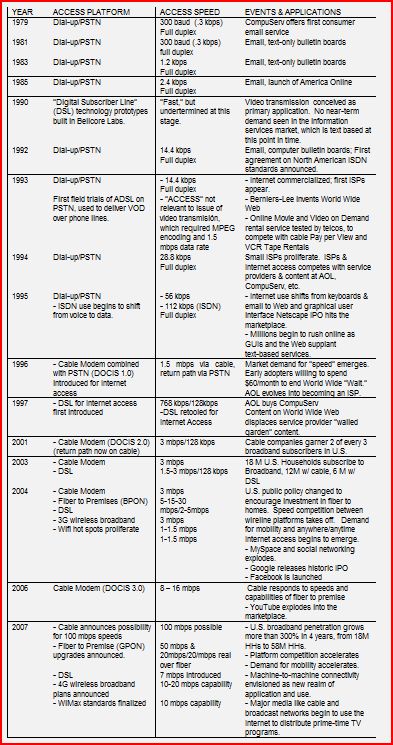
Very useful chart over on the Verizon policy blog put together by Link Hoewing and Larry Plumb. Link uses it illustrate the changes we have seen over the past three decades in terms of Internet access platforms and speeds. It’s too small to read here, so make sure to go there to see it more clearly and also see Link’s interesting discussion.
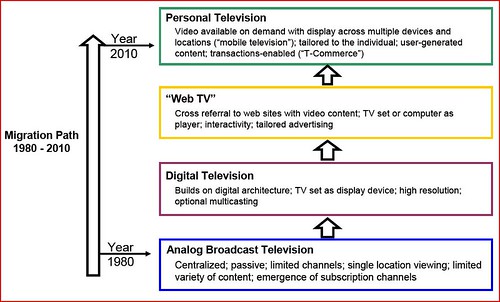
Progress & Freedom Foundation released a new report this week entitled “A Primer on the US Mobile Television Market,” by Joseph S. Kraemer, Ph.D., who is an Adjunct Fellow at PFF and a Director at Law and Economics Consulting Group. It’s not a policy piece; it just focuses on the projected growth of the mobile television marketplace over the next few years. Kraemer explains why “mobile video is forecasted to explode over the next four or five years.” He notes that it is the logical evolution of the television marketplace:
mobile digital television is a logical extension of the digitally-driven development of television from passive entertainment to an interactive, high value, versatile medium. Each stage builds upon the set of earlier stages. “Personal television” adds functionality and value to “web TV” which did the same to “digital television” which, in turn, did the same to “analog broadcast television.” The development process is additive and cumulative. Although critically important, mobile television is just one aspect of the evolving “personal television” stage.
 Continue reading →
 Verizon’s Tom Tauke and NCTA’s Kyle McSlarrow take to fisticuffs in their comments (well worth reading and remarkably… candid) on the Verizon Policy Blog after Tom asked “Will Cable and FCC Thwart Consumer Choice?” In case you missed it, Verizon has been feuding with cable providers before the FCC about Verizon’s practice of calling customers who ask to cancel their telephone service and offering them incentives to stay with Verizon rather than switch to a cable VoIP service.
Adam Thierer very capably addressed this subject several months ago:
there are two issues here: (1) Is Verizon technically violating any existing FCC regulations; and (2) do those rules make any sense?
I’ll leave it to the legal beagles to sort out the answer to question #1. From my perspective, the more important question is, regardless of what the regs say, what’s the impact of all this is on consumers and competition? On that point, it’s hard for me to see how those old number portability regulations make sense if they limit the ability of incumbents to play hard-ball in an attempt to retain customers. After all, that’s what we should want more of in the marketplace: good ol’ fashion head-to-head, facilities-based competition….
Bottom line: the FCC should be careful about regulating customer inducements by incumbents whether those offers happen before or after the porting process. The better approach would be to make sure that the incumbents can offer whatever inducements they want but then also make sure that rivals have a clear opportunity to respond and beat the offer.
Amen!
PFF has just releasing an updated edition of my booklet on “Parental Controls and Online Child Protection: A Survey of Tools & Methods.” The new version, Version 3.0, includes two new appendixes and updates to each section to reflect new parental control tools and programs developed in the last nine months.
The updated report is timely as it comes on the heels of the recently-announced Internet Safety Technical Task Force, which is being chaired by the Berkman Center for Internet & Society at Harvard Law School. I am privileged to serve as a member of the Task Force, which is evaluating various online safety technologies and strategies and then reporting back to state attorneys general with our findings.
Those issues and much more are covered in the latest edition of my report. The report explores the market for parental control tools, rating schemes, education efforts, and initiatives aimed at promoting online child safety. I believe that the parental controls and content management tools cataloged in the report represent a better, less restrictive alternative to government regulation. As I conclude after evaluating that state of the market: “There has never been a time in our nation’s history when parents have had more tools and methods at their disposal to help them decide what constitutes acceptable media content in their homes and in the lives of their children.”
Version 3.0 of the special report, now over 200 pages, contains over fifty exhibits and numerous updates in all five sections of the book. Major updates have been made to the Internet, social networking, and mobile media sections, reflecting the growing importance of those sectors and issues. A greatly expanded section on video empowerment technologies has also been included. Finally, two appendices have also been added: a comprehensive legislative index cataloging over thirty bills introduced in Congress on these issues (complied with John Morris of Center for Democracy & Technology), and a glossary of 35 relevant terms and cases.
The report is available free-of-charge on the PFF website, as are the previous editions. And I am happy to provide hard copies to those who are interested.
http://documents.scribd.com/ScribdViewer.swf?document_id=2887320&access_key=key-um5xjvf98bfnuu8811v&page=&version=1&auto_size=true
PFF has just released my latest paper entitled “Parental Control Perfection? The Impact of the DVR and VOD Boom on the Debate over TV Content Regulation.” In the report, I focus on the extent to which new video technologies, such as digital video recorders (DVRs) and video on demand (VOD) services, are changing the way households consume media and are helping parents better tailor viewing experiences to their tastes and values. I provide evidence showing the rapid spread of these technologies and discuss how parents are using these tools in their homes. Finally, I argue that these developments will have profound implications for debates over the regulation of video programming. As parents are given the ability to more effectively manage their family’s viewing habits and experiences, it will lessen—if not completely undercut—the need for government intervention on their behalf.
This 16-page report can be found at: http://www.pff.org/issues-pubs/pops/pop14.20DVRboomcontentreg.pdf

 The Technology Liberation Front is the tech policy blog dedicated to keeping politicians' hands off the 'net and everything else related to technology.