A headline in the USA Today earlier this week screamed, “Hello, Big Brother: Digital Sensors Are Watching Us.” It opens with an all too typical techno-panic tone, replete with tales of impending doom:
Odds are you will be monitored today — many times over. Surveillance cameras at airports, subways, banks and other public venues are not the only devices tracking you. Inexpensive, ever-watchful digital sensors are now ubiquitous.
They are in laptop webcams, video-game motion sensors, smartphone cameras, utility meters, passports and employee ID cards. Step out your front door and you could be captured in a high-resolution photograph taken from the air or street by Google or Microsoft, as they update their respective mapping services. Drive down a city thoroughfare, cross a toll bridge, or park at certain shopping malls and your license plate will be recorded and time-stamped.
Several developments have converged to push the monitoring of human activity far beyond what George Orwell imagined. Low-cost digital cameras, motion sensors and biometric readers are proliferating just as the cost of storing digital data is decreasing. The result: the explosion of sensor data collection and storage.
Oh my God! Dust off you copies of the
Unabomber Manifesto and run for your shack in the hills!
No, wait, don’t. Let’s instead step back, take a deep breath and think about this. As the article goes on to note, there will certainly be many benefits to our increasing “sensor society.” Advertising and retail activity will become more personalized and offer consumers more customized good and services. I wrote about that here at greater length in my essay on “Smart-Sign Technology: Retail Marketing Gets Sophisticated, But Will Regulation Kill It First?” More importantly, ubiquitous digital sensors and data collection/storage will also increase our knowledge of the world around us exponentially and do wonders for scientific, environmental, and medical research.
But that won’t soothe the fears of those who fear the loss of their privacy and the rise of a surveillance society in which our every move is watched or tracked. So, let’s talk about what those of you who feel that way want to do about it.
Continue reading →
While I was away at Oxford University last week, a USA Today story ran entitled “Online Hate Speech: Difficult to Police… and Define.” The author, Theresa Howard, was kind enough to call me for comment on the issue before I left and I made two general points in response to her questions about how serious online hate speech was and how we should combat it:
(1)
“The Internet is a cultural bazaar. It’s the place to find the best and worst of all human elements on display.” What I meant by that, quite obviously, is that you can’t expect to have the most open, accessible communications platform the world has ever known and not also have a handful of knuckleheads who use it spew vile, hateful, ridiculous comments. But we need to put things in perspective: Those jerks represent only a very, very small minority of all online speech and speakers. Hate speech is not the norm online. The overwhelmingly majority of online speech is of a socially acceptable — even beneficial — nature.
(2)
“When advocacy groups work together and use the new technology at their disposal, they have a way of signaling out bad speech and bad ideas.” What I meant by that was that the best way to combat the handful of neanderthals out there that spew hateful garbage is to: (a) use positive speech to drown out hateful speech, and (b) encourage websites to self-police themselves or use community policing techniques to highlight hateful speech and encourage the community to fight back. Importantly, this process is reinforcing. When online communities “flag and tag” objectionable or hateful content, it is easier for better site policing to occur, for social norms to develop, and for better speech to be targeted at that bad speech. Moreover, these new tools and methods are helping groups like the Anti-Defamation League and the National Hispanic Media Coalition to better identify hate speech and then channel their collective energy and efforts to unite the rest of the online community against those hateful speakers and sites.
I think this approach makes more sense than calling in governments to police online hate speech through censorship efforts. This is especially the case because, at the margins, “hate speech” can often be tricky to define and, at least in the United States, regulatory efforts could conflict with legitimate free speech rights. Again, the best way to deal with and marginalize such knuckleheads is with more and better speech. Fight stupidity with sensibility, not censorship.
Today’s USA Today features a debate between the editors and me on the question of the impact media has on children and what should be done about it. Their editorial argues that “Today’s mass media penetrate deeply and quietly, inflicting real damage on young children, an increasing body of research shows.” Specifically, they are referring to a new study commissioned by Common Sense Media (CSM), which claims that a review of 173 studies shows “that a strong correlation exists between greater exposure and adverse health outcomes.”
In my response entitled “Don’t Scapegoat Media,” which appears in its entirety down below the fold, I argue that “Media have long been a convenient scapegoat for the woes of the world,” and that we must be careful not to assume correlation equals causation when surveying the impact of media on kids. After all, I argue, “how do [those studies] account for the other variables that influence youth development, including broken homes, bad parents, socioeconomic status, troubled peer relations, poor schools and so on? And how is media exposure weighted relative to these other influences? Is a beer ad really as much of a negative influence as an alcoholic parent?” Again, read my entire response below. [Of course, even if one assumes some media has an impact on some kids, there are plenty of ways for parents and guardians to take control over the media in their lives, as I have shown in my big book on the subject.]
I was also quoted in this Washington Post article about the new CSM study on Tuesday.
Continue reading →
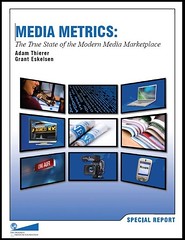 Faithful readers will recall that, several months ago, I penned a 7-part “Media Metrics” series that took a hard look at the health of the media marketplace. Today, the Progress & Freedom Foundation is releasing a greatly expanded version of these essays that I have put together with my PFF colleague Grant Eskelsen. In this 100-page special report, “Media Metrics: The True State of the Modern Media Marketplace,” we begin by noting that heated debates about the state of the media marketplace continue to rage in Washington, and opinions seem to range from grim to outright apocalyptic. As we note on pg. 1:
Many people—including a large number of legislators and regulators—argue that America’s media marketplace is in a miserable state. Some claim that citizens lack choice in media outlets and that options are just as scarce as ever. Others believe that media “localism” is dead or that many groups or niches go underserved because of a lack of true “diversity” in media. Others argue that the market is hopelessly over-concentrated in the hands of a few evil media barons who are hell-bent on force-feeding us corporate propaganda. And still others say that the quality of news and entertainment in our society has deteriorated because of a combination of all of the above. It all sounds quite troubling, but is any of it true?
After taking an objective look at the true state of America’s media marketplace, we conclude that such pessimism is unwarranted. Indeed, a careful review of the facts reveals that—contrary to what those media critics suggest—we have more media choice, more media competition, and more media diversity than ever before. Indeed, to the extent there was ever a “golden age” of media in America, we are living in it today. The media sky has never been brighter and it is getting brighter with each passing year.
Continue reading →
The USA Today editorial board published a nasty piece today belittling MySpace.com’s recent efforts to implement more safeguards for its users. Despite the fact that MySpace made over 70 promises to the Attorneys General as part of the agreement–the entire agreement is summarized here–that’s still not good enough for the USA Today’s editorial board, which wants full-blown identity verification before anyone is allowed on a social networking site:
“Even in the absence of a perfect software solution, interim steps are possible. How about using databases of drivers’ licenses to cross-check ages? In more than 20 states, they are public records. The point is, more effective safeguards are needed now, …. MySpace [should be] moving faster to set up age and ID verifications, not just study them.”
Well, where do I begin? I get so frustrated when I see comments like this because it is abundantly clear to me that people don’t think things through when it comes to age verification. As I pointed out in my lengthy PFF report, “Social Networking and Age Verification: Many Hard Questions; No Easy Solutions,” age verification is extremely complicated, and it would be even more complicated in this case because public officials are demanding the age verification of minors as well as adults, which presents a wide array of special challenges and concerns.
What Age Verification Really Is: The Death of Online Anonymity
We need to begin by understanding what age verification really is. By definition, mandatory age verification represents an effort to make online anonymity a crime. In simple terms, citizens would be forced to “show their papers” at the door of every website or else run the risk of being denied access–simply because they do not want to surrender their name or age.
Think about what that means. It’s easy to take the benefits of online anonymity for granted. There are millions of people who comment anonymously on blogs like this one every day, or write anonymous book or product reviews on Amazon.com or eBay, or who just chat with others about various topics under the cloak of anonymity. It is a wonderful thing.
Continue reading →
This morning in New York City, social networking website operator MySpace.com announced a major joint effort with 49 state Attorneys General aimed at better protecting children online. (Coverage at CNet, NYT and Forbes). At a joint press conference, MySpace and the AGs unveiled a “Joint Statement on Key Principles of Social Networking Safety” involving expanded online safety tools, improved education efforts, and law enforcement cooperation. They also agreed to create an industry-wide Internet Safety Technical Task Force to study online safety tools, including a review of online identity authentication technology.
 Generally speaking, the agreement is step forward for online safety. Indeed, many of the principles in the agreement could form a potential model “code of conduct” that other social networking sites could adopt. In a report I authored for the Progress & Freedom Foundation in August 2006, I argued that it was vital for companies and trade associations to take steps such as this to avoid the specter of government regulation or censorship:
All companies doing business online… must show policymakers and the general public that they are serious about addressing [online safety] concerns. If companies and trade associations do not step up to the plate and meet this challenge soon—and in a collective fashion—calls will only grow louder for increased government regulation of online speech and activities. What is needed is a voluntary code of conduct for companies doing business online. This code of conduct, or set of industry “best practices,” would be based on a straight-forward set of principles and policies that could be universally adopted by [a] wide variety of operators…
In particular, this code of conduct proposal called for companies to make specific pledges regarding improved online safety tools, expanded education / media literacy efforts, and ongoing assistance to law enforcement regarding investigations of online crimes.
Continue reading →
As Braden mentioned, we were both down in Raleigh, North Carolina this week testifying at a big hearing on mandatory age verification for social networking sites.
It was quite a heated battle. The legislation, SB 132, was supported at the hearing by North Carolina attorney general Roy Cooper, several of his staff attorneys, a couple of NC senate lawmakers, and some folks from Aristotle, a company that claims it has devised a workable age verification solution for social networking purposes. A vote on the proposal was delayed and we’re still awaiting the final outcome.
Down below, I have attached the outline of my remarks in which I argued that age verification mandates would actually make kids
less safe online. Here’s why:
Continue reading →
I’m putting the wraps on a big paper on the dangers of mandating age verification for social networking websites. One of the questions I ask in the study is exactly how broadly “social networking sites” will be defined for purposes of regulation? Will chat rooms, hobbyist sites, listservs, instant messaging, video sharing sites, online marketplaces or online multiplayer gaming sites qualify? If so, how will they be policed and how burdensome will age-verification mandates become for smaller sites? Finally, does the government currently have the resources to engage in such policing activities since almost all websites now have a social networking component? I explore these and other questions in my paper.
But now I have another type of site to add to list, and not one that I originally gave much consideration to: online newspapers. Over the weekend, the
USA Today relaunched its website, not only to freshen up its look, but also to fundamentally change the ways the site works. According to the editors, the new features of the site will give readers the ability to:
Continue reading →

 The Technology Liberation Front is the tech policy blog dedicated to keeping politicians' hands off the 'net and everything else related to technology.