If you’re in the D.C. area, come join the fun next Monday, November 15th, as the Advisory Committee on Transparency kicks off with its first event: The Future of Earmark Transparency (2:00 p.m., 2203 Rayburn House Office Building).
The Sunlight Foundation’s Daniel Schuman moderates a discussion that includes Steve Ellis of Taxpayers for Common Sense and yours truly. My WashingtonWatch.com project crowdsourced over 40,000 earmark requests last year, which we displayed on this map.
Earmarks are a hot topic right now. The new Republican Congress may make a move to ban them, but the Senate leadership may not be ready to go quite that far.
Will full-fledged earmark transparency be the compromise? It might provide a model for far more transparent processes throughout Congress.
Rep. Darrell Issa (R-CA) has a terrific op-ed piece on Internet-age government transparency in the Washington Times today:
If agencies used consistent data formats for their financial information, their financial reports could be electronically reconciled. It would be possible to trace funds from Congressional appropriations through agencies’ budgets to final use. The same data could flow automatically into USASpending.gov, without the errors and inconsistencies that make it unreliable today.
The idea is simple, if not easy to implement. Put government data in uniform formats, accessible to the public, and let public oversight work its will. Whether you prioritize good government, small government, or both, expect improvement.
Carl Malamud is a breakthrough thinker and doer on transparency and open government. In the brief video below, he makes the very interesting case that various regulatory codes are wrongly withheld from the public domain while citizens are expected to comply with them. It’s important, mind-opening stuff.
It seems a plain violation of due process that a person might be presumed to know laws that are not publicly available. I’m not aware of any cases finding that inability to access the law for want of money is a constitutional problem, but the situation analogizes fairly well to Harper v. Virginia, in which a poll tax that would exclude the indigent from voting was found to violate equal protection.
Regulatory codes that must be purchased at a high price will tend to cartelize trades by raising a barrier to entry against those who can’t pay for copies of the law. Private ownership of public law seems plainly inconsistent with due process, equal protection, and the rule of law. You’ll sense in the video that Malamud is no libertarian, but an enemy of an enemy of ordered liberty is a friend of liberty.
http://www.youtube.com/v/fht7mujzeC8?fs=1&hl=en_US
In a post here last month on “Two Paradoxes of Privacy Regulation,” I discussed some of the interesting — and to me, troubling — similarities between rising calls for online privacy regulation and ongoing attempts to enact various types of controls on online speech or expression. In that essay, I argued that while most privacy advocates are First Amendment supporters as it pertains to content regulation, they abandon their free speech values and corresponding constitutional tests when it comes to privacy regulation. When the topic of debate shifts from concerns about potentially objectionable content to the free movement of personal information, personal responsibility and self-regulation become the last option, not the first. Privacy advocates typically ignore, downplay, or denigrate user-empowerment tools, even though many of those same advocates endorse “self-help” efforts as the superior method of dealing with objectionable speech or media content. In essence, therefore, they are claiming self-help is the right answer in one context, but not the other. Ironically, therefore, privacy advocates and moral conservatives actually share much in common in that they are using the same playbook to advance their goals: They are rejecting personal responsibility and user-empowerment tools and techniques in favor or government control for their respective issues.
Keeping that insight in mind, I want to take this comparison a step further and suggest that what really unites these two movements is a general conservatism about how our online lives and online business should be governed. For the moral conservatives, that instinct is well-understood. They want hold the line against what they believe is a decaying moral order by restricting access to potentially objectionable speech or content — dirty words, violent video games, online porn, or whatever else. The conservatism of the modern privacy movement is less obvious at first blush. I suspect that many privacy conservatives would not consider themselves “conservative” at all, and they might even be highly offended at being grouped in with moral conservatives who seek to wield government power to control online speech and expression. Nonetheless, the two groups share a common trait —
an innate hostility to the impact of technological / social change within the realm of “rights” or values they care about. In their respective arenas, they both rejected the evolutionary dynamism of the free marketplace and they long for a return to a simpler and supposedly better time. Continue reading →
Taxpayers Against Earmarks is a new effort to rid the federal legislative process of some of its most acute horse-trading: earmarks. Find it at the cleverly named URL, EndingSpending.com.
My project WashingtonWatch.com has worked to generate earmark transparency. Here’s the earmarks main page, and you should expect to see FY 2011 earmarks there soon.
 There’s little doubt that many spending earmarks are part of a subtle—or not-so-subtle—quid pro quo in which federal legislators buy votes by directing funds to favored home-state or home-district interests. Taxpayers Against Earmarks has a well-produced web site that invites people to sign up and join the anti-earmark effort.
Earmarked spending is a small part of the overall budget, of course, but earmarking is emblematic of the “favor factory” that Congress has become as the federal budget and federal power have bloated. Federal spending is appropriate in the small number of cases when it provides national public goods that benefit the country as a whole, but refurbishing local museums, funding projects at state universities, and requiring the military to buy from a particular defense contractor do not benefit the general welfare. Taxpayers Against Earmarks is working to begin the process of getting federal spending under control.
J. C. R. Licklider (1915-1990) was early to expound on the potential of computing. His papers “Man-Computer Symbiosis” and “The Computer as a Communications Device” (both collected here) foresaw many of the uses we make of computers and the Internet today.
In Where Wizards Stay Up Late: The Origins of the Internet, Katie Hafner and Matthew Lyon write about “Lick’s” vision for computing’s influence on society:
In a McLuhanesque view of the power of electronic media, Lick saw a future in which, thanks in large part to the reach of computers, most citizens would be “informed about, and interested in, and involved in, the process of government.” He imagined what he called a “home computer console” and television sets linked together in a massive network. “The political process,” he wrote, “would essentially be a giant teleconference, and a campaign would be a months-long series of communications among candidates, propagandists, commentators, political action groups, and voters.”
My project WashingtonWatch.com is one of several efforts, however rudimentary, seeking to realize this vision. We’re working on it, Lick.
The Obama administration seems to be working to pull defeat from the jaws of victory on the president’s “Sunlight Before Signing” campaign promise. Whitehouse.gov sometimes posts bills as “pending” before they get out of Congress, when it’s premature to ask the public for a final review.
The problem is particularly acute today, as I note in a Cato@Liberty post:
H.R. 1586 is a “shell bill” that Congress has been batting back and forth, and it has covered various subject matters in its busy life. It indeed started out as a bill to tax the bonuses of executives in TARP-subsidized firms. When it passed the House, though, it had become the “Aviation Safety and Investment Act of 2010.” And this week it was amended in the Senate to contain a potpourri of spending and revenue programs. (WashingtonWatch.com cost estimate: $125 per U.S. family.)
 Lets say a high schooler has been assigned by her teacher to monitor the bills President Obama receives from Congress. From the White House’s pending legislation page, she clicks on a link to find a bewildering hodgepodge of bill versions on the Thomas page for the bill. (Click on the image at right to see a screen capture.)
And none of the bill versions has passed Congress! Thomas, the Library of Congress’ legislative tracking service, tells visitors that the last bill listed is most recent. But the current version of the bill is item four of six, referrred to as the “XXXXXXAct ofXXXX.” Thanks to Whitehouse.gov, our high schooler is misled into believing that President Obama will soon sign a tax on bonsuses given to TARP-slurping executives when in fact a variety of other policies may soon pass.
Lets say a high schooler has been assigned by her teacher to monitor the bills President Obama receives from Congress. From the White House’s pending legislation page, she clicks on a link to find a bewildering hodgepodge of bill versions on the Thomas page for the bill. (Click on the image at right to see a screen capture.)
And none of the bill versions has passed Congress! Thomas, the Library of Congress’ legislative tracking service, tells visitors that the last bill listed is most recent. But the current version of the bill is item four of six, referrred to as the “XXXXXXAct ofXXXX.” Thanks to Whitehouse.gov, our high schooler is misled into believing that President Obama will soon sign a tax on bonsuses given to TARP-slurping executives when in fact a variety of other policies may soon pass.
The phrase, “well, 26 times, but who‘s counting?” has 26 letters and numbers in it. Each one in this Cato@Liberty blog post about the Obama administration’s moves toward implementing Sunlight Before Signing is a link to another post about Sunlight Before Signing. I do like to entertain me.
Recall that President Obama promised on the campaign trail that he would post bills Congress sends him online for five days before he signs them. His early performance was not good, but he’s improving and Whitehouse.gov took major steps in the last few weeks to advance the ball.
There are now RSS feeds on Whitehouse.gov’s new “pending legislation” page—the stuff getting that sunlight—as well as on the “signed legislation” and “vetoed legislation” pages. Readers of this blog certainly know how feeds can propagate information.
As I said in my C@L post, “A habit of civic awareness can take root thanks to these RSS feeds . . . . We’ll have a more engaged, self-governing citizenry as a result.”
Won’t you help with that process by using these feeds yourself, and by promoting them to others by writing about the feeds, forwarding this post, reTweeting and so on?
Thanks!
Sincerely,
Democracy
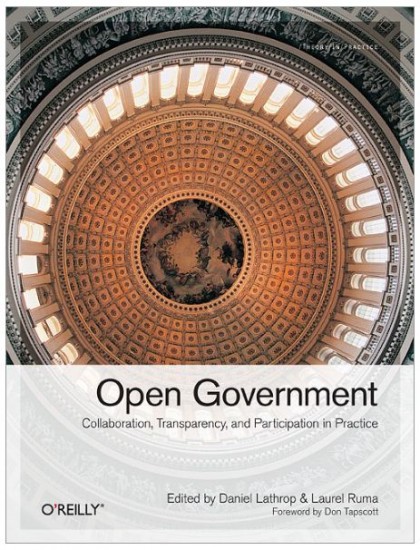 Those of you interested in transparency and “Government 2.0” issues will absolutely want to pick up Open Government: Collaboration, Transparency, and Participation in Practice, a terrific collection of 34 essays edited by Daniel Lathrop and Laurel Ruma. Much like Access Controlled, the collection of essays on global Internet filtering and censorship that I praised here last month, Open Government is a resource like no other in its field. It offers an amazing diversity of viewpoints covering virtual every aspect of the debate over transparency and open government.
The collection was published by O’Reilly Media and Tim O’Reilly himself has one of the best chapters in the book on “Government as a Platform.” “The magic of open data is that the same openness that enables transparency also enables innovation, as developers build applications that reuse government data in unexpected ways.” (p. 25) This explains why in their chapter on “Enabling Innovation for Civic Engagement,” David G. Robinson, Harlan Yu, and Edward W. Felten, of the Center for Information Technology Policy at Princeton University, speak of “a new baseline assumption about the public response to government data: when government puts data online, someone, somewhere will do something valuable and innovative with it.” (p.84) “By publishing its data in a form that is free, open, and reusable,” they continue, “government will empower citizens to dream up and implement their own innovative ideas of how to best connect with their governments.” (p. 89)
Indeed, just think about some of the many exciting sites and projects (both public and private) that have been developed thanks to government data becoming more accessible in recent years. Here’s a short list of some of the best: Continue reading →
I’ll present a short paper and lead some discussion on federal spending transparency tomorrow at an OMB Watch conference entitled “Strengthening Federal Spending Transparency: A Working Conference to Develop a Plan of Action.”
My paper is called “Federal Spending Transparency: Unlocking the Power of Abstraction.” It builds on lessons I learned from developing the Earmarkdata.org model aimed at getting earmark information out of Congress.
Information scientists will find the paper amateurish and riddled with imperfections. Policy people will find it obscure and dense. That’s what you get when you translate between two languages and cultures.
The goal:
Each piece of the policy making process—the budgets, bills, votes, etc.—should originate as structured data, feeding directly into the information infrastructure that the transparency community creates. A budget should come out not just in paper and PDF versions, but as a data set containing all the meaning that exists in the physical documents.
Make sense? If not, you’ll want to get yourself to where it does.


 The Technology Liberation Front is the tech policy blog dedicated to keeping politicians' hands off the 'net and everything else related to technology.