Wow, what a year for cyberlaw and information technology policy books! Both in terms of number of titles and the gravity of the books released, 2010 was one of the biggest years of the past decade (perhaps matched only by 2006 or 2008 in terms of significance). So, here’s my annual list of the Most Important Info-Tech Policy Books of 2010.
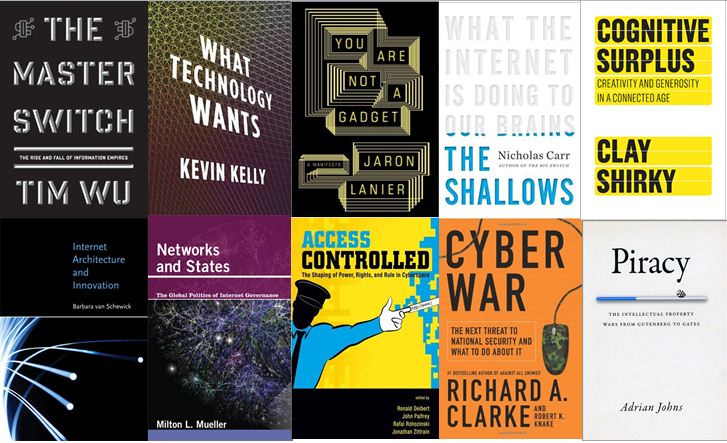 First, however, as is the case each year [see my 2008 & 2009 lists], I need to repeat a few disclaimers. First, what qualifies as an “important” info-tech policy book is highly subjective, but I would define it as a title that many people — especially scholars in the field — are currently discussing and that we will likely be referencing for many years to come. But I “weight” books in the sense that narrowly-focused titles lose a few points. For example, books that deal mostly with privacy issues, copyright law, or antitrust policy do not exactly qualify as the same sort of “info-tech policy book” as other titles that offer a broader exploration of policy issues / concerns. For that reason, “big picture” info-tech policy books tend to rank higher on my lists.
The second caveat: Merely because a book appears on my list
it does not necessarily mean I agree with everything in it. In fact, as was the case in previous years, I found much with which to disagree in my picks for the most important books of 2010 and I find that the cyber-libertarianism I subscribe to has very few fans out there.
With those caveats in mind, here are my choices for the Most Important Info-Tech Policy Books of 2010. Continue reading →
Former TLF blogger Tim Lee returns with this guest post. Find him most of the time at the Bottom-Up blog.
Thanks to Jim Harper for inviting me to return to TLF to offer some thoughts on the recent Adam Thierer–Tim Wu smackdown. I’ve recently finished finished reading The Master Switch, and I didn’t have have my friend Adam’s viscerally negative reactions.
To be clear, on the policy questions raised by
The Master Switch, Adam and I are largely on the same page. Wu exaggerates the extent to which traditional media has become more “closed” since 1980, he is too pessimistic about the future of the Internet, and the policy agenda he sketches in his final chapter is likely to do more harm than good. I plan to say more about these issues in future writings; for now I’d like to comment on the shape of the discussion that’s taken place so far here at TLF, and to point out what I think Adam is missing about The Master Switch.
Here’s the thing: my copy of the book is 319 pages long. Adam’s critique focuses almost entirely on the final third of the book, (pages 205-319) in which Wu tells the history of the last 30 years and makes some tentative policy suggestions. If Wu had published pages 205-319 as a stand-alone monograph, I would have been cheering along with Adam’s response to it.
But what about the first 200-some pages of the book? A reader of Adam’s epic 6-part critique is mostly left in the dark about their contents. And that’s a shame, because in my view those pages not only contain the best part of the book, but they’re also the most libertarian-friendly parts.
Those pages tell the history of the American communications industries—telephone, cinema, radio, television, and cable—between 1876 and 1980. Adam only discusses this history in one of his six posts. There, he characterizes Wu as blaming market forces for the monopolization of the telephone industry. That’s not how I read the chapter in question. Continue reading →
OK, so I’ve spent a week harassing Tim Wu and hammering away at the thesis, conclusions, and recommendations found in his new book, The Master Switch: The Rise and Fall of Information Empires. After pouring out about 17,000 words across six essays [1, 2, 3, 4, 5, 6] over the past week, I want to thank Tim for not seeking a restraining order against me for being his cyber-stalker during this period! Moreover, he has responded to several of my rants here with stoic dignity. I appreciate that, too. I would have been screaming mad if someone attacked one of my books this relentlessly!
Anyway, in the spirit of fair play, I want to offer Professor Wu the opportunity to respond more formally here on the
Tech Liberation Front. We need to do more of that here, and I feel bad that I didn’t make available to Jonathan Zittrain a similar opportunity when I was stalking him after the release of The Future of the Internet and How to Stop It. (see 1, 2, 3, 4, 5, 6, 7, 8 + video!) I am happy, however, that Jerry Brito posted here today this podcast he did with Prof. Wu so that we could hear him in his own words.
Anyway, I’ve just sent a note to Tim extending an invitation to formally respond even if he chooses to just compile some of the other comments he’s already made here, or to post something more substantive (even excerpts from the book). If he decides to take us up on the offer, I’ll post it his comments here. In the meantime, I want to encourage people to buy Tim’s book and judge it for themselves. Despite my deep disagreements with The Master Switch, it’s absolutely one of the most important information technology policy books of the past decade and it belongs on your bookshelf if you care about these issues. And I look forward to many more friendly fights with Tim in the future!
I’m going to close out my series of essays about Tim Wu’s new book, The Master Switch: The Rise and Fall of Information Empires, by discussing his proposed solutions. In the first five essays in the series, [1, 2, 3, 4, 5] I’ve critiqued Wu’s look at information history as well as his use of terms like “market failure,” “laissez-faire” and “open” vs. “closed.” I argued there’s a great deal of over-simplification, even outright distortion, in his use of those terms throughout the book.
Anyway, let’s run through the basics of the book once more before getting to Wu’s proposed solutions. By my reading of
The Master Switch, Wu’s argument essentially goes something like this:
- Information industries go through cycles. After a period of “openness” and competition, they tend to drift toward “closed,” corporate-controlled, anti-consumer models and outcomes.
- The resulting “monopolists” then block much innovation, competition, and free speech.
- Consequently, “the purely economic laissez-faire approach… is no longer feasible.”
- Moreover, information industries are more important than all others (“information industries… can never be properly understood as ‘normal’ industries”) and even traditional forms of regulation, including antitrust, “are clearly inadequate for the regulation of information industries.” (p. 303).
- Thus, special rules should apply to information-related sectors of our economy.
Again, I’ve challenged some of these assertions in my previous essays, specifically, Wu’s incomplete history of cycles and the fact that he greatly underplays the role of governments in “locking-in” sub-optimal market structures or, worse yet, creating those structures through misguided public policies or regulatory capture. Wu discusses some of those factors in his book, but he tends to regard them as secondary to the inquiry, whereas I believe they are crucial to understanding how most “closed” or anti-competitive scenarios develop or endure. Instead, Wu simplistically suggests that “the purely economic laissez-faire approach… is no longer feasible,” even though no such state of affairs has ever existed within communications or media industries. They have been subjected to varying levels of indirect influence or direct control almost since their inception.
Regardless, what does Tim Wu want done about the problems he has (mis-)diagnosed? Continue reading →
I want to thank Tim Wu for continuing to engage in a discussion here about his book, The Master Switch, with his various comments to my ongoing rants. After pouring out about 15,000 words over the past 4 days, I suspect I’m beginning to sound a bit like his cyber-stalker! I feel a bit bad about this because I really do like Tim a lot and find him to be one of the all-around coolest and most laid-back guys in the Net policy business. But, as I’ve noted in my ongoing series [see parts 1, 2, 3, & 4], we have profoundly different worldviews when it comes to information history and policy. And some of the recent comments he made to my 3rd post deserve a serious response.
In one of those comments he asks, “The question, then, is how you get, essentially, limited, controlled government in regulatory affairs; how you duplicate, in some sense, the limits imposed on other dangerous gov’t functions like the army. I don’t think this is having things both ways; I think this is trying to learn from what has gone wrong in the past.” In the other, he says: “The question I’m asking in the end of the book is whether we can do better; try to have rules against the worse forms abuse without a creeping regulation that turns into capture. I suspect you think that’s impossible, but I don’t.”
So, here’s my response (and I’m making it a new, dedicated post here instead of just a comment in an old thread because I feel we are getting to the heart of the difference between cyber-libertarians (like myself) and cyber-collectivists (or whatever Tim would call himself). Continue reading →
After posting the first three installments of my ongoing look at Tim Wu’s important new book, The Master Switch: The Rise and Fall of Information Empires, [see parts 1, 2, & 3], I’ve heard back from some readers as well as Prof. Wu himself that I may be going a bit hard on him, or that I am under-appreciating some of his valid critiques. In particular, Wu and others have claimed I’ve ignored or downplayed his admission that the problem of regulatory capture is a prime culprit of “the cycle” he addresses in his book. So, let me address that point here today.
I have acknowledged that Prof. Wu’s book includes some occasional references to the problem of regulatory capture or bureaucratic bungling throughout the history of communications and media policy. In a comment to my previous post, Wu itemizes a couple of those instances, most of which I’d already cited before. But here’s probably the best passage from the book on this point:
Again and again in the histories I have recounted, the state has shown itself an inferior arbiter of what is good for the information industries. The federal government’s role in radio and television from the 1920s through the 1960s, for instance, was nothing short of a disgrace…. Government’s tendency to protect large market players amounts to an illegitimate complicity … [particularly its] sense of obligation to protect big industries irrespective of their having become uncompetitive. (p. 308)
I agree. And, as I also noted in my previous essay, I very much appreciated this footnote in chapter 3 of Wu’s book: “The technical term for such a system is ‘corporatism’: in its extreme manifestation it is called ‘fascism.” Wu is absolutely right. I applaud him for labeling this system what it really is.
But here’s what’s so damn peculiar about Wu and his book when it comes to the problem of regulatory capture and bureaucratic mismanagement: as soon as he raises it, he immediately walks away from it. There’s seemingly never any serious lesson drawn from it. Continue reading →
This is the third installment in a series of essays about Tim Wu’s new book, The Master Switch:
The Rise and Fall of Information Empires. As I noted in my first essay, Wu’s book promises to make waves in Internet policy circles, so I’m devoting some space here to debunking what I regard as some of the myths that drive his hyper-pessimistic worldview regarding the supposed death of openness. In my second essay, I challenged Wu’s view of technological “cycles” and “market failure” and noted that he paints an overly simplistic portrait of both. In a similar vein, in this installment I will address Wu’s mistaken claim that purely free markets and “laissez-faire” have guided America’s communications and media sectors over the past century.
Wu’s narrative in
The Master Switch is heavily dependent upon his retelling of the histories of several major sectors: telephony, film, broadcast radio, and cable television. After surveying the history of those sectors throughout the past century, Wu concludes that “the purely economic laissez-faire approach… is no longer feasible” (p. 303) and that a fairly sweeping new regulatory regime – which I will address in a forthcoming post – is necessary to address the imperfections of the free market.
As any serious historian of the past century of information industries knows, however, we’ve never had anything remotely resembling a “purely economic laissez-faire approach” to communications, media or information policy in this country. We’ve had a mixed system that allowed a certain degree of market activity accompanied by very heavy doses of “public interest” regulation. Indeed, the story of 20
th century communications and media markets is one of artificial barriers to entry, government (mis-)allocation of key resources (like spectrum), price controls, rate-of-return regulations, speech controls and mandates, regulatory capture, and good ‘ol boy corporatism. Continue reading →
Tim Wu was kind enough to comment on my general overview and critique of his new book, The Master Switch:
The Rise and Fall of Information Empires. That essay will be the first of many I plan to pen about Wu’s important book. I appreciate Prof. Wu being willing to engage me in a debate over some of these issues since I’m sure he has better things to do with his time. Some of the points he raised in his comment will be addressed in subsequent posts.
In this post, I want to respond briefly to his assertion that I was “missing the point of the book” which is “to describe the world we live in.” He says that his book, “suggests that we tend to go through open and closed cycles in the Information Industries, and that, roughly, both have their strengths and weaknesses, and both become popular at different times for various reasons.” But he fears there are “greater risks in the closed periods.”
Contrary to what he suggests, I certainly understand that’s the point of his book, it’s just that I don’t fully agree with his analysis or conclusions. Let me be clear about a crucial point, however: I accept that almost every industry goes through “cycles” of some sort and that, typically, after a “Wild West” period of greater “openness” and more atomistic competition, some degree of “consolidation” or more “closed” (or proprietary) models often sets in. (A somewhat different and far more descriptive interpretation of such cycles can be found in Deborah Spar’s 2001 book, Ruling the Waves: Cycles of Discovery, Chaos, and Wealth from Compass to the Internet. She outlines a more refined 4-part cycle of: Innovation, Commercialization, Creative Anarchy, and Rules.)
My primary beef with Prof. Wu is that, contrary to his assertion yesterday in commenting on my post, his book seems to regard the progression of “the Cycle” as mostly linear and one-directional: straight down toward a perfectly closed, corporate-controlled, anti-consumer Hell. By my reading of his book – much like Lessig and Zittrain’s work – Wu is painting an overly pessimistic portrait of technologies being subjected to the “perfect control” of largely unfettered markets.
I believe history – especially recent history — teaches us something very different. Continue reading →
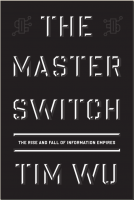 Tim Wu’s new book, The Master Switch: The Rise and Fall of Information Empires, will be released next week and it promises to make quite a splash in cyberlaw circles. It will almost certainly go down as one of the most important info-tech policy books of 2010 and will probably win the top slot in my next end-of-year list.
Of course, that doesn’t mean I agree with everything in it. In fact, I disagree vehemently with Wu’s general worldview and recommendations, and even much of his retelling of the history of information sectors and policy. Nonetheless, for reasons I will discuss in this first of many critiques, the book’s impact will be significant because Wu is a rock star in this academic arena as well as a committed activist in his role as chair of the radical regulatory activist group, Free Press. Through his work at Free Press as well as the New America Foundation, Professor Wu is attempting to craft a plan of action to reshape the Internet and cyberspace.
I stand in opposition to almost everything that Wu and those groups stand for, thus, I will be spending quite a bit of time addressing his perspectives and proposals here in coming months, just as I did when Jonathan Zittrain’s hugely important The Future of the Internet & How to Stop It was released two years ago (my first review is here and my latest critique is here). In today’s essay, I’ll provide a general overview and foreshadow my critiques to come. (Note: Tim was kind enough to have his publisher send me an advance uncorrected proof of the book a few months ago, so I’ll be using that version to construct these critiques. Please consult the final version for cited material and page numbers.) Continue reading →
TLF readers will definitely want to check out the online symposium underway over at the Concurring Opinions blog debating the thesis set forth in Jonathan Zittrain’s important 2008 book, The Future of the Internet and How to Stop It. The symposium will feature a terrific cast of thinkers, including: Steven Bellovin, Ryan Calo, Laura DeNardis, James Grimmelmann, Orin Kerr, Lawrence Lessig, Harry Lewis,Daithí Mac Síthigh, Betsy Masiello, Salil Mehra, Quinn Norton, Alejandro Pisanty, Joel Reidenberg, Barbara van Schewick and me! Regular contributors to the Concurring Opinions blog, such as Frank Pasquale, are also taking part.
Faithful readers will recall that I named Zittrain’s book the most important Internet policy book of 2008 and one of the most important books of the past decade. It’s impact has already been enormous. But I’ve also been unrelenting in my criticism of the book and Zittrain’s dour forecast for the future of Internet “openness” and digital “generativity.” Down below I have reproduced my contribution to the Concurring Opinions symposium, but I encourage you to hop over there to check out all the essays that are pouring in on this topic.


 In his opening essay in this symposium, Jonathan Zittrain ensures us that he is “not exactly a pessimist.” “I recognize, and celebrate,” he says, “the fact that the digital environment of 2010 is the coolest, most interesting, most option-filled it’s ever been.” Terrific! I am glad to hear that because the crux of my repeated critiques of his book, The Future of the Internet, over the past two years has been focused on its unrelenting – and largely unwarranted – pessimism about our possible cyber-futures. Alas, his essay on these pages still displays much of that underlying techno-pessimism and begs me to ask: Will the real Jonathan Zittrain please stand up? Continue reading →

 The Technology Liberation Front is the tech policy blog dedicated to keeping politicians' hands off the 'net and everything else related to technology.