Yesterday, the Senate passed S. 602, “The Child Safe Viewing Act of 2007,” which was introduced by Sen. Mark Pryor (D-AR) in February 2007. The bill requires the Federal Communications Commission (FCC) to study the market for “advance blocking technologies” (i.e., parental controls and rating systems) that parents can use to protect their kids from inappropriate content from various sources and platforms. On the surface, the measure seems harmless enough, but in practice, it could have some troubling long-term free speech implications if it leads to more government meddling with parental controls and ratings systems.
The measure requires the FCC to initiate a notice of inquiry to consider measures to examine:
- the existence and availability of advanced blocking technologies that are compatible with various communications devices or platforms;
- methods of encouraging the development, deployment, and use of such technology by parents that do not affect the packaging or pricing of a content provider’s offering; and
- the existence, availability, and use of parental empowerment tools and initiatives already in the market.
That all sounds harmless enough. Indeed, such a study could produce some useful information about the state of the parental controls marketplace. (Of course, I could save them some taxpayer dollars and just send copies of my big
Parental Controls & Online Child Safety report to all FCC officials!)
But it’s what comes next in the bill that causes me some heartburn. As part of the review mandated by the bill, S. 602 commands the FCC to “consider advanced blocking technologies that”:
Continue reading →
In late June, the Federal Communications Commission (FCC) opened a Notice of Inquiry and Notice of Proposed Rulemaking regarding “Sponsorship Identification Rules and Embedded Advertising” (MB Docket No. 08-90). Basically, it’s an inquiry into the product placement and embedded advertising practices on television. Some at the FCC want such practices regulated.
PFF filed comments in the matter today. Ken Ferree and I argue that that FCC regulation of such advertising practices would be unnecessary and unwise. “If the Notice demonstrates anything,” we argue, “it is that a majority of the current Commissioners live in a world wholly alien and unfamiliar to most Americans; indeed, a world long forgotten if it ever existed.” We continue:
The Notice alludes menacingly to new, “subtle and sophisticated means” of commercial messaging, to “sneaky commercials” (quoting a senescent order topped with nearly fifty-years of dust) and to “vindicat[ing]” the policy goals of the Communications Act – as if the FCC must exact vengeance on those who would try – horror of horrors – to sell goods and services to the American public. The melodramatic tone of the Notice is intended, of course, to set the stage for the Commission’s latest effort to micromanage the free marketplace of ideas, i.e., the media. Only by portraying “embedded” advertising as something new and nefarious can the Commission hope to justify a new portfolio of intrusive and burdensome speech regulations in the name of preserving the “public’s right to know who is paying to air commercials or other program matter on broadcast television and radio and cable.”
And, as we make clear in the filing, we don’t buy the argument that the public are nothing more than mindless sheep:
Continue reading →
Just FYI, the latest update of my booklet on “Parental Controls and Online Child Protection: A Survey of Tools & Methods” is now live. The new version, Version 3.1, provides minor updates to all sections of the book and a new appendix of relevant research in the field. I issue major updates early each year and 1 or 2 tweaks during the course of the year to reflect the evolution of the parental control and online child safety market and debate. 
For those not familiar with the report, it explores the market for parental control tools, rating schemes, education efforts, and initiatives aimed at promoting online child safety. I believe that the parental controls and content management tools cataloged in the report represent a better, less restrictive alternative to government regulation. As I conclude after evaluating that state of the market: “There has never been a time in our nation’s history when parents have had more tools and methods at their disposal to help them decide what constitutes acceptable media content in their homes and in the lives of their children.”
The report is available free-of-charge on the PFF website, and the previous editions of the report are housed there too in case you want to see how it has evolved over the past two years. For those interested in taking a quick look at the report, I have embedded it down below the fold as a Scribd file. Finally, as is always the case, I encourage readers to send me updates and suggestions for how to improve the report and I will incorporate them into future versions.
Continue reading →
Haven’t they been punished enough? Inmates in our nation’s prisons may find themselves without over-the-air television next February, unless Congress acts to fill a gap in the subsidy program for TV converter boxes. That’s right: according to a story run last week by Associated Press, “the upcoming switch to digital television is presenting a challenge to prison officials who want to make sure prison TVs are up and running. When broadcasters make the switch in February, televisions that aren’t hooked up to cable, satellite or a converter box will be reduced to static”.
The reason? Under the converter box subsidy program established by Congress, prisons are not eligible for the $40 subsidy for the converter boxes needed to let old televisions pick up broadcast signals after next February. That means — unless prison officials somehow find $40 elsewhere — or unless their penal institution has a cable or satellite subscription — incarcerated murderers and thieves will be
forced to watch static.
Honest to god. I’m not making this up. This was an actual news story. The AP story went on to explain that “[w]hile TV might seem like an undeserved luxury for inmates, both prison officials and prisoners said the tube provides a sense of normalcy.”
Oh, now I understand. “Normalcy.” I didn’t understand that prison is supposed to provide a sense of normalcy.
Excuse me while I sit in stunned silence for a moment.
One interesting side note. I found the AP story on the website of WYFF in Greenville, SC, which — perhaps not surprisingly — is an over-the-air TV station. Go figure.
 Having covered free speech and media policy issues for many years now, one of the arguments I hear a lot is that we moderns have an unnatural fascination with murder, mayhem, and violence as well as gossip and celebrities. Social critics and proponents of media content regulation often wax nostalgic about the supposed “good ol’ days” when all we thought and talked about was enlightened and enriching topics.
It’s all complete nonsense. Anyone who has seriously studied our nation’s history — or, for that matter, the history of any country or civilization — knows that we humans have
always been fascinated by the morbid and tales of debauchery, especially when those tales involve public officials or celebrities.
I was reminded of this again today when reading two articles in the
Washington Post.
Continue reading →
Lately I’ve been writing about potentially historic upcoming First Amendment case of FCC v. Fox Television Stations. The Supreme Court will hear the case on Tuesday, November 4th. All the briefs in the case are in and can be found on the ABA website here. But I’ve pasted the links for all of them below as well. In coming days and weeks I might be highlighting some of the comments from the briefs. [The docket number for the case is 07-582]. The amicus brief I filed with my friends at CDT can be found here, and I wrote about it last week here on the TLF.
The
FCC v. Fox case is the indecency case involving the FCC’s new policy for “fleeting expletives.” I wrote about the Second Circuit Court of Appeals decision here. The full decision is here. The FCC v. Fox case could become the most important First Amendment-related Supreme Court case since FCC v. Pacifica Foundation, which just turned 30 years old last month. Anyway, here are all the briefs in the case, starting with the merit briefs by the lead parties:
Continue reading →
 Along with my friends John Morris and Sophia Cope of the Center for Democracy & Technology, I have just submitted an amicus brief to the Supreme Court in the potentially historic free speech case FCC v. Fox, which will be heard in November.
[Reminder: The
FCC v. Fox case is the indecency case involving the FCC’s new policy for “fleeting expletives.” I wrote about the Second Circuit Court of Appeals decision here. The full decision is here. By contrast, the so-called “Janet Jackson case” — CBS v. FCC — took place in the Third Circuit Court of Appeals and that court recently handed down a decision that also went against the FCC. I wrote about the Third Circuit’s decision here.]
The
FCC v. Fox case could become the most important First Amendment-related Supreme Court case since FCC v. Pacifica Foundation, which just turned 30 years old last month. Of course, it could be that the Supreme Court simply sticks to the procedural questions regarding whether the FCC moved too far, too fast in reversing it’s long-standing policy of restraint regarding “fleeting expletives.” That’s essentially what the Second Circuit did. On the other hand, the Supremes might reach the substantive First Amendment issues tied up in the Pacifica case. We just won’t know for sure until the case is handed down.
Regardless, in the joint CDT-PFF amicus brief filed today, we argue that the FCC has both gone too far procedurally and that “the time is rapidly approaching for this Court to find that broadcast, like the Internet and other means of mass communication, ‘is entitled to the highest protection from government intrusion’ and that there is no longer a factual ‘basis for qualifying the level of First Amendment scrutiny that should be applied to this medium.'” Citing
Reno v. ACLU, 521 U.S. at 863, 870.”
A more detailed summary of our argument follows below.
Continue reading →
Just as the 505-day XM Sirius antitrust saga comes to a bittersweet end, reports have resurfaced that a new satellite merger may be in the works. Dish Network is floating the idea of merging with competitor DirecTV. Dish Network and DirecTV, the two largest satellite television providers in the U.S., tried to merge back in 2001. Antitrust officials ultimately blocked that merger, concluding that it would hurt competition in television programming. Naturally, a renewed merger attempt would likely encounter similar obstacles, according to industry observers.
This time around, though, the deal may have a better shot of surviving regulatory scrutiny, buoyed by the approval of the XM-Sirius merger. Compared to 2001, competition among video providers is thriving, and there are more alternatives to satellite television than ever before. Many consumers can now choose from a multitude of terrestrial television providers—phone companies are rapidly rolling out IPTV-based video services like FiOS TV and U-Verse, and cable overbuilders like RCN are gaining momentum in densely populated areas.
In addition, a growing number of viewers are shunning traditional television services entirely, turning to a la carte substitutes like the iTunes episode store, Netflix, and Xbox Live Marketplace. With an $8.99 per month subscription to Netflix, it’s possible to stream instantly a video library eclipsing that available on cable or satellite TV. Ad-supported video websites like Hulu and Comedy Central, which offer hundreds of archived TV shows on the Web for free, may soon render the television channel obsolete.
Dish Network’s talk of a potential merger comes on the heels of the company’s first ever quarterly loss of subscribers, and that may just be the tip of an iceberg. Until recently, television subscribers were largely content with watching programs on a predefined schedule, but on-demand services are changing that. As viewers come to expect the ability to watch any show anytime, without bothering to record it in advance, the lack of bidirectionality inherent in Direct-Broadcast Satellite is a glaring deficiency that cable and telecom firms will exploit at every juncture. Unless satellite providers can negotiate arrangements with broadband carriers, or succeed in building wireless networks with newly acquired spectrum, Dish and DirecTV face a bleak future, especially if they are unable to trim costs and enhance content choice.
Continue reading →
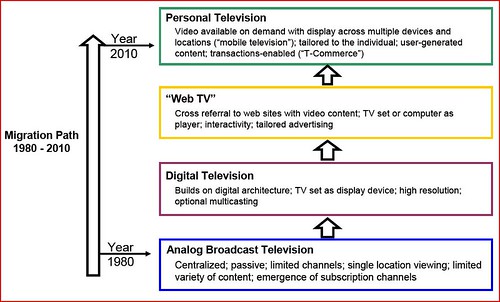
Progress & Freedom Foundation released a new report this week entitled “A Primer on the US Mobile Television Market,” by Joseph S. Kraemer, Ph.D., who is an Adjunct Fellow at PFF and a Director at Law and Economics Consulting Group. It’s not a policy piece; it just focuses on the projected growth of the mobile television marketplace over the next few years. Kraemer explains why “mobile video is forecasted to explode over the next four or five years.” He notes that it is the logical evolution of the television marketplace:
mobile digital television is a logical extension of the digitally-driven development of television from passive entertainment to an interactive, high value, versatile medium. Each stage builds upon the set of earlier stages. “Personal television” adds functionality and value to “web TV” which did the same to “digital television” which, in turn, did the same to “analog broadcast television.” The development process is additive and cumulative. Although critically important, mobile television is just one aspect of the evolving “personal television” stage.
 Continue reading →

 The Technology Liberation Front is the tech policy blog dedicated to keeping politicians' hands off the 'net and everything else related to technology.