 When it comes to theories about how to best raise kids, I’m a big believer in what might be referred to “a resiliency approach” to child-rearing. That is, instead of endlessly coddling our children and hovering over them like “helicopter parents,” as so many parents do today, I believe it makes more sense to instill some core values and common sense principles and then give them some breathing room to live life and learn lessons from it. Yes, that includes making mistakes. And, oh yes, your little darlings might actually gets some bump and bruises along the way — or at least have their egos bruised in the process. But this is how kids learn lessons and become responsible adults and citizens. Wrapping them in bubble wrap and filling their heads without nothing but fear about the outside would will ultimately lead to the opposite: sheltered, immature, irresponsible, and unprepared young adults — many of whom expect someone else (the government, their college, their employer, or still their parents!) to be there to take care of them well into their 20’s or even 30’s. Again, you gotta let kids live a little and learn from their experiences.
This explains why I find Lenore Skenazy’s new book,
Free-Range Kids: Giving Our Children the Freedom We Had Without Going Nuts with Worry
, to be such a breath of fresh air. [Here’s her blog of the same name.] She argues that “if we try to prevent every possible danger of difficult in our child’s everyday life, that child never gets a chance to grow up.” (p. 5) As she told
Salon recently:
You want kids to feel like the world isn’t so dangerous. You want to teach them how to cross the street safely. You want to teach them that you never go off with a stranger. You teach them what to do in an emergency, and then you assume that generally emergencies don’t happen, but they’re prepared if they do. Then, you let them go out.
The fun of childhood is not holding your mom’s hand. The fun of childhood is when you don’t have to hold your mom’s hand, when you’ve done something that you can feel proud of. To take all those possibilities away from our kids seems like saying: “I’m giving you the greatest gift of all, I’m giving you safety. Oh, and by the way I’m taking away your childhood and any sense of self-confidence or pride. I hope you don’t mind.”
Exactly right, in my opinion. Again, let kids live and learn from it. Teach lessons but then encourage ‘learning by doing’ and let them understand these things for themselves. That is resiliency theory in a nutshell.
Continue reading →
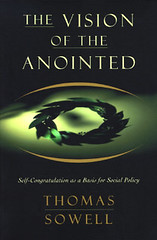 Berin recently encouraged me to re-read Thomas Sowell’s The Vision of the Anointed: Self-Congratulation as a Basis for Social Policy, which I hadn’t looked at since I first read it back in 1995 or 96. I’m glad I did since Sowell’s work has always been profoundly influential on my thinking (especially his masterpiece, A Conflict of Visions) and I had forgotten how useful The Vision of the Anointed was in helping me understand the reoccurring model that drives ideological crusades to expand government power over our lives and economy.
“The great ideological crusades of the twentieth-century intellectuals have ranged across the most disparate fields,” Sowell noted in the book. But what they all had in common, he argued, was “their moral exaltation of the anointed above others, who are to have their different views nullified and superseded by the views of the anointed, imposed via the power of government.” (p. 5) These elitist, government-expanding crusades shared several key elements, which Sowell identified as follows:
- Assertion of a great danger to the whole society, a danger to which the masses of people are oblivious.
- An urgent need for government action to avert impending catastrophe.
- A need for government to drastically curtail the dangerous behavior of the many, in response to the prescient conclusions of the few.
- A disdainful dismissal of arguments to the contrary as either uninformed, irresponsible, or motivated by unworthy purposes.
You can see this model at work on a daily basis today with our government’s various efforts to reshape our economy, but I think this model is equally applicable to debates over social policy and speech control. In particular, the various “technopanics” I have been writing about recently fit this model. (See 1, 2, 3, 4, 5). For example, consider how this plays out in the debate over online social networking:
Continue reading →
Says Epic Games founder and CEO Tim Sweeney. I wonder what the FTC will think about this prospect in the report Congress asked them to send this year about video games. I think it’s safe to assume that the thought of life-like sex and violence will create a true technopanic.
My friend Anne Collier of Net Family News, one of America’s great sages on child safety issues, has produced a terrific list of reasons “Why Technopanics are Bad.” Technopanics and moral panics are topics I’ve spent quite a bit of time commenting on here. (See 1, 2, 3, 4.) Anne is a rare voice of sanity and sensible advice when it comes to online child safety issues and I encourage you to read all her excellent work on the subject, including her book with Larry Magid, MySpace Unraveled: A Parent’s Guide to Teen Social Networking. Anyway, here’s Anne’s list, and I encourage you to go over to her site and contribute your thoughts and suggestions about what else to add:
Technopanics are bad because they…
- Cause fear, which interferes with parent-child communication, which in turn puts kids at greater risk.
- Cause schools to fear and block digital media when they need to be teaching constructive use, employing social-technology devices and teaching new media literacy and citizenship classes throughout the curriculum.
- Turn schools into barriers rather than contributors to young people’s constructive use.
- Increase the irrelevancy of school to active young social-technology users via the sequestering or banning of educational technology and hamstring some of the most spirited and innovative educators.
- Distract parents, educators, policymakers from real risks – including, for example, child-pornography laws that do not cover situations where minors can simultaneously be victim and “perpetrator” and, tragically, become registered sex offenders in cases where there no criminal intent (e.g., see this).
- Reduce the competitiveness of US education among developed countries already effectively employing educational technology and social media in schools.
- Reduce the competitiveness of US technology and media businesses practicing good corporate citizenship where youth online safety is concerned.
- Lead to bad legislation, which aggravates above outcomes and takes the focus off areas where good laws on the books can be made relevant to current technology use.
- Widen the participation gap for youth – technopanics are barriers for children and teens to full, constructive participation in participatory culture and democracy.
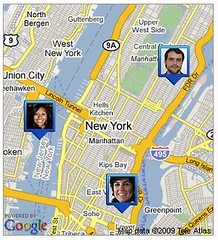 Google’s latest major launch is “Latitude,” a geo-location service that lets users find friends on a digital map and then network with them. These services are often referred to as “LBS,” which stands for “location-based services.” I wrote about LBS here before in my essay on “The Next Great Technopanic: Wireless Geo-Location / Social Mapping.” As I pointed out in that piece, LBS raise privacy concerns with some people because, by their nature, these technologies involve the tracking of users.
But I’ve argued that those concerns are generally over-blown, especially because you have to download and opt-in to these services. In other words, you know what you’re getting into. Moreover, companies who offer these services, like Loopt and now Google, go out of their way to offer privacy safeguards. Indeed, even some privacy activists agree.
For example, Michael Zimmer of the School of Information Studies at the University of Wisconsin-Milwaukee, is someone who pays close attention to privacy issues and is often critical of Google and other companies for supposedly not paying enough attention to privacy concerns. In the case of Latitude, however, he argues that “Google Actually Got it (Mostly) Right.” Here’s his snapshot of “what Google’s done to help give users control of their information flows in Latitude”:
Continue reading →
 Eric Goldman is the man. His “Technology & Marketing Law Blog” is must-reading for cyberlaw geeks; packed with indispensable updates and insights about breaking development in the world of Internet law.
Anyway, he’s just published his “2008 Cyberlaw Year-in-Review,” which provides a comprehensive overview of the major developments and cases from the past year. This is the sort of compendium that I used to have to spend big bucks to get from DC law firms. And Eric just gives it away as a public resource. God bless him.
This week, I have been up at Harvard University participating in another meeting of the Internet Safety Technical Task Force (ISTTF), of which I am a member. The ISTTF was organized earlier this year pursuant to an agreement between 49 state attorneys general (AGs) and social networking giant MySpace.com. A group of experts from academia, non-profit organizations, and industry were appointed to the Task Force, which is charged with evaluating the market for online child safety tools and methods and issuing a report on the matter to the AGs at the end of this year. ISTTF members have been meeting privately and publicly in both Cambridge, MA and Washington, D.C. The Task Force has been very ably chaired by John Palfrey, co-director of Harvard’s Berkman Center for Internet & Society.
Although the ISTTF is looking at a wide variety of tools and methods associated with online child protection (ex: filters, monitoring tools, educational campaigns, etc.), many of the AGs who crafted the agreement with MySpace that led to the Task Force’s formation have made it clear that they are
most interested in having the ISTTF evaluate age verification / online verification technologies. In fact, at the start of this week’s session at Harvard Law School, AGs Martha Coakely of Massachusetts and Richard Blumenthal of Connecticut both spoke and made it abundantly clear they expect the Task Force to develop age and identify-verification tools for social networking sites (SNS). AG Blumenthal said we need to deal with “the dangers of anonymity” and repeated his standard line about online age verification: “If we can put a man on the moon, we can make the Internet safe.” [Of course, putting a man on the moon took hundreds of billions of dollars and a decade to accomplish, but never mind that fact! Moreover, one could also argue that if we can put a man on the moon we can cure hunger, AIDS, and the common cold, but some things are obviously easier said than done. Finally, putting a man on the moon didn’t require all Americans or their kids to give up their anonymity or privacy rights in order to accomplish the feat!]
On many occasions here before, I have outlined various questions and reservations about proposals to mandate online age verification. Last year, I also published a lengthy white paper on the issue and hosted a lively debate on Capitol Hill [transcript here] about this. I also have discussed age verification in my book on parental controls and online child safety. [Braden Cox also talked about his experiences up at Harvard this week here, and CNet’s Chris Soghoian had a brutal assessment of this week’s proposals on his “Surveillance State” blog.]
In this essay, I will discuss the new fault lines in the debate over online age verification and outline where I think we are heading next on this front. I will argue:
- There is now widespread understanding that it is extraordinarily difficult to verify the ages and identities of minors online using the methods we typically use to verify adults. Because of this, age verification proponents are increasingly proposing two alternative models of verifying kids before they go online or visit SNS…
- First, for those who continue to believe that we must do whatever we can to verify kids themselves, schools and school records are increasingly being viewed as the primary mechanism to facilitate that. This raises two serious questions: Do we want schools to serve as DMVs for our children? And, do we want more school records or information about our kids being accessed or put online?
- Second, for those who are uncomfortable with the idea of verifying kids or using schools, or school records, to accomplish that task, parental permission-based forms of authentication are becoming the preferred regulatory approach. Under this scheme, which might build upon the regulatory model found in the Children’s Online Privacy Protection Act of 1998 (COPPA), parents or guardians would be verified somehow and then would vouch for their children before they were allowed on a SNS, however defined. But how do we establish a clear link between parents and kids? And will parents be willing to surrender a great deal more information (about themselves and their kids) before their kids can go online? And, is it sensible to use a law that was meant to protect the privacy and personal information of children to potentially gather a great deal more information about them, and their parents?
- It remains very unclear how either of those two verification methods would make children safer online. Indeed, that could actually make kids less safe by compromising their personal information and creating a false sense of security online for them and their parents.
- It is highly unlikely the Internet Safety Technical Task Force will be able to reach consensus on this complicated, controversial issue. A small camp will likely flock to the sort of proposals mentioned above. Another, larger camp (including me) will flock to education-based approaches to child safety as well increased reliance on other parental empowerment tools and strategies, industry self-regulatory efforts, social norms, and better intervention strategies for troubled youth. But the age verification debate will go on and, as was the case over the past two years, the legal battleground will be state capitals across America, with AGs likely pushing for age verification mandates regardless of what the Task Force concludes.
Continue reading if you are interested in the details.
Continue reading →
To: Hon. David Patterson, Governor, State of New York
From: Adam Thierer, life-long gamer and Senior Fellow at the Progress & Freedom Foundation
Date: July 17, 2008
Re: That video game bill (A. 11717/ S. 6401) you have been asked to sign
Dear Gov. Patterson:
I write today to ask a few questions about a measure that is currently sitting on your desk awaiting your signature. The measure (A. 11717/ S. 6401), which recently passed through the New York legislature, proposes a new regulatory regime for video games. It would include greater state-based oversight of video game labels and console controls as well as an advisory board to monitor the industry.
As a life-long gamer—and now the parent of two young gamers—this is a subject I care deeply about. I also come at this topic from an academic perspective as someone who analyzes the intersection of child safety concerns and free speech issues surrounding various types of media and communications technologies. I am the author of a frequently-updated book,
Parental Controls & Online Child Safety: A Survey of Tools & Methods, which provides a comprehensive look at the many tools and methods on the market today that can help parents deal with concerns about objectionable media content.
But mostly I write you today from the perspective of someone who just enjoys games. Actually, let me clarify that: I am utterly infatuated with video games. Gaming has been a life-long passion of mine and something I have enjoyed with friends and family since I owned my very first PONG and Atari 2600 systems in the 1970s. Since then, I have owned virtually every major video game console sold in the United States. Even today, as I approach 40 years of age, I find myself sitting down many nights to enjoy games with my son and daughter on the Xbox 360 and Sony PS3 consoles that we have in our home.
Like millions of other Americans, gaming is now fully integrated into the fabric of my life and the lives of my children. It has become one of the most enjoyable media experiences for my generation and the generation of kids that we are raising. And, although I am certain that the New York legislature had the best of intentions in mind when passing this bill, I believe I speak for a great number of those other American gamers when I say that the measure on your desk is somewhat of an insult to our intelligence. Let me explain by raising a few questions about this bill, which I will argue is unnecessary, unworkable, and unconstitutional:
Continue reading →
A few days ago, I posted an essay about the recent history of “moral panics,” or “technopanics,” as Alice Marwick refers to them in her brilliant new article about the recent panic over MySpace and social networking sites in general.
I got thinking about technopanics again today after reading the
Washington Post’s front-page article, “When the Phone Goes With You, Everyone Else Can Tag Along.” In the piece, Post staff writer Ellen Nakashima discusses the rise of mobile geo-location technologies and services, which are becoming more prevalent as cell phones grow more sophisticated. These services are often referred to as “LBS,” which stands for “location-based services.”
Many of phones and service plans offered today include LBS technologies, which are very useful for parents like me who might want to monitor the movement of their children. Those same geo-location technologies can be used for other LBS purposes. Geo-location technologies are now being married to social networking utilities to create an entirely new service and industry: “social mapping.” Social mapping allows subscribers to find their friends on a digital map and then instantly network with them. Companies such as Loopt and Helio have already rolled out commercial social mapping services. Loopt has also partnered with major carriers to roll out its service nationwide, including the new iPhone 3G. It is likely that many other rivals will join these firms in coming months and years.
These new LBS services present exciting opportunities for users to network with friends and family, and it also open up a new world of commercial / advertising opportunities. Think of how stores could offer instantaneous coupons as you walk by their stores, for example. And very soon, you can imagine a world were many of our traditional social networking sites and services are linked into LBS tools in a seamless fashion. But as today’s
Washington Post article notes, mobile geo-location and social mapping is also raising some privacy concerns:
Continue reading →

Sean Garrett of the 463 Blog posted an excellent essay this week about the great moral panic of 1995, when Time magazine ran its famous cover “Cyberporn” story that included this unforgettable image. Unfortunately for Time, the article also included a great deal of erroneous information about online pornography that was pulled from a bogus study that found 83.5 percent of all online images were pornographic! The study was immediately debunked by scholars, but not before Congress rushed to judgment and passed the Communications Decency Act, which sought to ban all “indecent” online content. It was later struck down as unconstitutional, of course.
Anyway, Sean’s essay also brought to my attention this amazing new article by Alice Marwick, a PhD Candidate in the Department of Media, Culture, and Communication at New York University: “To Catch a Predator? The MySpace Moral Panic“. The topic of “moral panics” is something I have done quite a bit of work on, but Marwick’s paper is absolute must-reading on the topic, especially as it pertains to the recent moral panic of MySpace and social networking sites.
Continue reading →

 The Technology Liberation Front is the tech policy blog dedicated to keeping politicians' hands off the 'net and everything else related to technology.