Reason magazine recently published my review of Franklin Foer’s new book, World Without Mind: The Existential Threat of Big Tech. My review begins as follows:
If you want to sell a book about tech policy these days, there’s an easy formula to follow.
First you need a villain. Google and Facebook should suffice, but if you can throw in Apple, Amazon, or Twitter, that’s even better. Paint their CEOs as either James Bond baddies bent on world domination or naive do-gooders obsessed with the quixotic promise of innovation.
Finally, come up with a juicy Chicken Little title. Maybe something like World Without Mind: The Existential Threat of Big Tech. Wait—that one’s taken. It’s the title of Franklin Foer’s latest book, which follows this familiar techno-panic template almost perfectly.
The book doesn’t break a lot of new ground; it serves up the same old technopanicky tales of gloom-and-doom that many others have said will befall us unless
something is done to save us. But Foer’s unique contribution is to unify many diverse strands of modern tech criticism in one tome, and then amp up the volume of panic about it all. Hence, the “existential” threat in the book’s title. I bet you didn’t know the End Times were so near!
Read the rest of my review over at Reason. And, if you care to read some of my other essays on technopanics through the ages, here’s a compendium of them.
“First electricity, now telephones. Sometimes I feel as if I were living in an H.G. Wells novel.” –Dowager Countess, Downton Abbey
Every technology we take for granted was once new, different, disruptive, and often ridiculed and resisted as a result. Electricity, telephones, trains, and television all caused widespread fears once in the way robots, artificial intelligence, and the internet of things do today. Typically it is realized by most that these fears are misplaced and overly pessimistic, the technology gets diffused and we can barely remember our life without it. But in the recent technopanics, there has been a concern that the legal system is not properly equipped to handle the possible harms or concerns from these new technologies. As a result, there are often calls to regulate or rein in their use.
In the late 1980s, video cassette recorders (VCRs) caused a legal technopanic. The concerns were less that VCRs would lead to some bizarre human mutation as in many technopanics, but rather that the existing system of copyright infringement and vicarious liability could not adequately address the potential harm to the motion picture industry. The then president of the Motion Picture Association of America Jack Valenti famously told Congress, “I say to you that the VCR is to the American film producer and the American public as the Boston Strangler is to the woman home alone.”
I’ve written herebefore about the problems associated with the “technopanic mentality,” especially when it comes to how technopanics sometimes come to shape public policy decisions and restict important new, life-enriching innovations. As I argued in a recent book, the problem with this sort Chicken Little thinking is that, “living in constant fear of worst-case scenarios—and premising public policy on them—means that best-case scenarios will never come about. When public policy is shaped by precautionary principle reasoning, it poses a serious threat to technological progress, economic entrepreneurialism, social adaptation, and long-run prosperity.”
Perhaps the worst thing about worst-case thinking is how short-sighted and hubristic it can be. The technopanic crowd often has an air of snooty-ness about them in that they ask us to largely ignore the generally positive long-run trends associated with technological innovation and instead focus on hypothetical fears about an uncertain future that apparently only they can foresee. This is the case whether they are predicting the destruction of jobs, economy, lifestyles, or culture. Techno-dystopia lies just around the corner, they say, but the rest of us ignorant sheep who just can’t see it coming!
In his wonderful 2013 book,
Smarter Than You Think: How Technology Is Changing Our Minds for the Better, Clive Thompson correctly noted that “dystopian predictions are easy to generate” and “doomsaying is emotionally self-protective: if you complain that today’s technology is wrecking the culture, you can tell yourself you’re a gimlet-eyed critic who isn’t hoodwinked by high-tech trends and silly, popular activities like social networking. You seem like someone who has a richer, deeper appreciation for the past and who stands above the triviality of today’s life.”
Stated differently, the doomsayers are guilty of a type of social and technical arrogance. They are almost always wrong on history, wrong on culture, and wrong on facts. Again and again, humans have proven remarkably resilient in the face of technological change and have overcome short-term adversity. Yet, the technopanic pundits are almost never called out for their elitist attitudes later when their prognostications are proven wildly off-base. And even more concerning is the fact that their Chicken Little antics lead them and others to ignore the more serious risks that could exist out there and which are worthy of our attention.
Here’s a nice example of that last point that comes from a silent film made all the way back in 1911! Continue reading →
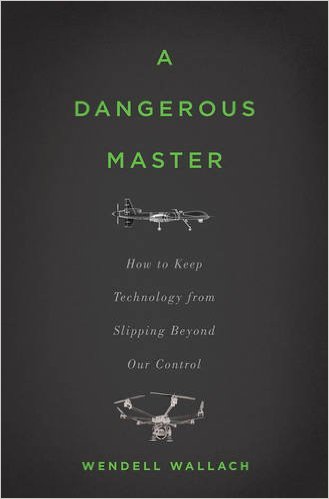
On May 3rd, I’m excited to be participating in a discussion with Yale University bioethicist Wendell Wallach at the Microsoft Innovation & Policy Center in Washington, DC. (RSVP here.) Wallach and I will be discussing issues we write about in our new books, both of which focus on possible governance models for emerging technologies and the question of how much preemptive control society should exercise over new innovations.
Of all the books of technological criticism or skepticism that I’ve read in recent years—and I have read stacks of them!—
A Dangerous Master is by far the most thoughtful and interesting. I have grown accustomed to major works of technological criticism being caustic, angry affairs. Most of them are just dripping with dystopian dread and a sense of utter exasperation and outright disgust at the pace of modern technological change.
Although he is certainly concerned about a wide variety of modern technologies—drones, robotics, nanotech, and more—Wallach isn’t a purveyor of the politics of panic. There are some moments in the book when he resorts to some hyperbolic rhetoric, such as when he frets about an impending “techstorm” and the potential, as the book’s title suggests, for technology to become a “dangerous master” of humanity. For the most part, however, his approach is deeper and more dispassionate than what is found in the leading tracts of other modern techno-critics.
Viruses, malware, spam, data breeches, and critical system intrusions are just some of the security-related concerns that often motivate precautionary thinking and policy proposals.[1] But as with privacy- and safety-related worries, the panicky rhetoric surrounding these issues is usually unfocused and counterproductive.
In today’s cybersecurity debates, for example, it is not uncommon to hear frequent allusions to the potential for a “digital Pearl Harbor,”[2] a “cyber cold war,”[3] or even a “cyber 9/11.”[4] These analogies are made even though these historical incidents resulted in death and destruction of a sort not comparable to attacks on digital networks. Others refer to “cyber bombs” or technological “time bombs,” even though no one can be “bombed” with binary code.[5] Michael McConnell, a former director of national intelligence, went so far as to say that this “threat is so intrusive, it’s so serious, it could literally suck the life’s blood out of this country.”[6]
Such outrageous statements reflect the frequent use of “threat inflation” rhetoric in debates about online security.[7] Threat inflation has been defined as “the attempt by elites to create concern for a threat that goes beyond the scope and urgency that a disinterested analysis would justify.”[8] Unfortunately, such bombastic rhetoric often conflates minor cybersecurity risks with major ones. For example, dramatic doomsday stories about hackers pushing planes out of the sky misdirects policymakers’ attention from the more immediate, but less gripping, risks of data extraction and foreign surveillance. Well-meaning skeptics might then conclude that our real cybersecurity risks are also not a problem. In the meantime, outdated legislation and inappropriate legal norms continue to impede beneficial defensive measures that could truly improve security. Continue reading →
It was my pleasure this week to be invited to deliver some comments at an event hosted by the Information Technology and Innovation Foundation (ITIF) to coincide with the release of their latest study, “The Privacy Panic Cycle: A Guide to Public Fears About New Technologies.” The goal of the new ITIF report, which was co-authored by Daniel Castro and Alan McQuinn, is to highlight the dangers associated with “the cycle of panic that occurs when privacy advocates make outsized claims about the privacy risks associated with new technologies. Those claims then filter through the news media to policymakers and the public, causing frenzies of consternation before cooler heads prevail, people come to understand and appreciate innovative new products and services, and everyone moves on.” (p. 1)
As Castro and McQuinn describe it, the privacy panic cycle “charts how perceived privacy fears about a technology grow rapidly at the beginning, but eventually decline over time.” They divide this cycle into four phases: Trusting Beginnings, Rising Panic, Deflating Fears, and Moving On. Here’s how they depict it in an image:
Last Wednesday, it was my great pleasure to testify at a Senate Commerce Committee hearing entitled, “The Connected World: Examining the Internet of Things.” The hearing focused “on how devices… will be made smarter and more dynamic through Internet technologies. Government agencies like the Federal Trade Commission, however, are already considering possible changes to the law that could have the unintended consequence of slowing innovation.”
But the session went well beyond the Internet of Things and became a much more wide-ranging discussion about how America can maintain its global leadership for the next-generation of Internet-enabled, data-driven innovation. On both sides of the aisle at last week’s hearing, one Senator after another made impassioned remarks about the enormous innovation opportunities that were out there. While doing so, they highlighted not just the opportunities emanating out of the IoT and wearable device space, but also many other areas, such as connected cars, commercial drones, and next-generation spectrum.
I was impressed by the energy and nonpartisan vision that the Senators brought to these issues, but I wanted to single out the passionate statement that Sen. Cory Booker (D-NJ) delivered when it came his turn to speak because he very eloquently articulated what’s at stake in the battle for global innovation supremacy in the modern economy. (Sen. Booker’s remarks were not published, but you can watch them starting at the 1:34:00 mark of the hearing video.) Continue reading →
On Sunday night, 60 Minutes aired a feature with the ominous title, “Nobody’s Safe on the Internet,” that focused on connected car hacking and Internet of Things (IoT) device security. It was followed yesterday morning by the release of a new report from the office of Senator Edward J. Markey (D-Mass) called Tracking & Hacking: Security & Privacy Gaps Put American Drivers at Risk,which focused on connected car security and privacy issues. Employing more than a bit of techno-panic flare, these reports basically suggest that we’re all doomed.
On
60 Minutes, we meet former game developer turned Department of Defense “cyber warrior” Dan (“call me DARPA Dan”) Kaufman–and learn his fears of the future: “Today, all the devices that are on the Internet [and] the ‘Internet of Things’ are fundamentally insecure. There is no real security going on. Connected homes could be hacked and taken over.”
60 Minutes reporter Lesley Stahl, for her part, is aghast. “So if somebody got into my refrigerator,” she ventures, “through the internet, then they would be able to get into everything, right?” Replies DARPA Dan, “Yeah, that’s the fear.” Prankish hackers could make your milk go bad, or hack into your garage door opener, or even your car.
This segues to a humorous segment wherein Stahl takes a networked car for a spin. DARPA Dan and his multiple research teams have been hard at work remotely programming this vehicle for years. A “hacker” on DARPA Dan’s team proceeded to torment poor Lesley with automatic windshield wiping, rude and random beeps, and other hijinks. “Oh my word!” exclaims Stahl. Continue reading →
I suppose it was inevitable that the DRM wars would come to the world of drones. Reporting for the Wall Street Journal today, Jack Nicas notes that:
In response to the drone crash at the White House this week, the Chinese maker of the device that crashed said it is updating its drones to disable them from flying over much of Washington, D.C.SZ DJI Technology Co. of Shenzhen, China, plans to send a firmware update in the next week that, if downloaded, would prevent DJI drones from taking off within the restricted flight zone that covers much of the U.S. capital, company spokesman Michael Perry said.
Washington Post reporter Brian Fung explains what this means technologically:
The [DJI firmware] update will add a list of GPS coordinates to the drone’s computer telling it where it can and can’t go. Here’s how that system works generally: When a drone comes within five miles of an airport, Perry explained, an altitude restriction gets applied to the drone so that it doesn’t interfere with manned aircraft. Within 1.5 miles, the drone will be automatically grounded and won’t be able to fly at all, requiring the user to either pull away from the no-fly zone or personally retrieve the device from where it landed. The concept of triggering certain actions when reaching a specific geographic area is called “geofencing,” and it’s a common technology in smartphones. Since 2011, iPhone owners have been able to create reminders that alert them when they arrive at specific locations, such as the office.
This is complete overkill and it almost certainly will not work in practice. First, this is just DRM for drones, and just as DRM has failed in most other cases, it will fail here as well. If you sell somebody a drone that doesn’t work within a 15-mile radius of a major metropolitan area, they’ll be online minutes later looking for a hack to get it working properly. And you better believe they will find one. Continue reading →
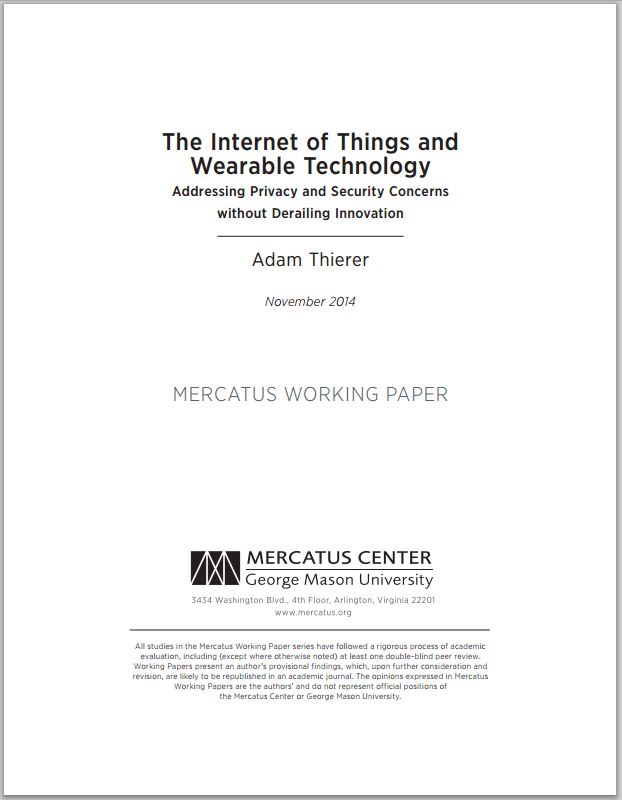
The Mercatus Center at George Mason University has just released my latest working paper, “The Internet of Things and Wearable Technology: Addressing Privacy and Security Concerns without Derailing Innovation.” The “Internet of Things” (IoT) generally refers to “smart” devices that are connected to both the Internet and other devices. Wearable technologies are IoT devices that are worn somewhere on the body and which gather data about us for various purposes. These technologies promise to usher in the next wave of Internet-enabled services and data-driven innovation. Basically, the Internet will be “baked in” to almost everything that consumers own and come into contact with.
Some critics are worried about the privacy and security implications of the Internet of Things and wearable technology, however, and are proposing regulation to address these concerns. In my new 93-page article, I explain why preemptive, top-down regulation would derail the many life-enriching innovations that could come from these new IoT technologies. Building on a recent book of mine, I argue that “permissionless innovation,” which allows new technology to flourish and develop in a relatively unabated fashion, is the superior approach to the Internet of Things.
As I note in the paper and my earlier book, if we spend all our time living in fear of the worst-case scenarios — and basing public policies on them — then best-case scenarios can never come about. As the old saying goes: nothing ventured, nothing gained. Precautionary principle-based regulation paralyzes progress and must be avoided. We instead need to find constructive, “bottom-up” solutions to the privacy and security risks accompanying these new IoT technologies instead of top-down controls that would limit the development of life-enriching IoT innovations. Continue reading →
The Technology Liberation Front is the tech policy blog dedicated to keeping politicians' hands off the 'net and everything else related to technology. Learn more about TLF →




 The Technology Liberation Front is the tech policy blog dedicated to keeping politicians' hands off the 'net and everything else related to technology.