Posts tagged as:

Both parties of Congress has been increasingly critical of federal agencies’ inefficient use of spectrum in the past few years and it seems like agencies are getting the message. The NTIA, which is the official manager of federal agency spectrum, released a letter yesterday announcing that the Department of Defense would be relocating some of its systems. Defense had reached an agreement with broadcasters that Defense systems will share spectrum in the Broadcast Auxiliary Service (BAS) band.

The soon-to-be vacated band held by Defense will eventually be auctioned off–hopefully in 2014–for billions of dollars and likely used for mobile broadband provided by wireless carriers like AT&T, Verizon, Sprint, and T-Mobile. These carriers face serious congestion problems because of government-created scarcity of spectrum.

The carriers actually had targeted some of BAS spectrum because they weren’t convinced Defense would be willing to move their systems. The broadcaster deal reached with Defense means everyone’s apparently happy–the broadcasters can keep their BAS spectrum, the feds get new equipment and Congress off their back (temporarily), and the carriers get new spectrum for auction.

The deal is welcome news because the spectrum will be put to a higher-valued use once auctioned. The federal government pays almost nothing for its own spectrum and is a poor steward of the resource. Transferring spectrum from agencies to carriers means lower phone bills and more mobile broadband coverage. Government agencies are notoriously resistant to moving their systems or sharing with others, so entering into a sharing pact with the broadcasters indicates some of the resistance is thawing.

It’s not unequivocal good news, though.

The government is clearing out from a 25 MHz band of spectrum and occupying the larger, 85 MHz BAS band that will be shared with broadcasters. The military will need a larger band because sharing imposes some capacity constraints necessitating new, agile systems that search the airwaves to make sure they don’t interfere with existing broadcast users. Dynamic sharing like this only adds to the cost and complexity and may imperil next years’ planned auction.

Further, the BAS band is unavailable for auction only because of the antiquated command-and-control regime the FCC uses to award spectrum licenses. BAS is mostly used for electronic news gathering, which relays local and national newscasts from reporters on the scene to broadcast studios. Broadcasters have used BAS spectrum since the 1960s when it was allocated to them for free.

In a market, broadcasters likely would not have as much BAS spectrum as they currently have. In fact, because of technology changes and squeezed newsroom budgets, broadcasters are finding cheaper alternatives. Increasingly, journalists are using carriers’ LTE technology to transmit their breaking newscasts since the technology costs a fraction of the cost of news vans and equipment needed for BAS transmissions. That is to say, there are alternative business models in the absence of Soviet-style allocations.

So despite these industry changes, BAS spectrum cannot be auctioned for its highest-valued use (probably mobile broadband) under current FCC rules. Further, it will be even more difficult to bring the benefits of auctions to the airwaves if federal users are intermingling with existing users, broadcasters in this case. It’s a trend to be wary of. Let’s just hope that next year’s planned auctions occur on time so that more consumers can benefit from mobile broadband.


Randall Stross discusses his recent book: The Launch Pad: Inside Y Combinator, Silicon Valley’s Most Exclusive School for Startups. Stross’s behind-the-scenes look at Y Combinator details how the seed fund has been able to produce young entrepreneurs and successful startups such as Dropbox and Airbnb. Stross also discusses Y Combinator’s early history, the typical Y Combinator participant, the fund’s rate of return, the gender gap in the program, and the reason Silicon Valley has become the epicenter for startups.

Download

Related Links

GMLR coverI’m pleased to announce the release of my latest law review article, “A Framework for Benefit-Cost Analysis in Digital Privacy Debates.” It appears in the new edition of the George Mason University Law Review. (Vol. 20, No. 4, Summer 2013)

This is the second of two complimentary law review articles I am releasing this year dealing with privacy policy. The first, “The Pursuit of Privacy in a World Where Information Control is Failing,” was published in Vol. 36 of the Harvard Journal of Law & Public Policy this Spring. (FYI: Both articles focus on privacy claims made against private actors — namely, efforts to limit private data collection — and not on privacy rights against governments.)

My new article on benefit-cost analysis in privacy debates makes a seemingly contradictory argument: benefit-cost analysis (“BCA”) is extremely challenging in online child safety and digital privacy debates, yet it remains essential that analysts and policymakers attempt to conduct such reviews. While we will never be able to perfectly determine either the benefits or costs of online safety or privacy controls, the very act of conducting a regulatory impact analysis (“RIA”) will help us to better understand the trade-offs associated with various regulatory proposals. Continue reading →

Timothy B. Lee, founder of The Washington Post’s blog The Switch discusses his approach to reporting at the intersection of technology and policy. He covers how to make tech concepts more accessible; the difference between blogs and the news; the importance of investigative journalism in the tech space; whether paywalls are here to stay; Jeff Bezos’ recent purchase of The Washington Post; and the future of print news.

Download

Related Links

Sherwin Siy, Vice President of Legal Affairs at Public Knowledge, discusses emerging issues in digital copyright policy. He addresses the Department of Commerce’s recent green paper on digital copyright, including the need to reform copyright laws in light of new technologies. This podcast also covers the DMCA, online streaming, piracy, cell phone unlocking, fair use recognition, digital ownership, and what we’ve learned about copyright policy from the SOPA debate.

Download

Related Links

Jerry Ellig, senior research fellow at the Mercatus Center at George Mason University, discusses the the FCC’s lifeline assistance benefit funded through the Universal Service Fund (USF). The program, created in 1997, subsidizes phone services for low-income households. The USF is not funded through the federal budget, rather via a fee from monthly phone bills — reaching an all-time high of 17% of telecomm companies’ revenues last year. Ellig discusses the similarities between the USF fee and a tax, how the fee fluctuates, how subsidies to the telecomm industry have boomed in recent years, and how to curb the waste, fraud and abuse that comes as a result of the lifeline assistance benefit.

Download

Related Links

“In today’s globally competitive era, the United States cannot continue to delay its transition to Internet-enabled infrastructure.”

Last week the Department of Defense (DoD) filed comments with the FCC in its proceeding examining the transition from outdated telephone technologies to Internet Protocol (the “IP-transition”). The comments, which were filed “on behalf of the consumer interests” of the DoD by a civilian attorney in the Army’s Regulatory Law Office (emphasis added), ask the FCC to “consider potential adverse consequences on public safety and national security” of requiring federal agencies to “prematurely transition to different technologies.”

What are these potential adverse consequences? The italicized “interests” of the DoD provide the answer: It wants to avoid incurring any costs to upgrade its outdated telephone technologies to modern, Internet Protocol technologies when its current communications contracts expire in 2017. Continue reading →

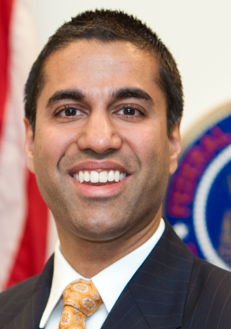
Ajit Pai FCCAjit Pai, a Republican commissioner at the Federal Communications Commission (FCC), had an outstanding op-ed in the L.A. Times yesterday about state and local efforts to regulate private taxi or ride-sharing services such as Uber, Lyft, and Sidecar. “Ever since Uber came to California,” Pai notes, “regulators have seemed determined to send Uber and companies like it on a one-way ride out of the Golden State.” Regulators have thrown numerous impediments in their way in California as well as in other states and localities (including here in Washington, D.C.). Pai continues on to discuss how, sadly, “tech start-ups in other industries face similar burdens”:

For example, Square has created a credit card reader for mobile devices. Small businesses love Square because it reduces costs and is convenient for customers. But some states want a piece of the action. Illinois, for example, has ordered Square to stop doing business in the Land of Lincoln until it gets a money transmitter license, even though the money flows through existing payment networks when Square processes credit cards. If Square had to get licenses in the 47 states with such laws, it could cost nearly half a million dollars, an extraordinary expense for a fledgling company.

He also notes that “Obstacles to entrepreneurship aren’t limited to the tech world”:

Across the country, restaurant associations have tried to kick food trucks off the streets. Auto dealers have used franchise laws to prevent car company Tesla from cutting out the middleman and selling directly to customers. Professional boards, too, often fiercely defend the status quo, impeding telemedicine by requiring state-by-state licensing or in-person consultations and even restricting who can sell tooth-whitening services.

What’s going on here? It’s an old and lamentable tale of incumbent protectionism and outright cronyism, Pai notes: Continue reading →

Adam Thierer, Senior Research Fellow at the Mercatus Center discusses his recent working paper with coauthor Brent Skorup, A History of Cronyism and Capture in the Information Technology Sector. Thierer takes a look at how cronyism has manifested itself in technology and media markets — whether it be in the form of regulatory favoritism or tax privileges. Which tech companies are the worst offenders? What are the consequences for consumers? And, how does cronyism affect entrepreneurship over the long term?

Download

Related Links

WP coverThe Mercatus Center at George Mason University has just released a new paper by Brent Skorup and me entitled, “A History of Cronyism and Capture in the Information Technology Sector.” In this 73-page working paper, which we hope to place in a law review or political science journal shortly, we document the evolution of government-granted privileges, or “cronyism,” in the information and communications technology marketplace and in the media-producing sectors. Specifically, we offer detailed histories of rent-seeking and regulatory capture in: the early history of the telephony and spectrum licensing in the United States; local cable TV franchising; the universal service system; the digital TV transition in the 1990s; and modern video marketplace regulation (i.e., must-carry and retransmission consent rules, among others.

Our paper also shows how cronyism is slowly creeping into new high-technology sectors.We document how Internet companies and other high-tech giants are among the fastest-growing lobbying shops in Washington these days. According to the Center for Responsive Politics, lobbying spending by information technology sectors has almost doubled since the turn of the century, from roughly $200 million in 2000 to $390 million in 2012.  The computing and Internet sector has been responsible for most of that growth in recent years. Worse yet, we document how many of these high-tech firms are increasingly seeking and receiving government favors, mostly in the form of targeted tax breaks or incentives. Continue reading →