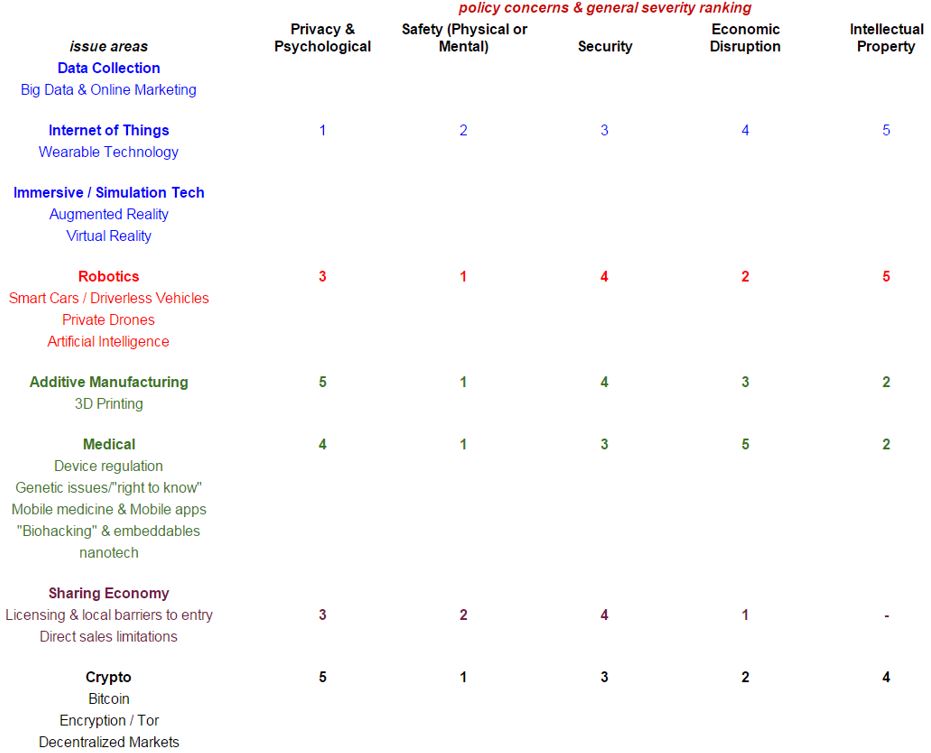
On the whiteboard that hangs in my office, I have a giant matrix of technology policy issues and the various policy “threat vectors” that might end up driving regulation of particular technologies or sectors. Along with my colleagues at the Mercatus Center’s Technology Policy Program, we constantly revise this list of policy priorities and simultaneously make an (obviously quite subjective) attempt to put some weights on the potential policy severity associated with each threat of intervention. The matrix looks like this: [Sorry about the small fonts. You can click on the image to make it easier to see.]
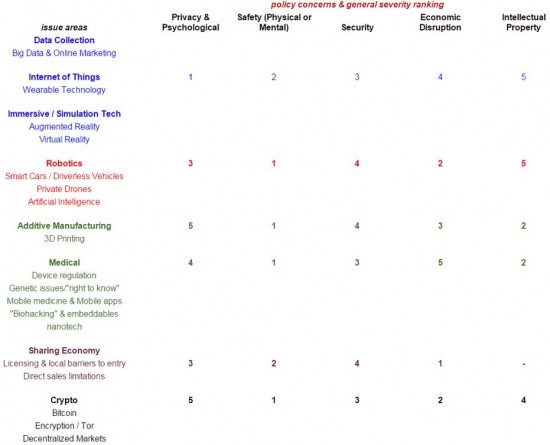
I use 5 general policy concerns when considering the likelihood of regulatory intervention in any given area. Those policy concerns are:
- privacy (reputation issues, fear of “profiling” & “discrimination,” amorphous psychological / cognitive harms);
- safety (health & physical safety or, alternatively, child safety and speech / cultural concerns);
- security (hacking, cybersecurity, law enforcement issues);
- economic disruption (automation, job dislocation, sectoral disruptions); and,
- intellectual property (copyright and patent issues).
Continue reading →
Last week while I was visiting the Silicon Valley area, it was my pleasure to visit the venture capital firm of Andreessen Horowitz. While I was there, Sonal Chokshi was kind enough to invite me on the a16z podcast, which was focused on “Making the Case for Permissionless Innovation.” We had a great discussion on a wide range of disruptive technology policy issues (robotics, drones, driverless cars, medical technology, Internet of Things, crypto, etc.) and also talked about how innovators should approach Washington and public policymakers more generally. Our 23-minute conversation follows:
And for more reading on permissionless innovation more generally, see my book page.
“Why hasn’t Europe fostered the kind of innovation that has spawned hugely successful technology companies?” asks James B. Stewart in an important new column for the New York Times (“A Fearless Culture Fuels U.S. Tech Giants“).
That’s a great question, and one that I have tried to answer in a series of recent essays. (See, for example, “Europe’s Choice on Innovation” and “Embracing a Culture of Permissionless Innovation.”) What I have suggested in those essays is that the starkly different outcomes on either side of the Atlantic in terms of recent economic growth and innovation can primarily be explained by cultural attitudes toward risk-taking and failure. “For innovation and growth to blossom, entrepreneurs need a clear green light from policymakers that signals a general acceptance of risk-taking—especially risk-taking that challenges existing business models and traditional ways of doing things,” I have argued. And the most powerful proof of this is to examine the amazing natural experiment that has played out on either side of the Atlantic over the past two decades with the Internet and the digital economy.
For example, an annual Booz & Company report on the world’s most innovative companies revealed that 9 of the top 10 most innovative companies are based in the U.S. and that most of them are involved in computing and digital technology. None of them are based in Europe, however. Another recent survey revealed that the world’s 15 most valuable Internet companies (based on market capitalizations) have a combined market value of nearly $2.5 trillion, but none of them are European while 11 of them are U.S. firms. Again, it is America’s tech innovators that dominate that list.
Many European officials and business leaders are waking up to this grim reality and are wondering how to reverse this situation. In his
Times essay, Stewart quotes Danish economist Jacob Kirkegaard of the Peterson Institute for International Economics, who notes that Europeans “all want a Silicon Valley. . . . But none of them can match the scale and focus on the new and truly innovative technologies you have in the United States. Europe and the rest of the world are playing catch-up, to the great frustration of policy makers there.”
OK, but why is that? Continue reading →
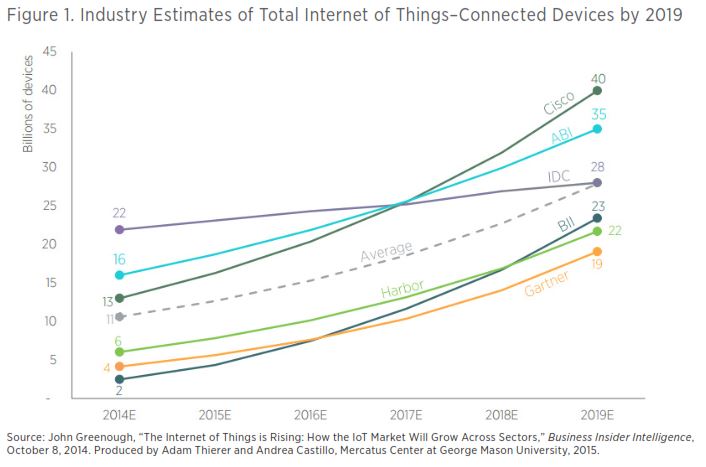
The “Internet of Things” (IoT) is already growing at a breakneck pace and is expected to continue to accelerate rapidly. In a short new paper (“Projecting the Growth and Economic Impact of the Internet of Things“) that I’ve just released with my Mercatus Center colleague Andrea Castillo, we provide a brief explanation of IoT technologies before describing the current projections of the economic and technological impacts that IoT could have on society. In addition to creating massive gains for consumers, IoT is projected to provide dramatic improvements in manufacturing, health care, energy, transportation, retail services, government, and general economic growth. Take a look at our paper if you’re interested, and you might also want to check out my 118-page law review article, “The Internet of Things and Wearable Technology: Addressing Privacy and Security Concerns without Derailing Innovation” as well as my recent congressional testimony on the policy issues surrounding the IoT.)
 Last Wednesday, it was my great pleasure to testify at a Senate Commerce Committee hearing entitled, “The Connected World: Examining the Internet of Things.” The hearing focused “on how devices… will be made smarter and more dynamic through Internet technologies. Government agencies like the Federal Trade Commission, however, are already considering possible changes to the law that could have the unintended consequence of slowing innovation.”
But the session went well beyond the Internet of Things and became a much more wide-ranging discussion about how America can maintain its global leadership for the next-generation of Internet-enabled, data-driven innovation. On both sides of the aisle at last week’s hearing, one Senator after another made impassioned remarks about the enormous innovation opportunities that were out there. While doing so, they highlighted not just the opportunities emanating out of the IoT and wearable device space, but also many other areas, such as connected cars, commercial drones, and next-generation spectrum.
I was impressed by the energy and nonpartisan vision that the Senators brought to these issues, but I wanted to single out the passionate statement that Sen. Cory Booker (D-NJ) delivered when it came his turn to speak because he very eloquently articulated what’s at stake in the battle for global innovation supremacy in the modern economy. (Sen. Booker’s remarks were not published, but you can watch them starting at the 1:34:00 mark of the hearing video.) Continue reading →
This morning at 9:45, the Senate Committee on Commerce, Science, and Transportation is holding a full committee hearing entitled, “The Connected World: Examining the Internet of Things.” According to the Committee press release, the hearing “will focus on how devices — from home heating systems controlled by users online, to wearable devices that track health and activity with the help of Internet-based analytics — will be made smarter and more dynamic through Internet technologies. Government agencies like the Federal Trade Commission, however, are already considering possible changes to the law that could have the unintended consequence of slowing innovation.”
It is my pleasure to have been invited to testify at this hearing. I’ve long had an interest in the policy issues surrounding the Internet of Things. All my relevant research products can be found online here, including my latest law review article, “The Internet of Things and Wearable Technology Addressing Privacy and Security Concerns without Derailing Innovation.“
My testimony, which can be found on the Mercatus Center website here, begins by highlighting the three general conclusions of my work:
- First, the Internet of Things offers compelling benefits to consumers, companies, and our country’s national competitiveness that will only be achieved by adopting a flexible policy regime for this fast-moving space.
- Second, while there are formidable privacy and security challenges associated with the Internet of Things, top-down or one-size-fits-all regulation will limit innovative opportunities.
- Third, with those first two points in mind, we should seek alternative and less costly approaches to protecting privacy and security that rely on education, empowerment, and targeted enforcement of existing legal mechanisms. Long-term privacy and security protection requires a multifaceted approach incorporating many flexible solutions.
Continue reading →
Farhad Manjoo’s latest New York Times column, “Giving the Drone Industry the Leeway to Innovate,” discusses how the Federal Aviation Administration’s (FAA) current regulatory morass continues to thwart many potentially beneficial drone innovations. I particularly appreciated this point:
But perhaps the most interesting applications for drones are the ones we can’t predict. Imposing broad limitations on drone use now would be squashing a promising new area of innovation just as it’s getting started, and before we’ve seen many of the potential uses. “In the 1980s, the Internet was good for some specific military applications, but some of the most important things haven’t really come about until the last decade,” said Michael Perry, a spokesman for DJI [maker of Phantom drones]. . . . He added, “Opening the technology to more people allows for the kind of innovation that nobody can predict.”
That is exactly right and it reflects the general notion of “permissionless innovation” that I have written about extensively here in recent years. As I summarized in a recent essay: “Permissionless innovation refers to the notion that experimentation with new technologies and business models should generally be permitted by default. Unless a compelling case can be made that a new invention or business model will bring serious harm to individuals, innovation should be allowed to continue unabated and problems, if they develop at all, can be addressed later.” Continue reading →
Yesterday, the Federal Trade Commission (FTC) released its long-awaited report on “The Internet of Things: Privacy and Security in a Connected World.” The 55-page report is the result of a lengthy staff exploration of the issue, which kicked off with an FTC workshop on the issue that was held on November 19, 2013.
I’m still digesting all the details in the report, but I thought I’d offer a few quick thoughts on some of the major findings and recommendations from it. As I’ve noted here before, I’ve made the Internet of Things my top priority over the past year and have penned several essays about it here, as well as in a big new white paper (“The Internet of Things and Wearable Technology: Addressing Privacy and Security Concerns without Derailing Innovation”) that will be published in the Richmond Journal of Law & Technology shortly. (Also, here’s a compendium of most of what I’ve done on the issue thus far.)
I’ll begin with a few general thoughts on the FTC’s report and its overall approach to the Internet of Things and then discuss a few specific issues that I believe deserve attention. Continue reading →
What sort of public policy vision should govern the Internet of Things? I’ve spent a lot of time thinking about that question in essays here over the past year, as well as in a new white paper (“The Internet of Things and Wearable Technology: Addressing Privacy and Security Concerns without Derailing Innovation”) that will be published in the Richmond Journal of Law & Technology early next year.
But I recently heard three policymakers articulate their recommended vision for the Internet of Things (IoT) and I found their approach so inspiring that I wanted to discuss it here in the hopes that it will become the foundation for future policy in this arena.
Last Thursday, it was my pleasure to attend a Center for Data Innovation (CDI) event on “How Can Policymakers Help Build the Internet of Things?” As the title implied, the goal of the event was to discuss how to achieve the vision of a more fully-connected world and, more specifically, how public policymakers can help facilitate that objective. It was a terrific event with many excellent panel discussions and keynote addresses.
Two of those keynotes were delivered by Senators Deb Fischer (R-Neb.) and Kelly Ayotte (R-N.H.). Below I will offer some highlights from their remarks and then relate them to the vision set forth by Federal Trade Commission (FTC) Commissioner Maureen K. Ohlhausen in some of her recent speeches. I will conclude by discussing how the Ayotte-Fischer-Ohlhausen vision can be seen as the logical extension of the Clinton Administration’s excellent 1997
Framework for Global Electronic Commerce, which proposed a similar policy paradigm for the Internet more generally. This shows how crafting policy for the IoT can and should be a nonpartisan affair. Continue reading →
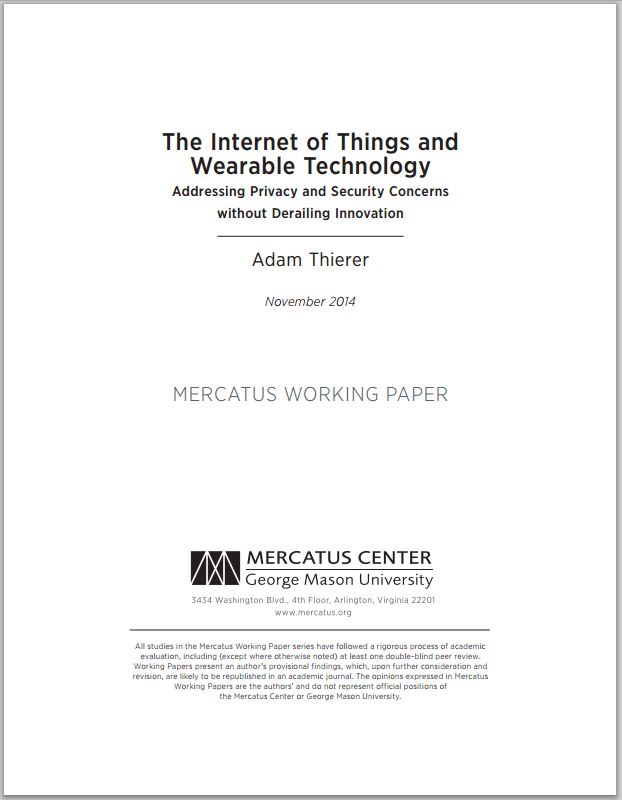 The Mercatus Center at George Mason University has just released my latest working paper, “The Internet of Things and Wearable Technology: Addressing Privacy and Security Concerns without Derailing Innovation.” The “Internet of Things” (IoT) generally refers to “smart” devices that are connected to both the Internet and other devices. Wearable technologies are IoT devices that are worn somewhere on the body and which gather data about us for various purposes. These technologies promise to usher in the next wave of Internet-enabled services and data-driven innovation. Basically, the Internet will be “baked in” to almost everything that consumers own and come into contact with.
Some critics are worried about the privacy and security implications of the Internet of Things and wearable technology, however, and are proposing regulation to address these concerns. In my new 93-page article, I explain why preemptive, top-down regulation would derail the many life-enriching innovations that could come from these new IoT technologies. Building on a recent book of mine, I argue that “permissionless innovation,” which allows new technology to flourish and develop in a relatively unabated fashion, is the superior approach to the Internet of Things.
As I note in the paper and my earlier book, if we spend all our time living in fear of the worst-case scenarios — and basing public policies on them — then best-case scenarios can never come about. As the old saying goes: nothing ventured, nothing gained. Precautionary principle-based regulation paralyzes progress and must be avoided. We instead need to find constructive, “bottom-up” solutions to the privacy and security risks accompanying these new IoT technologies instead of top-down controls that would limit the development of life-enriching IoT innovations. Continue reading →


 The Technology Liberation Front is the tech policy blog dedicated to keeping politicians' hands off the 'net and everything else related to technology.