Written with Christopher Koopman and Brent Skorup (originally published on Medium on 4/10/17)
Innovation isn’t just about the latest gee-whiz gizmos and gadgets. That’s all nice, but something far more profound is at stake: Innovation is the single most important determinant of long-term human well-being. There exists widespread consensus among historians, economists, political scientists and other scholars that technological innovation is the linchpin of expanded economic growth, opportunity, choice, mobility, and human flourishing more generally. It is the ongoing search for new and better ways of doing things that drives human learning and prosperity in every sense — economic, social, and cultural.
As the Industrial Revolution revealed, leaps in economic and human growth cannot be planned. They arise from societies that reward risk takers and legal systems that accommodate change. Our ability to achieve progress is directly proportional to our willingness to embrace and benefit from technological innovation, and it is a direct result of getting public policies right.
The United States is uniquely positioned to lead the world into the next era of global technological advancement and wealth creation. That’s why we and our colleagues at the Technology Policy Program at the Mercatus Center at George Mason University devote so much time and energy to defending the importance of innovation and countering threats to it. Unfortunately, those threats continue to multiply as fast as new technologies emerge. Continue reading →
Today, the U.S. Department of Transportation released its eagerly-awaited “Federal Automated Vehicles Policy.” There’s a lot to like about the guidance document, beginning with the agency’s genuine embrace of the potential for highly automated vehicles (HAVs) to revolutionize this sector and save thousands of lives annually in the process.
It is important we get HAV policy right, the DOT notes, because, “35,092 people died on U.S. roadways in 2015 alone” and “94 percent of crashes can be tied to a human choice or error.” (p. 5) HAVs could help us reverse that trend and save thousands of lives and billions in economic costs annually. The agency also documents many other benefits associated with HAVs, such as increasing personal mobility, reducing traffic and pollution, and cutting infrastructure costs.
I will not attempt here to comment on every specific recommendation or guideline suggested in the new DOT guidance document. I could nit-pick about some of the specific recommended guidelines, but I think many of the guidelines are quite reasonable, whether they are related to safety, security, privacy, or state regulatory issues. Other issues need to be addressed and CEI’s Marc Scribner does a nice job documenting some of them is his response to the new guidelines.
Instead of discussing those specific issues today, I want to ask a more fundamental and far-reaching question which I have been writing about in recent papers and essays:
Is this guidance or regulation? And what does the use of informal guidance mechanisms like these signal for the future of technological governance more generally? Continue reading →
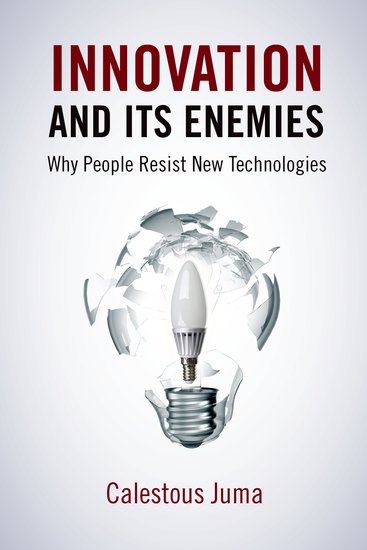
“The quickest way to find out who your enemies are is to try doing something new.” Thus begins Innovation and Its Enemies, an ambitious new book by Calestous Juma that will go down as one of the decade’s most important works on innovation policy.
Juma, who is affiliated with the Harvard Kennedy School’s Belfer Center for Science and International Affairs, has written a book that is rich in history and insights about the social and economic forces and factors that have, again and again, lead various groups and individuals to oppose technological change. Juma’s extensive research documents how “technological controversies often arise from tensions between the need to innovate and the pressure to maintain continuity, social order, and stability” (p. 5) and how this tension is “one of today’s biggest policy challenges.” (p. 8)
What Juma does better than any other technology policy scholar to date is that he identifies how these tensions develop out of deep-seated psychological biases that eventually come to affect attitudes about innovations among individuals, groups, corporations, and governments. “Public perceptions about the benefits and risks of new technologies cannot be fully understood without paying attention to intuitive aspects of human psychology,” he correctly observes. (p. 24) Continue reading →
I’m pleased to announce the publication of my latest law review article, “Guns, Limbs, and Toys: What Future for 3D Printing?” The article, which appears in Vol. 17 of the Minnesota Journal of Law, Science & Technology, was co-authored with Adam Marcus. Here’s the abstract:
We stand on the cusp of the next great industrial revolution thanks to technological innovations and developments that could significantly enhance the welfare of people across the world. This article will focus on how one of those modern inventions–3D printing–could offer the public significant benefits, but not without some serious economic, social, and legal disruptions along the way. We begin by explaining what 3D printing is and how it works. We also discuss specific applications of this technology and its potential benefits. We then turn to the policy frameworks that could govern 3D printing technologies and itemize a few of the major public policy issues that are either already being discussed, or which could become pertinent in the future. We offer some general guidance for policymakers who might be pondering the governance of 3D printing technologies going forward. Contra to the many other articles and position papers that have already been penned about 3D printing policy, which only selectively defend permissionless innovation in narrow circumstances, we endorse it as the default rule across all categories of 3D printing applications.
More specifically, we do a deep dive into 3 primary public policy “fault lines” for 3D printing: firearms, medical devices, and intellectual property concerns. Read the whole thing for more details.
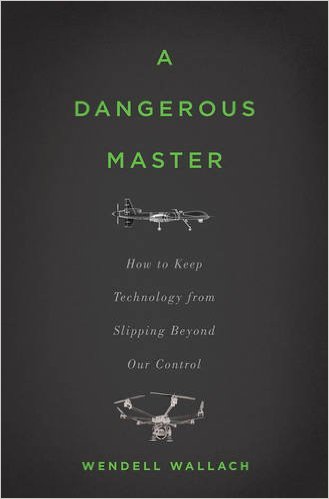
On May 3rd, I’m excited to be participating in a discussion with Yale University bioethicist Wendell Wallach at the Microsoft Innovation & Policy Center in Washington, DC. (RSVP here.) Wallach and I will be discussing issues we write about in our new books, both of which focus on possible governance models for emerging technologies and the question of how much preemptive control society should exercise over new innovations.
Of all the books of technological criticism or skepticism that I’ve read in recent years—and I have read stacks of them!—
A Dangerous Master is by far the most thoughtful and interesting. I have grown accustomed to major works of technological criticism being caustic, angry affairs. Most of them are just dripping with dystopian dread and a sense of utter exasperation and outright disgust at the pace of modern technological change.
Although he is certainly concerned about a wide variety of modern technologies—drones, robotics, nanotech, and more—Wallach isn’t a purveyor of the politics of panic. There are some moments in the book when he resorts to some hyperbolic rhetoric, such as when he frets about an impending “techstorm” and the potential, as the book’s title suggests, for technology to become a “dangerous master” of humanity. For the most part, however, his approach is deeper and more dispassionate than what is found in the leading tracts of other modern techno-critics.
I am pleased to announce the release of the second edition of my book, Permissionless Innovation: The Continuing Case for Comprehensive Technological Freedom. As with the first edition, the book represents a short manifesto that condenses — and attempts to make more accessible — arguments that I have developed in various law review articles, working papers, and blog posts over the past few years. The book attempts to accomplish two major goals.
First, I attempt to show how the central fault line in almost all modern technology policy debates revolves around “the permission question,” which asks:
Must the creators of new technologies seek the blessing of public officials before they develop and deploy their innovations? How that question is answered depends on the disposition one adopts toward new inventions. Two conflicting attitudes are evident.
One disposition is known as the “precautionary principle.” Generally speaking, it refers to the belief that new innovations should be curtailed or disallowed until their developers can prove that they will not cause any harms to individuals, groups, specific entities, cultural norms, or various existing laws, norms, or traditions.
The other vision can be labeled “permissionless innovation.” It refers to the notion that experimentation with new technologies and business models should generally be permitted by default. Unless a compelling case can be made that a new invention will bring serious harm to society, innovation should be allowed to continue unabated and problems, if they develop at all, can be addressed later.
I argue that we are witnessing a grand clash of visions between these two mindsets today in almost all major technology policy discussions today. Continue reading →
U.S. Commodity Futures Trading Commission (CFTC) Commissioner J. Christopher Giancarlo delivered an amazing address this week before the Depository Trust & Clearing Corporation 2016 Blockchain Symposium. The title of his speech was “Regulators and the Blockchain: First, Do No Harm,” and it will go down as the definitive early statement about how policymakers can apply a principled, innovation-enhancing policy paradigm to distributed ledger technology (DLT) or “blockchain” applications.
“The potential applications of this technology are being widely imagined and explored in ways that will benefit market participants, consumers and governments alike,” Giancarlo noted in his address. But in order for that to happen, he said, we have to get policy right. “It is time again to remind regulators to ‘do no harm,'” he argued, and he continued on to note that
The United States’ global leadership in technological innovation of the Internet was built hand-in-hand with its enlightened “do no harm” regulatory framework. Yet, when the Internet developed in the mid-1990s, none of us could have imagined its capabilities that we take for granted today. Fortunately, policymakers had the foresight to create a regulatory environment that served as a catalyst rather than a choke point for innovation. Thanks to their forethought and restraint, Internet-based applications have revolutionized nearly every aspect of human life, created millions of jobs and increased productivity and consumer choice. Regulators must show that same forethought and restraint now [for the blockchain].
What Giancarlo is referring to is the approach that the U.S. government adopted toward the Internet and digital networks in the mid-1990s. You can think of this vision as “permissionless innovation.” As I explain in my recent book of the same title, permissionless innovation refers to the notion that we should generally be free to experiment and learn new and better ways of doing things through ongoing trial-and-error. Continue reading →
The success of the Internet and the modern digital economy was due to its open, generative nature, driven by the ethos of “permissionless innovation.” A “light-touch” policy regime helped make this possible. Of particular legal importance was the immunization of online intermediaries from punishing forms of liability associated with the actions of third parties.
As “software eats the world” and the digital revolution extends its reach to the physical world, policymakers should extend similar legal protections to other “generative” tools and platforms, such as robotics, 3D printing, and virtual reality.
Throughout the year, I collect some of the more notable tech policy-related essays that I’ve read and then publish an end-of-year list here. (Here, for example, are my end-of-year lists from 2014 and 2013.) So, here are some of my favorite essays and editorials from 2015. (Note: They are just in chronological order. No ranking here.)
Larry Downes – “Take note Republicans and Democrats, this is what a pro-innovation platform looks like,” Washington Post, January 7. (Downes explains how governments need to adapt to accommodate and embrace new forms of technological innovation. He notes: “Here at home, the opportunity to wrap themselves in the flag of innovation is knocking for both parties, but so far there are few takers. Republicans and Democrats regularly invoke the rhetoric of innovation, entrepreneurship, and the transformative power of technology. But in reality neither party pursues policies that favor the disruptors. Instead, where lawmakers once took a largely hands-off approach to Silicon Valley, as the Internet revolution enters a new stage of industry transformation, the temptation to intervene, to usurp, to micromanage, to circumscribe the future — becomes irresistible.”) Equally excellent was Larry’s essay later in the year, “Fewer, Faster, Smarter.” (“As the technology revolution proceeds, the concept of government may return to its pre-industrial roots, setting the most basic rules of the economy and standing by as regulator of last resort when markets fail for some or all consumers over an extended period of time. Even then, the solution may simply be to tweak the incentives to encourage better behavior, rather than more full-fledged—and usually ill-fated—micromanagement of fast-changing industries.”)
Bryant Walker Smith – “Slow Down That Runaway Ethical Trolley,” CIS Blog, January 12. (Smith, a leading expert on autonomous vehicle systems, notes that, while serious ethical dilemmas will always be present with such technologies, we should not allow the perfect to be the enemy of the good. “The fundamental ethical question, in my opinion, is this: In the United States alone, tens of thousands of people die in motor vehicle crashes every year, and many more are injured. Automated vehicles have great potential to one day reduce this toll, but the path to this point will involve mistakes and crashes and fatalities. Given this stark choice, what is the proper balance between caution and urgency in bringing these systems to the market? How safe is safe enough?”)
Andrew McAfee – “Who are the humanists, and why do they dislike technology so much?” Financial Times, July 7, 2015. (A brief but brilliant exploration of the philosophical fight over differing conceptions of “humanism.” McAfee, appropriately in my opinion, calls into question technological critics who self-label themselves “humanists” and then suggest that those who believe in the benefits of technological innovation and progress are somehow opposed to humanity. In reality, of course, nothing could be further from the truth!)
Jocelyn Brewer – “Techno-Fear is Hurting Kids, Not Their Use of Digital Devices,” July 7, 2015. (A beautiful piece that makes it clear why “the Internet… is not addictive. Technology is not a drug.” Brewer continues on to make the case for avoiding fear-based messaging about Internet problems and instead adopting a more sensible approach: “Rather than trotting out interminable lists of the negative consequences of our adoption of technology lets raise awareness of how to avoid the pitfalls of not approaching this new era with solutions and proactive thinking.” Amen, sister!)
Evan Ackerman – “We Should Not Ban ‘Killer Robots,’ and Here’s Why,” IEEE Spectrum, July 29, 2015, (A thought-provoking piece about a controversial subject in which Ackerman argues that “banning the technology is not going to solve the problem if the problem is the willingness of humans to use technology for evil”)
Tim O’Reilly – “Networks and the Nature of the Firm,” Medium, August 14, 2015. (Explores the economics of the sharing economy and “the huge economic shift led by software and connectedness.”)
Joe Queenan – “America’s Need for Pointless Updates and Cat Videos,” Wall Street Journal, December 3, 2015. (“The back-to-nature, turn-off-your-cellphone movement is based on a false assumption. . . . Time not spent doing dumb stuff would otherwise be wasted doing other dumb stuff. It’s called ‘play,’ without which Jack is a dull boy. It is a variation on the old saying that nature abhors a vacuum. So nature created the Internet.”)
Dominic Basulto – “Can we just stop with all these tech dystopia stories?” Washington Post, Dec 8, 2015. (“Yes, a dystopian future is possible, but so is a utopian future. Most likely, the answer is somewhere in the middle, the way it’s been for millennia.”)
I recently finishedLearning by Doing: The Real Connection between Innovation, Wages, and Wealth, by James Bessen of the Boston University Law School. It’s a good book to check out if you are worried about whether workers will be able to weather this latest wave of technological innovation. One of the key insights of Bessen’s book is that, as with previous periods of turbulent technological change, today’s workers and businesses will obviously need find ways to adapt to rapidly-changing marketplace realities brought on by the Information Revolution, robotics, and automated systems.
That sort of adaptation takes time, but for technological revolutions to take hold and have meaningful impact on economic growth and worker conditions, it requires that large numbers of ordinary workers acquire new knowledge and skills, Bessen notes. But, “that is a slow and difficult process, and history suggests that it often requires social changes supported by accommodating institutions and culture.” (p 223) That is not a reason to resist disruptive forms of technological change, however. To the contrary, Bessen says, it is crucial to allow ongoing trial-and-error experimentation and innovation to continue precisely because it represents a learning process which helps people (and workers in particular) adapt to changing circumstances and acquire new skills to deal with them. That, in a nutshell, is “learning by doing.” As he elaborates elsewhere in the book:
Major new technologies become ‘revolutionary’ only after a long process of learning by doing and incremental improvement. Having the breakthrough idea is not enough. But learning through experience and experimentation is expensive and slow. Experimentation involves a search for productive techniques: testing and eliminating bad techniques in order to find good ones. This means that workers and equipment typically operate for extended periods at low levels of productivity using poor techniques and are able to eliminate those poor practices only when they find something better. (p. 50)
Luckily, however, history also suggests that, time and time again, that process has happened and the standard of living for workers and average citizens alike improved at the same time. Continue reading →
The Technology Liberation Front is the tech policy blog dedicated to keeping politicians' hands off the 'net and everything else related to technology. Learn more about TLF →



 The Technology Liberation Front is the tech policy blog dedicated to keeping politicians' hands off the 'net and everything else related to technology.