Posts tagged as:

We hear a lot today about the importance of “disruptive innovation,” “deep technologies,”  “moonshots,” and even “technological miracles.” What do these terms mean and how are they related? Are they just silly clichés used to hype techno-exuberant books, articles, and speeches? Or do these terms have real meaning and importance?

This article explores those questions and argues that, while these terms are confronted with definitional challenges and occasional overuse, they retain real importance to human flourishing, economic growth, and societal progress.

Basic Concepts

Don Boudreaux defines moonshots as, “radical but feasible solutions to important problems” and Mike Cushing has referred to them as “innovation that achieves the previously unthinkable.” “Deep technology” is another buzzword being used to describe such revolutionary and important innovations. Swati Chaturvedi of investment firm Propel[x] says deep technologies are innovations that are “built on tangible scientific discoveries or engineering innovations” and “are trying to solve big issues that really affect the world around them.”

“Disruptive technology” or “game-changing innovations” are other terms that are often used in reference to technologies and inventions with major societal impacts. “Transformative technologies” is another increasingly popular term, albeit one focused mostly on health and wellness-related innovations. Continue reading →


I recently posted an essay over at The Bridge about “The Pacing Problem and the Future of Technology Regulation.” In it, I explain why the pacing problem—the notion that technological innovation is increasingly outpacing the ability of laws and regulations to keep up—“is becoming the great equalizer in debates over technological governance because it forces governments to rethink their approach to the regulation of many sectors and technologies.”

In this follow-up article, I wanted to expand upon some of the themes developed in that essay and discuss how they relate to two other important concepts: the “Collingridge Dilemma” and technological determinism. In doing so, I will build on material that is included in a forthcoming law review article I have co-authored with Jennifer Skees, Ryan Hagemann (“Soft Law for Hard Problems: The Governance of Emerging Technologies in an Uncertain Future”) as well as a book I am finishing up on the growth of “evasive entrepreneurialism” and “technological civil disobedience.”

Recapping the Nature of the Pacing Problem

First, let us quickly recap that nature of “the pacing problem.” I believe Larry Downes did the best job explaining the “problem” in his 2009 book on The Laws of Disruption. Downes argued that “technology changes exponentially, but social, economic, and legal systems change incrementally” and that this “law” was becoming “a simple but unavoidable principle of modern life.” Continue reading →

[first published at The Bridge on August 9, 2018]

What happens when technological innovation outpaces the ability of laws and regulations to keep up?

This phenomenon is known as “the pacing problem,” and it has profound ramifications for the governance of emerging technologies. Indeed, the pacing problem is becoming the great equalizer in debates over technological governance because it forces governments to rethink their approach to the regulation of many sectors and technologies.

The Innovation Cornucopia

Had Rip Van Winkle woken up his famous nap today, he’d be shocked by all the changes around him. At-home genetics tests, personal drones, driverless cars, lab-grown meats, and 3D-printed prosthetic limbs are just some of the amazing innovations that would boggle his mind. New devices and services are flying at us so rapidly that we sometimes forget that most did not even exist a short time ago. Continue reading →

Dan Wang has a new post titled “How Technology Grows (a restatement of definite optimism)” and it is characteristically good. For tech policy wonks and policymakers, put it in your queue. The essay clocks in at 7500 words, but there’s a lot to glean from the piece. Indeed, he puts into words a number of ideas I’ve been wanting to write about. To set the stage, he begins first by defining what we mean by technology:

Technology should be understood in three distinct forms: as processes embedded into tools (like pots, pans, and stoves); explicit instructions (like recipes); and as process knowledge, or what we can also refer to as tacit knowledge, know-how, and technical experience. Process knowledge is the kind of knowledge that’s hard to write down as an instruction. You can give someone a well-equipped kitchen and an extraordinarily detailed recipe, but unless he already has some cooking experience, we shouldn’t expect him to prepare a great dish.

As he rightly points out, the United States has, for various reasons, set aside the focus on process knowledge. Where this is especially evident comes in our manufacturing base:

When firms and factories go away, the accumulated process knowledge disappears as well. Industrial experience, scaling expertise, and all the things that come with learning-by-doing will decay. I visited Germany earlier this year to talk to people in industry. One point Germans kept bringing up was that the US has de-industrialized itself and scattered its production networks. While Germany responded to globalization by moving up the value chain, the US manufacturing base mostly responded by abandoning production.

The US is an outlier among rich countries when it comes to manufacturing exports. It needs improvement. Continue reading →

The White House has announced a new effort to help prepare workers for the challenges they will face in the future. While it’s a well-intentioned effort, and one that I hope succeeds, I’m skeptical about it for a simple reason: It’s just really hard to plan for the workforce needs of the future and train people for jobs that we cannot possibly envision today.

Writing in the Wall Street Journal today, Ivanka Trump, senior adviser to the president, outlines the elements of new Executive Order that President Trump is issuing “to prioritize and expand workforce development so that we can create and fill American jobs with American workers.” Toward that end, the Administration plans on:

  • establishing a National Council for the American Worker, “composed of senior administration officials, who will develop a national strategy for training and retraining workers for high-demand industries.” This is meant to bring more efficiency and effectiveness to the “more than 40 workforce-training programs in more than a dozen agencies, and too many have produced meager results.”
  • “facilitat[ing] the use of data to connect American businesses, workers and educational institutions.” This is meant to help workers find “what jobs are available, where they are, what skills are required to fill them, and where the best training is available.”
  • launching a nationwide campaign “to highlight the growing vocational crisis and promote careers in the skilled trades, technology and manufacturing.”
The Administration also plans on creating a new advisory board of experts to address these issues, and the administration is also “asking companies and trade groups throughout the country to sign our new Pledge to America’s Workers—a commitment to invest in the current and future workforce.” They hope to encourage companies to take additional steps “to educate, train and reskill American students and workers.” Perhaps some of these steps make sense, and perhaps a few will even help workers deal with the challenges of our more complex, fast-evolving, global economy. But I doubt it. Continue reading →

I’ve been working on a new book that explores the rise of evasive entrepreneurialism and technological civil disobedience in our modern world. Following the publication of my last book, Permissionless Innovation: The Continuing Case for Comprehensive Technological Freedom, people started bringing examples of evasive entrepreneurialism and technological civil disobedience to my attention and asked how they were related to the concept of permissionless innovation. As I started exploring and cataloging these cases studies, I realized I could probably write an entire book about these developments and their consequences.

Hopefully that book will be wrapped up shortly. In the meantime, I am going to start rolling out some short essays based on content from the book. To begin, I will state the general purpose of the book and define the key concepts discussed therein. In coming weeks and months, I’ll build on these themes, explain why they are on the rise, explore the effect they are having on society and technological governance efforts, and more fully develop some relevant case studies. Continue reading →

On Monday, April 16th, the Technology Policy Institute hosted an event on “Facebook & Cambridge Analytica: Regulatory & Policy Implications.” I was invited to deliver some remarks on a panel that included Howard Beales of George Washington University, Stuart Ingis of Venable LLP, Josephine Wolff of the Rochester Institute of Technology, and Thomas Lenard of TPI, who moderated. I offered some thoughts about the potential trade-offs associated with treating Facebook like a regulated public utility. I wrote an essay here last week on that topic. My remarks at the event begin at the 13:45 mark of the video.


We hear a lot these days about “technological moonshots.” It’s an interesting phrase because the meaning of both words in it are often left undefined. I won’t belabor the point about how people define–or, rather, fail to define–“technology” when they use it. I’ve already spent a lot of time writing about that problem. See, for example, this constantly updated essay here about “Defining ‘Technology.'” It’s a compendium I began curating years ago that collects what dozens of others have had to say on the matter. I’m always struck by how many different definitions are out there that I keep unearthing.

The term “moonshots” has a similar problem. The first meaning is the literal one that hearkens back to President Kennedy’s famous 1962 “we choose to go to the moon” speech. That use of the terms implies large government programs and agencies, centralized control, and top-down planning with a very specific political objective in mind. Increasingly, however, the term “moonshot” is used more generally, as I note in this new Mercatus essay about “Making the World Safe for More Moonshots.”  My Mercatus Center colleague Donald Boudreaux has referred to moonshots as, “radical but feasible solutions to important problems,” and  Mike Cushing of Enterprise Innovation  defines a moonshot as an “innovation that achieves the previously unthinkable.” I like that more generic use of the term and think it could be used appropriately when discussing the big innovations many of us hope to see in fields as diverse as quantum computing, genetic editing, AI and autonomous systems, supersonic transport, and much more. I still have some reservations about the term, but I think it’s definitely a better term than “disruptive innovation,” which is also used differently by various scholars and pundits.

Continue reading →

[Remarks p repared for Fifth Annual Conference on Governance of Emerging Technologies: Law, Policy & Ethics at Arizona State University, Phoenix, AZ, May 18, 2017.]

_________________

What are we to make of this peculiar new term “permissionless innovation,” which has gained increasing currency in modern technology policy discussions? And how much relevance has this notion had—or should it have—on those conversations about the governance of emerging technologies? That’s what I’d like to discuss here today.

Uncertain Origins, Unclear Definitions

I should begin by noting that while I have written a book with the term in the title, I take no credit for coining the phrase “permissionless innovation,” nor have I been able to determine who the first person was to use the term. The phrase is sometimes attributed to Grace M. Hopper, a computer scientist who was a rear admiral in the United States Navy. She once famously noted that, “It’s easier to ask forgiveness than it is to get permission.”

“Hopper’s Law,” as it has come to be known in engineering circles, is probably the most concise articulation of the general notion of “permissionless innovation” that I’ve ever heard, but Hopper does not appear to have ever used the actual phrase anywhere. Moreover, Hopper was not necessarily applying this notion to the realm of technological governance, but was seemingly speaking more generically about the benefit of trying new things without asking for the blessing of any number of unnamed authorities or overseers—which could include businesses, bosses, teachers, or perhaps even government officials. Continue reading →

[originally posted on Medium ]

Today is the anniversary of the day the machines took over.

Exactly twenty years ago today, on May 11, 1997, the great chess grandmaster Garry Kasparov became the first chess world champion to lose a match to a supercomputer. His battle with IBM’s “Deep Blue” was a highly-publicized media spectacle, and when he lost Game 6 of his match against the machine, it shocked the world.

At the time, Kasparov was bitter about the loss and even expressed suspicions about how Deep Blue’s team of human programmers and chess consultants might have tipped the match in favor of machine over man. Although he still wonders about how things went down behind the scenes during the match, Kasparov is no longer as sore as he once was about losing to Deep Blue. Instead, Kasparov has built on his experience that fateful week in 1997 and learned how he and others can benefit from it.

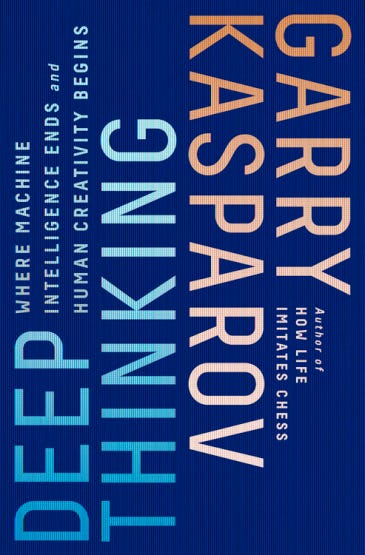
The result of this evolution in his thinking is Deep Thinking: Where Machine Intelligence Ends and Human Creativity Begins, a book which serves as a paean to human resiliency and our collective ability as a species to adapt in the face of technological disruption, no matter how turbulent.

Kasparov’s book serves as the perfect antidote to the prevailing gloom-and-doom narrative in modern writing about artificial intelligence (AI) and smart machines. His message is one of hope and rational optimism about future in which we won’t be racing against the machines but rather running alongside them and benefiting in the process.

Overcoming the Technopanic Mentality

There is certainly no shortage of books and articles being written today about AI, robotics, and intelligent machines. The tone of most of these tracts is extraordinarily pessimistic. Each page is usually dripping with dystopian dread and decrying a future in which humanity is essentially doomed.

As I noted in a recent essay about “The Growing AI Technopanic,” after reading through most of these books and articles, one is left to believe that in the future: “Either nefarious-minded robots enslave us or kill us, or AI systems treacherously trick us, or at a minimum turn our brains to mush.” These pessimistic perspectives are clearly on display within the realm of fiction, where every sci-fi book, movie, or TV show depicts humanity as certain losers in the proverbial “race” against machines. But such lugubrious lamentations are equally prevalent within the pages of many non-fiction books, academic papers, editorials, and journalistic articles.

Given the predominantly panicky narrative surrounding the age of smart machines, Kasparov’s Deep Thinking serves as a welcome breath of fresh air. The aim of his book is finding ways of “doing a smarter job of humans and machines working together” to improve well-being. Continue reading →