In my latest column for The Hill, I consider that dangers of government gambling our tax dollars on risky industrial policy programs. I begin by noting:
Roll the dice at a casino enough times, and you are bound to win a few games. But knowing the odds are not in your favor, how much are you willing to risk losing by continuing to gamble?
This is the same issue governments confront when they gamble taxpayer dollars on industrial policy efforts, which can best be described as targeted and directed efforts to plan for specific future industrial outputs and outcomes. Throwing enough money at risky ventures might net a few wins, but at what cost? Could those resources have been better spent? And do bureaucrats really make better bets than private investors?
I continue on to note that, while the US is embarking on a major new industrial policy push, history does not provide us with a lot of hope regarding Uncle Sam’s betting record when he starts rolling those industrial policy dice. “How much tolerance should the public have for government industrial policy gambling?” I ask. I continue on:
Generally speaking, “basic” support (broad-based funding for universities and research labs) is wiser than “applied” (targeted subsidies for specific firms or sectors). With basic R&D funding, the chances of wasting resources on risky investments can be contained, at least as compared to highly targeted investments in unproven technologies and firms.
I also argue that “The riskiest bets on new technologies and sectors are better left to private investors,” and note how, “America’s venture capital industry remains the envy of the world because it continues to power world-beating advanced technology.” Accordingly, I conclude: Continue reading →
Industrial Policy is a red-hot topic once again with many policymakers and pundits of different ideological leanings lining up to support ambitious new state planning for various sectors — especially 5G, artificial intelligence, and semiconductors. A remarkably bipartisan array of people and organizations are advocating for government to flex its muscle and begin directing more spending and decision-making in various technological areas. They all suggest some sort of big plan is needed, and it is not uncommon for these industrial policy advocates to suggest that hundreds of billions will need to be spent in pursuit of those plans.
Others disagree, however, and I’ll be using this post to catalog some of their concerns on an ongoing basis. Some of the criticisms listed here are portions of longer essays, many of which highlight other types of steps that governments can take to spur innovative activities. Industrial policy is an amorphous term with many definitions of a broad spectrum of possible proposals. Almost everyone believes in
some form of industrial policy if you define the term broadly enough. But, as I argued in a September 2020 essay “On Defining ‘Industrial Policy‘,” I believe it is important to narrow the focus of the term such that we can continue to use the term in a rational way. Toward that end, I believe a proper understanding of industrial policy refers to targeted and directed efforts to plan for specific future industrial outputs and outcomes.
The collection of essays below is merely an attempt to highlight some of the general concerns about the most ambitious calls for expansive industrial policy, many of which harken back to debates I was covering in the late 1980s and early 1990s, when I first started a career in policy analysis. During that time, Japan and South Korea were the primary countries of concern cited by industrial policy advocates. Today, it is China’s growing economic standing that is fueling calls for ambitious state-led targeted investments in “strategic” sectors and technologies. To a lesser extent, grandiose European industrial policy proposals are also prompting new US counter-proposals.
All this activity is what has given rise to many of the critiques listed below. If you have suggestions for other essays I might add to this list, please feel free to pass them along. FYI: There’s no particular order here.
Calls for revitalizing American industrial policy have multiplied in recent years, with many pundits and policymakers suggesting that the U.S. should consider taking on Europe and China by emulating their approaches to technological development. The goal would be to have Washington formulate a set of strategic innovation goals and mobilize government planning and spending around them.
We continue on to argue that what most of these advocates miss is that:
China’s targeting efforts are often antithetical to both innovation and liberty, and involve plenty of red tape and bureaucracy. China has become a remarkably innovative country for many reasons, including its greater tolerance for risk-taking, even as the Chinese Communist Party continues to pump resources into strategic sectors. But most Chinese innovation is permissible only insomuch as it furthers the party’s objectives, a strategy the U.S. obviously wouldn’t want to copy.
We discuss the problems associated with some of those Chinese efforts as well as proposed US responses, like the recently released 756 page report from the National Security Commission on Artificial Intelligence. The report takes an everything-and-the-kitchen-sink approach to state direction for new AI-related efforts and spending. While that report says the government now must “drive change through top-down leadership” in order to “win the AI competition that is intensifying strategic competition with China,” we argue that there could be some serious pitfalls with top-down, high price tag approaches.
Jump over to the
Discourse site to read the full essay, as well as our previous essay, which asked, “Can European-Style Industrial Policies Create Tech Supremacy?” These two essay build on the research Connor and I have been doing on global artificial intelligence policies in the US, China, and the EU. In a much longer forthcoming white paper, we explore both the regulatory and industrial policy approaches for AI being adopted in the US, China, and the EU. Stay tuned for more.
Over at Discourse magazine, Connor Haaland and I have an new essay (“Can European-Style Industrial Policies Create Tech Supremacy?”) examining Europe’s effort to develop national champion in a variety of tech sectors using highly targeted industrial policy efforts. The results have not been encouraging, we find.
Thus far, however, the Europeans don’t have much to show for their attempts to produce home-grown tech champions. Despite highly targeted and expensive efforts to foster a domestic tech base, the EU has instead generated a string of industrial policy failures that should serve as a cautionary tale for U.S. pundits and policymakers, who seem increasingly open to more government-steered innovation efforts.
We examine case studies in internet access, search, GPS, video services, and the sharing economy. We then explore newly-proposed industrial policy efforts aimed at developing their domestic AI market. We note how:
no amount of centralized state planning or spending will be able to overcome Europe’s aversion to technological risk-taking and disruption. The EU’s innovation culture generally values stability—of existing laws, institutions and businesses—over disruptive technological change. […]
There are no European versions of Microsoft, Google or Apple, even though Europeans obviously demand and consume the sort of products and services those U.S.-based companies provide. It’s simply not possible given the EU’s current regulatory regime.
It seems unlikely that Europe will have much better luck developing home-grown champions in AI and robotics using this same playbook. “American academics and policymakers with an affinity for industrial policy might want to consider a model other than Europe’s misguided combination of fruitless state planning and heavy-handed regulatory edicts,” we conclude.
This report was a major undertaking that involved dozens of interviews, extensive historic research, several events and presentations, and then numerous revisions before the final product was released. The final PDF version of the journal article is attached.
[This article originally appeared at Discourse on January 6, 2021.]
Time magazine recently declared 2020 “The Worst Year Ever.” By historical standards that may be a bit of hyperbole. For America’s digital technology sector, however, that headline rings true. After a remarkable 25-year run that saw an explosion of innovation and the rapid ascent of a group of U.S. companies that became household names across the globe, politicians and pundits in 2020 declared the party over.
“We now are on the cusp of a new era of tech policy, one in which the policy catches up with the technology,” says Darrell M. West of the Brookings Institution in a recent essay, “The End of Permissionless Innovation.” West cites the House Judiciary Antitrust Subcommittee’s October report on competition in digital markets—where it equates large tech firms with the “oil barons and railroad tycoons” of the Gilded Age—as the clearest sign that politicization of the internet and digital technology is accelerating.
It is hardly the only indication that America is set to abandon permissionless innovation and revisit the era of heavy-handed regulation for information and communication technology (ICT) markets. Equally significant is the growing bipartisan crusade against Section 230, the provision of the 1996 Telecommunications Act that shields “interactive computer services” from liability for information posted or published on their systems by users. No single policy has been more important to the flourishing of online speech or commerce than Sec. 230 because, without it, online platforms would be overwhelmed by regulation and lawsuits.
But now, long knives are coming out for the law, with plenty of politicians and academics calling for it to be gutted. Calls to reform or repeal Sec. 230 were once exclusively the province of left-leaning academics or policymakers, but this year it was conservatives in the White House, on Capitol Hill and at the Federal Communications Commission (FCC) who became the leading cheerleaders for scaling back or eliminating the law. President Trump railed against Sec. 230 repeatedly on Twitter, and most recently vetoed the annual National Defense Authorization Act in part because Congress did not include a repeal of the law in the measure.
Meanwhile, conservative lawmakers in Congress such as Sens. Josh Hawley and Ted Cruz have used subpoenas, angry letters and heated hearings to hammer digital tech executives about their content moderation practices. Allegations of anti-conservative bias have motivated many of these efforts. Even Supreme Court Justice Clarence Thomas questioned the law in a recent opinion.
Other proposed regulatory interventions include calls for new national privacy laws, an “Algorithmic Accountability Act” to regulate artificial intelligence technologies, and a growing variety of industrial policy measures that would open the door to widespread meddling with various tech sectors. Some officials in the Trump administration even pushed for a nationalized 5G communications network in the name of competing with China.
This growing “techlash” signals a bipartisan “Back to the Future” moment, with the possibility of the U.S. reviving a regulatory playbook that many believed had been discarded in history’s dustbin. Although plenty of politicians and pundits are taking victory laps and giving each other high-fives over the impending end of the permissionless innovation era, it is worth considering what America will be losing if we once again apply old top-down, permission slip-oriented policies to the technology sector. Continue reading →
Marc Andreessen is interviewed by Sriram Krishan in his new newsletter, The Observer Effect, and asked what motivates him to support technological innovation and “to go read up on a new topic every day” related to tech and progress. His answer is inspirational and perfectly encapsulates why I also have made technological progress the focus of my life’s work:
I am a deep believer in – after learning a lot over the years about economic history and of cultural history – that technology really is the driver. There were basically millennia of just subsistence farming industry and all of a sudden, there was this vertical takeoff a few hundred years ago. And quality of life exploded around the world. Not evenly but starting in Europe and expanding out. It’s basically all technology. It’s always the printing press, it’s the internet and on and on. And you get this incredible upward trajectory. We have the potential over the course of the next century or over the next few centuries to really dramatically advance and have life be better for virtually everybody. Technology is quite literally the lever for being able to take natural resources and able to make something better out of them.
And so it’s just it’s the most interesting and by far the most useful and the most beneficial thing I can think of doing.
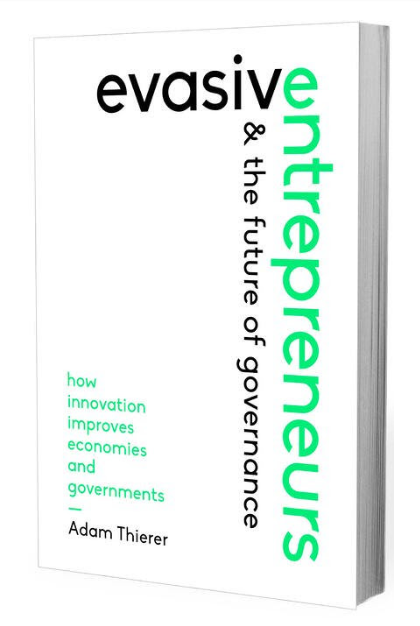
Amen, brother! I devoted my last two books
(Permissionless Innovation and Evasive Entrepreneurs) and all my life’s work, to proving that exact point. Also, I really like Andreessen’s definition of technology as, “the lever for being able to take natural resources and able to make something better out of them.” I’ve added that to my running compendium, “Defining Technology,” which features various definitions of technology.
A pandemic is no time for bad governance. As the COVID-19 crisis intensified, bureaucrats and elected officials slumbered. Government regulations prevented many in the private sector from helping with response efforts. The result was a sudden surge of evasive entrepreneurialism and technological civil disobedience. With institutions and policies collapsing around them, many people took advantage of cutting‐edge technological capabilities to evade public policies that were preventing practical solutions from emerging.
Examples were everywhere. Distilleries started producing hand sanitizers to address shortages while average folks began sharing do‐it‐yourself sanitizer recipes online. The Food and Drug Administration (FDA) looked to modify hand sanitizer guidelines quickly to allow for it, but few really cared because those rules weren’t going to stop them. Gray markets in face masks, medical face shields, and respirators developed. Some people and organizations worked together to make medical devices using off‐the‐shelf hardware and open source software. More simply, others just fired up sewing machines to make masks—and then, faced with an emerging public health consensus, the guidance from the federal government shifted dramatically: where formerly ordinary people were instructed not to buy or use masks, within a matter of days, the policy reversed, and all were encouraged to make and use cloth protective masks. Continue reading →
The Technology Liberation Front is the tech policy blog dedicated to keeping politicians' hands off the 'net and everything else related to technology. Learn more about TLF →
 In my latest column for The Hill, I consider that dangers of government gambling our tax dollars on risky industrial policy programs. I begin by noting:

 The Technology Liberation Front is the tech policy blog dedicated to keeping politicians' hands off the 'net and everything else related to technology.