Posts tagged as:

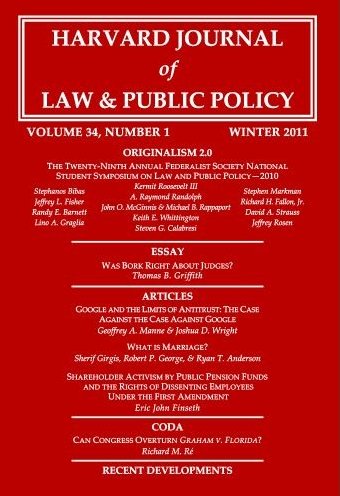
HJLPP coverI’m excited to announce the release of my latest law review article, “The Pursuit of Privacy in a World Where Information Control is Failing,” which appears in the next edition (vol. 36) of the Harvard Journal of Law & Public Policy. This is the first of two complimentary law review articles that I will be releasing this year dealing with privacy policy. The second, which will be published later this summer by the George Mason University Law Review, is entitled, “A Framework for Benefit-Cost Analysis in Digital Privacy Debates.” (FYI: Both articles focus on privacy claims made against private actors — namely, efforts to limit private data collection — and not on privacy rights against governments.)

The new Harvard Journal article is divided into three major sections. Part I focuses on some of normative challenges we face when discussing privacy and argues that there may never be a widely accepted, coherent legal standard for privacy rights or harms here in the United States. It also explores the tensions between expanded privacy regulation and online free speech. Part II turns to the many enforcement challenges that are often ignored when privacy policies are being proposed or formulated and argues that legislative and regulatory efforts aimed at protecting privacy must now be seen as an increasingly intractable information control problem. Most of the problems policymakers and average individuals face when it comes to controlling the flow of private information online are similar to the challenges they face when trying to control the free flow of digitalized bits in other information policy contexts, such as online safety, cybersecurity, and digital copyright.

If the effectiveness of law and regulation is limited by the normative considerations discussed in Part I and the practical enforcement complications discussed in Part II, what alternatives remain to assist privacy-sensitive individuals? I address that question in Part III of the paper and argue that the approach America has adopted to deal with concerns about objectionable online speech and child safety offers a path forward on the privacy front as well. Continue reading →

[Note: I later adapted this essay into a short book, which you can download for free here.]

Let’s talk about “permissionless innovation.” We all believe in it, right? Or do we? What does it really mean? How far are we willing to take it? What are its consequences? What is its opposite? How should we balance them?

What got me thinking about these questions was a recent essay over at The Umlaut by my Mercatus Center colleague Eli Dourado entitled, “‘Permissionless Innovation’ Offline as Well as On.” He opened by describing the notion of permissionless innovation as follows:

In Internet policy circles, one is frequently lectured about the wonders of “permissionless innovation,” that the Internet is a global platform on which college dropouts can try new, unorthodox methods without the need to secure authorization from anyone, and that this freedom to experiment has resulted in the flourishing of innovative online services that we have observed over the last decade.

Eli goes on to ask, “why it is that permissionless innovation should be restricted to the Internet. Can’t we have this kind of dynamism in the real world as well?”

That’s a great question, but let’s ponder an even more fundamental one: Does anyone really believe in the ideal of “permissionless innovation”? Is there anyone out there who makes a consistent case for permissionless innovation across the technological landscape, or is it the case that a fair degree of selective morality is at work here? That is, people love the idea of “permissionless innovation” until they find reasons to hate it — namely, when it somehow conflicts with certain values they hold dear. Continue reading →

Is geek culture sexist? Joseph Reagle, Assistant Professor of Communications Studies at Northeastern University and author of a new paper entitled, “Free as in Sexist? Free culture and the gender gap,” returns to Surprisingly Free to address geek feminism and the technology gender gap.

According to Reagle, only 1% of the free software community and 9% of Wikipedia editors are female, which he sees as emblematic of structural problems in the geek community. While he does not believe that being a geek or a nerd is in any way synonymous with being a sexist, he concludes that three things that he otherwise loves—geekiness, openness, and the rhetoric and ideology of freedom–are part of the problem inasmuch as they allow informal cliques to arise, dominate the discussion, and squeeze out minority views. Reagle also comments on a unintentional androcentricity he has observed even amongst free software community heroes, highlighting the ways in which this behavior can be alienating to women and prevents geek culture from growing beyond its traditional base.

Reagle prescribes a 3-step solution to sexism in geek culture: talking about gender; challenging and expanding what it means to be a geek; and not allowing the rhetoric of freedom to be used as an excuse for bad behavior.

Reagle further supports efforts to form female-only subcultures within the geek community, which opponents argue goes against the free software value of openness. Instead of the balkanization of their movement that opponents fear, these closed-group discussions actually strengthen geek culture at large, according to Reagle.

Download

Related Links

Ronald A. Cass, Dean Emeritus of Boston University School of Law, discusses his new book, Laws of Creation: Property Rights in the World of Ideas, which he co-authored with Boston University colleague Keith Hylton. Written as a primer for understanding intellectual property law and a defense of intellectual property, Laws of Creation explains the basis of IP and its justification. 

According to Cass, not all would-be reformers share a similar guiding philosophy, distinguishing between those who support property rights but nevertheless have specific critiques of the intellectual property system as it currently stands, and reformers who do not see a place for property.

Cass explains that the current intellectual property system is neither wholly good nor wholly bad, but is a matter of weighing tradeoffs. On the whole, he argues, intellectual property benefits society. Cass also argues that intellectual property law in the U.S. is still more functional than that in other countries, such as Italy, and that, while it would benefit from some reform, it is fundamentally a workable system.

Download

Related Links

By Geoffrey Manne & Berin Szoka

As Democrats insist that income taxes on the 1% must go up in the name of fairness, one Democratic Senator wants to make sure that the 1% of heaviest Internet users pay the same price as the rest of us. It’s ironic how confused social justice gets when the Internet’s involved.

Senator Ron Wyden is beloved by defenders of Internet freedom, most notably for blocking the Protect IP bill—sister to the more infamous SOPA—in the Senate. He’s widely celebrated as one of the most tech-savvy members of Congress. But his latest bill, the “Data Cap Integrity Act,” is a bizarre, reverse-Robin Hood form of price control for broadband. It should offend those who defend Internet freedom just as much as SOPA did.

Wyden worries that “data caps” will discourage Internet use and allow “Internet providers to extract monopoly rents,” quoting a New York Times editorial from July that stirred up a tempest in a teapot. But his fears are straw men, based on four false premises.

First, US ISPs aren’t “capping” anyone’s broadband; they’re experimenting with usage-based pricing—service tiers. If you want more than the basic tier, your usage isn’t capped: you can always pay more for more bandwidth. But few users will actually exceed that basic tier. For example, Comcast’s basic tier, 300 GB/month, is so generous that 98.5% of users will not exceed it. That’s enough for 130 hours of HD video each month (two full-length movies a day) or between 300 and 1000 hours of standard (compressed) video streaming.

Second, Wyden sets up a false dichotomy: Caps (or tiers, more accurately) are, according to Wyden, “appropriate if they are carefully constructed to manage network congestion,” but apparently for Wyden the only alternative explanation for usage-based pricing is extraction of monopoly rents. This simply isn’t the case, and propagating that fallacy risks chilling investment in network infrastructure. In fact, usage-based pricing allows networks to charge heavy users more, thereby recovering more costs and actually reducing prices for the majority of us who don’t need more bandwidth than the basic tier permits—and whose usage is effectively subsidized by those few who do. Unfortunately, Wyden’s bill wouldn’t allow pricing structures based on cost recovery—only network congestion. So, for example, an ISP might be allowed to price usage during times of peak congestion, but couldn’t simply offer a lower price for the basic tier to light users.

That’s nuts—from the perspective of social justice as well as basic economic rationality. Even as the FCC was issuing its famous Net Neutrality regulations, the agency rejected proposals to ban usage-based pricing, explaining:

prohibiting tiered or usage-based pricing and requiring all subscribers to pay the same amount for broadband service, regardless of the performance or usage of the service, would force lighter end users of the network to subsidize heavier end users. It would also foreclose practices that may appropriately align incentives to encourage efficient use of networks.

It is unclear why Senator Wyden thinks the FCC—no friend of broadband “monopolists”—has this wrong. Continue reading →

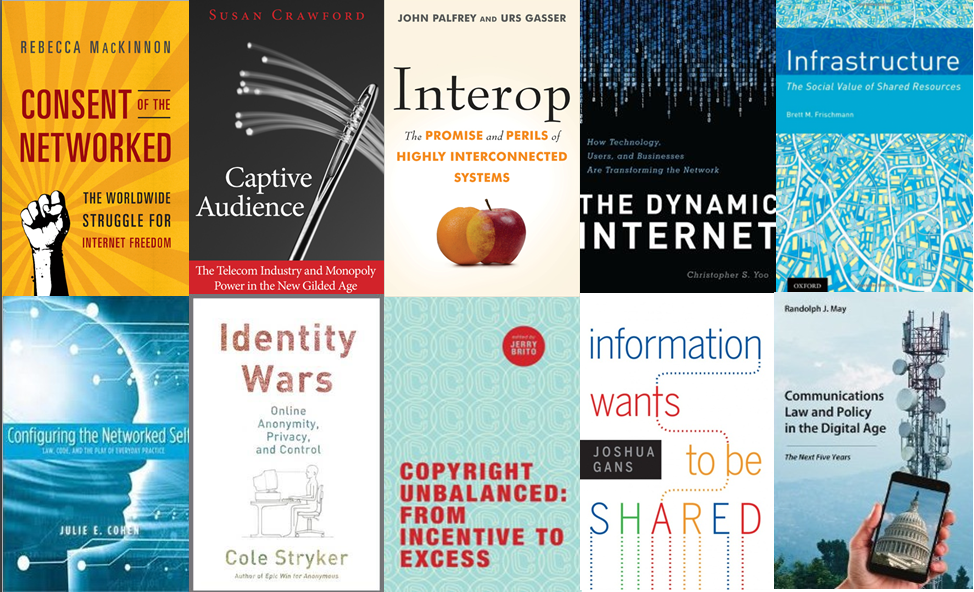
The number of major cyberlaw and information tech policy books being published annually continues to grow at an astonishing pace, so much so that I have lost the ability to read and review all of them. In past years, I put together end-of-year lists of important info-tech policy books (here are the lists for 2008, 2009, 2010, and 2011) and I was fairly confident I had read just about everything of importance that was out there (at least that was available in the U.S.). But last year that became a real struggle for me and this year it became an impossibility. A decade ago, there was merely a trickle of Internet policy books coming out each year. Then the trickle turned into a steady stream. Now it has turned into a flood. Thus, I’ve had to become far more selective about what is on my reading list. (This is also because the volume of journal articles about info-tech policy matters has increased exponentially at the same time.)

So, here’s what I’m going to do. I’m going to discuss what I regard to be the five most important titles of 2012, briefly summarize a half dozen others that I’ve read, and then I’m just going to list the rest of the books out there. I’ve read most of them but I have placed an asterisk next to the ones I haven’t.  Please let me know what titles I have missed so that I can add them to the list. (Incidentally, here’s my compendium of all the major tech policy books from the 2000s and here’s the running list of all my book reviews.)

Continue reading →

If the FCC stops moving forward on Internet transformation, the universal service and intercarrier compensation reform order will become a death warrant for telephone companies.

CLIP hosted an event earlier this month to discuss Internet transformation. What is Internet transformation? In a recent op-ed, FCC Commissioner Ajit Pai noted that it “is really two different things—a technology revolution and a regulatory transition.”

The technology revolution began with the commercialization of the Internet, which enables the delivery of any communications service over any network capable of handling Internet Protocol (IP). According to the National Broadband Plan, the “Internet is transforming the landscape of America more rapidly and more pervasively than earlier infrastructure networks.” In little more than a decade, the Internet destroyed the monopoly structure of the old communications industry from within and replaced it with intermodal competition. Continue reading →

Vinton Cerf, one of the “fathers of the internet,” discusses what he sees as one of the greatest threats to the internet—the encroachment of the United Nations’ International Telecommunications Union (ITU) into the internet realm. ITU member states will meet this December in Dubai to update international telecommunications regulations and consider proposals to regulate the net. Cerf argues that, as the face of telecommunications is changing, the ITU is attempting to justify its continued existence by expanding its mandate to include the internet. Cerf says that the business model of the internet is fundamentally different from that of traditional telecommunications, and as a result, the ITU’s regulatory model will not work. In place of top-down ITU regulation, Cerf suggests that open multi-stakeholder processes and bilateral agreements may be a better solutions to the challenges of governance on the internet.

Download

Related Links

In my last post, I discussed an outstanding new paper from Ronald Cass on “Antitrust for High-Tech and Low: Regulation, Innovation, and Risk .” As I noted, it’s one of the best things I’ve ever read about the relationship between antitrust regulation and the modern information economy. That got me thinking about what other papers on this topic that I might recommend to others. So, for what it’s worth, here are the 12 papers that have most influenced my own thinking on the issue. (If you have other suggestions for what belongs on the list, let me know. No reason to keep it limited to just 12.)

  1. J. Gregory Sidak & David J. Teece, “Dynamic Competition in Antitrust Law,” 5 Journal of Competition Law & Economics (2009).
  2. Geoffrey A. Manne &  Joshua D. Wright, “Innovation and the Limits of Antitrust,” 6 Journal of Competition Law & Economics, (2010): 153
  3. Joshua D. Wright, “Antitrust, Multi-Dimensional Competition, and Innovation: Do We Have an Antitrust-Relevant Theory of Competition Now?” (August 2009).
  4. Daniel F. Spulber, “Unlocking Technology: Antitrust and Innovation,” 4(4) Journal of Competition Law & Economics, (2008): 915.
  5. Ronald Cass, “Antitrust for High-Tech and Low: Regulation, Innovation, and Risk ,” 9(2) Journal of Law, Economics and Policy, Forthcoming (Spring 2012)
  6. Richard Posner, “Antitrust in the New Economy,” 68 Antitrust Law Journal, (2001).
  7. Stan J. Liebowitz & Stephen E. Margolis,”Path Dependence, Lock-in, and History,” 11(1) Journal of Law, Economics and Organization, (April 1995): 205-26.
  8. Robert Crandall and Charles Jackson, “Antitrust in High-Tech Industries,” Technology Policy Institute (December 2010).
  9. Bruce Owen, “Antitrust and Vertical Integration in ‘New Economy’ Industries,” Technology Policy Institute (November 2010).
  10. Douglas H. Ginsburg & Joshua D. Wright, “Dynamic Analysis and the Limits of Antitrust Institutions,” 78 (1) Antitrust Law Journal (2012): 1-21.
  11. Thomas Hazlett, David Teece, Leonard Waverman, “Walled Garden Rivalry: The Creation of Mobile Network Ecosystems,” George Mason University Law and Economics Research Paper Series, (November 21, 2011), No. 11-50.
  12. David S. Evans, “The Antitrust Economics of Two Sided Markets.”

Google’s first lesson for building affordable, one Gbps fiber networks with private capital is crystal clear: If government wants private companies to build ultra high-speed networks, it should start by waiving regulations, fees, and bureaucracy.

Executive Summary

For three years now the Obama Administration and the Federal Communications Commission (FCC) have been pushing for national broadband connectivity as a way to strengthen our economy, spur innovation, and create new jobs across the country. They know that America requires more private investment to achieve their vision. But, despite their good intentions, their policies haven’t encouraged substantial private investment in communications infrastructure. That’s why the launch of Google Fiber is so critical to policymakers who are seeking to promote investment in next generation networks.

The Google Fiber deployment offers policymakers a rare opportunity to examine policies that successfully spurred new investment in America’s broadband infrastructure. Google’s intent was to “learn how to bring faster and better broadband access to more people.” Over the two years it planned, developed, and built its ultra high-speed fiber network, Google learned a number of valuable lessons for broadband deployment – lessons that policymakers can apply across America to meet our national broadband goals.

To my surprise, however, the policy response to the Google Fiber launch has been tepid. After reviewing Google’s deployment plans, I expected to hear the usual chorus of Rage Against the ISP from Public KnowledgeFree Press, and others from the left-of-center, so-called “public interest” community (PIC) who seek regulation of the Internet as a public utility. Instead, they responded to the launch with deafening silence.

Maybe they were stunned into silence. Google’s deployment is a  real-world rejection of the public interest community’s regulatory agenda more powerful than any hypothetical. Google is building fiber in Kansas City because its officials were willing to waive regulatory barriers to entry that have discouraged broadband deployments in other cities. Google’s first lesson for building affordable, one Gbps fiber networks with private capital is crystal clear: If government wants private companies to build ultra high-speed networks, it should start by waiving regulations, fees, and bureaucracy . Continue reading →