Here’s a presentation I’ve been using lately for various audiences about “Cronyism: History, Costs, Case Studies and Solutions.” In the talk, I offer a definition of cronyism, explain its origins, discuss how various academics have traditionally thought about it, outline a variety of case studies, and then propose a range of solutions. Readers of this blog might be interested because I briefly mention the rise of cronyism in the high-tech sector. Brent Skorup and I have a huge paper in the works on that topic, which should be out early next year.
 This may be the best speech by a regulator that you will read in your entire life. Federal Communications Commission (FCC) Commissioner Robert McDowell delivered an address in Rome today entitled, “The Siren Call of “Please Regulate My Rival”: A Recipe for Regulatory Failure.” I highly recommend it (and not just because I’m cited in it!) It is infused with important insights about the ugly downsides of excessive regulation of technology markets.
McDowell is an astute student of regulatory history and he documents how, despite the best of intentions, economic regulation has often been turned into a tool that industry exploits for their own narrow interests. Sadly, examples of such “regulatory capture” are rampant, as I have documented here before. McDowell notes that many telecom and media companies “suffer from the ‘please regulate my rival’ malady of an industry that has been regulated too much and for too long. History is replete with such scenarios,” he says, “and the desire for more regulation for competitors always ends badly for the incumbent regulated industry in the form of unintended and harmful consequences.” That is exactly right.
I strongly encourage you to read the entire speech, but if you only have time to read one thing, make it the powerful and poetic closing paragraphs, which I have reprinted below:
Continue reading →
It’s time again to look back at the major cyberlaw and information tech policy books of the year. I’ve decided to drop the top 10 list approach I’ve used in past years (see 2008, 2009, 2010) and just use a more thematic listing of major titles released in 2011. This thematic approach gets me out of hot water since I have found that people take numeric lists very seriously, especially when they are the author of one of the books and their title isn’t #1 on the list! Nonetheless, at the end, I will name what I regard as the most important Net policy book of the year.
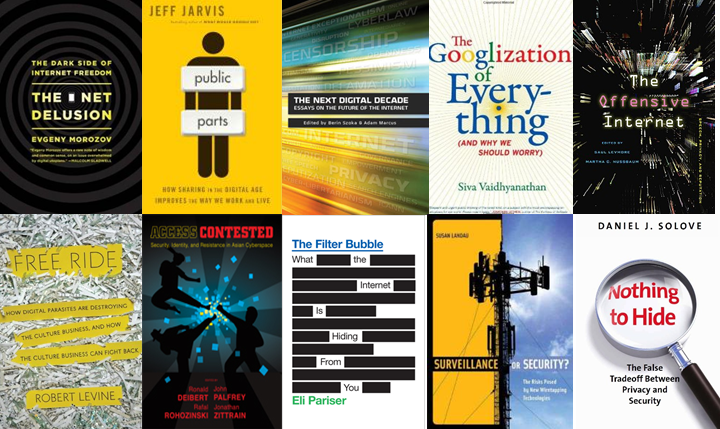
I hope I’ve included all the major titles released during the year, but I ask readers to please let me know what I have missed that belongs on this list. I want this to be a useful resource to future scholars and students in the field. [Reminder: Here’s my compilation of major Internet policy books from the past decade.] Where relevant, I’ve added links to my reviews as well as discussions with the authors that Jerry Brito conducted as part of his “Surprisingly Free” podcast series. Finally, as always, I apologize to international readers for the somewhat U.S.-centric focus of this list.
Continue reading →
2009 was not as big of a year for Internet and information technology (“info-tech”) policy books as 2008 was, but there were still some notable titles released that offered interesting perspectives about the future of the Net and the impact the Digital Revolution is having on our lives, culture, and economy. So, like last year, I figured I would throw together my list of the 10 most important info-tech policy books of the year.
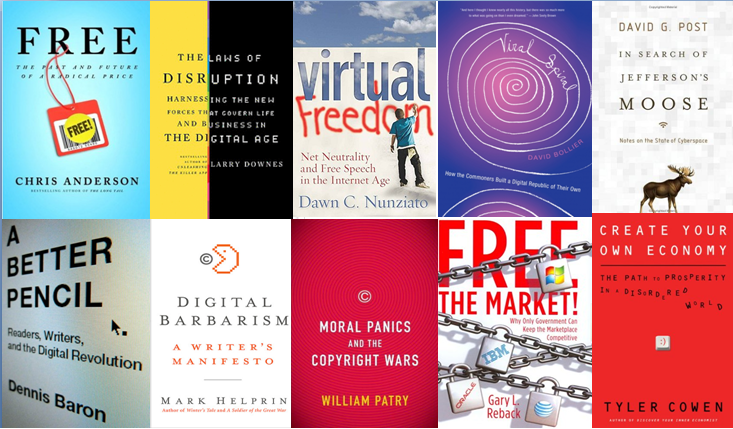 First, let me repeat a few of the same caveats and disclaimers that I set forth last year. What qualifies as an “important” info-tech policy book? Simply put, it’s a title that many people are currently discussing and that we will likely be referencing for many years to come. However, I want to be clear that merely because a book appears on my list it does not necessarily mean I agree with everything said in it. In fact, as was the case in previous years, I found much with which to disagree in my picks for the most important books of 2009 and I find that the cyber-libertarianism I subscribe to has very few fans out there.
Another caveat: Narrowly-focused titles lose a few points on my list. For example, if a book deals mostly with privacy issues, copyright law, or antitrust policy, it does not exactly qualify as the same sort of “tech policy book” as other titles found on this list since it is a narrow exploration of just one set of issues with a bearing on technology policy.
With those caveats in mind, here are my choices for the Most Important Info-Tech Policy Books of 2009. Continue reading →
The Entertainment Consumers Association (ECA) is a group that does some good things to mobilize gamers to fight misguided regulation of video games. I greatly appreciate their tireless efforts to fight stereotypes and myths about games and gamers, and to specifically counter the hysteria about video games that we sometimes see in the press, and definitely see in political circles on a regular basis. They’re a great ally in the fight for freedom of speech and artistic expression in this field.
That’s why I was so sorry to see the ECA launch a new campaign that encourages gamers to petition their congressional leaders and encourage them to regulate the high-tech economy more and waste more taxpayer dollars on inefficient universal service programs and subsidies:
Net Neutrality and Universal Broadband are not only great for America; they allow us to play the games we want at high speeds! … ECA believes that Universal Broadband and Net Neutrality are vital for the development of the national infrastructure, and believes that this bill is an important opportunity to let Congress know that you agree.
Continue reading →
Some sensible thinking here about broadband pork stimulus plans from Saul Hansell of the New York Times. In his piece on the NYT Bits blog this week, “Does Broadband Need a Stimulus?” he argues that people should stop grumbling about the “relatively small sum” of $6 billion that the new administration has proposed for wiring rural areas and urban centers. Hansell argues:
This also seems to be a rather sound policy choice because, as I look at it, the noise about a broadband gap is hooey. With new cable modem technology becoming available, 19 out of 20 American homes eventually will be able to have Internet service that is faster than any available now anywhere in the world. And that’s without one new cable being laid.
That fact hasn’t prevented a lot of folks involved in telecommunications policy from calling for a lot of money to be spent on backhoes and cable riggers. For example, the Communications Workers of America and the Telecommunications Industry Association called for $25 billion in subsidies to network providers as well as tax breaks. The Free Press, a group that advocates for media diversity, recommended spending $44 billion, with an emphasis on subsidizing companies to compete with existing cable and phone companies.
Running a new fiber-optic cable to every American home may well increase competition in broadband providers, but it isn’t needed to deliver high-speed Internet service. Current cable modems use just one of the more than 100 channels on a typical cable system and can often offer speeds of 16 megabits per second or more. The next generation of modems, using a technology called Docsis 3, allows several of those video channels to be combined to offer what ultimately can be Internet service as fast as 1 gigabit per second — 10 times faster than is offered in Japan, which generally is regarded as having the fastest broadband infrastructure.
Continue reading →
As TLF readers may know, I took over in July as Chairman of the Board of the Space Frontier Foundation. As I explained in my recent interview on The Space Show, SFF has been the leading citizens’ advocacy group for space commercialization since 1988. Dedicated to promoting Princeton physicist Gerard O’Neill‘s vision of space settlement, as described in his 1976 masterpiece The High Frontier, the Foundation has always argued that “space is a place, not a program.”
We sent out the following press release on October 28, calling for a major transformation of the U.S. government’s space program by which the U.S. government would buy commercial transportation to the International Space Station. We’ll have more to say about this in the coming weeks.
Space Frontier Foundation Finds Funding Source for COTS-D
 The Space Frontier Foundation today called upon Presidential candidates Barack Obama and John McCain to invest the $2 billion in new funds they have promised to NASA for reducing the “Gap” in U.S. human spaceflight (after the Space Shuttle is retired in 2010) to spur innovation and competition in America.
Foundation Chairman Berin Szoka said “It’s time that our national leaders give American entrepreneurs a shot at closing this gap. Let’s take the two billion dollars in the candidates’ plans and fund up to five winners of COTS-D.”
The NASA Authorization Act of 2008, recently signed into law by the President, directs NASA to “issue a notice of intent [by mid-April 2009] … to enter into a funded, competitively awarded Space Act Agreement with two or more commercial entities’ for transporting humans to the ISS”-the “Capability D” of NASA’s Commercial Orbital Transportation Services program (or COTS-D for short). But that directive is not yet funded.
Szoka continued, “Let’s have an American competition in space – to create good jobs, fuel innovation, and close the gap more quickly. With private funds matching government’s investment, we can dramatically leverage the $2 billion to produce breakthroughs in a new American industry – commercial orbital human spaceflight.” Continue reading →
The Federal Circuit significantly limited the patentability of software and business methods today. Mike Masnick at TechDirt summarizes the holding of the case as follows:
the court has said that there’s a two-pronged test to determine whether a software of business method process patent is valid: (1) it is tied to a particular machine or apparatus, or (2) it transforms a particular article into a different state or thing. In other words, pure software or business method patents that are neither tied to a specific machine nor change something into a different state are not patentable.
I’m sure several of my TLF colleagues will have a great deal to say about this. Tim Lee has already written about this on Ars Technica:
The Bilski decision, then, is a clear signal that the pendulum has begun to swing back toward tighter limits on software and business patents. However, it remains to be seen how far the court will go in this direction. Bilski was a relatively easy case. The applicant made little effort to hide the fact that he was seeking to patent a mental process, something the Supreme Court has clearly said is not allowed. Therefore, the Federal Circuit’s rejection of this patent doesn’t tell us how it will rule when confronted with software or business method patents that are tied more directly to a physical machine or a transformation of matter. And indeed, the Federal Circuit reiterated that some software and business method patents are valid, so we are unlikely to return to the near-prohibition on such patents that prevailed until the early 1980s.
Thoughts?
Debates about online privacy often seem to assume relatively homogeneous privacy preferences among Internet users. But the reality is that users vary widely, with many people demonstrating that they just don’t care who sees what they do, post or say online. Attitudes vary from application to application, of course, but that’s precisely the point: While many reflexively talk about the “importance of privacy” as if a monolith of users held a single opinion, no clear consensus exists for all users, all applications and all situations.
If a picture is worth a thousand words, this picture makes the point brilliantly—showing:
locations where [Flickr] users are more likely to post their photos as “public,” which is the default setting, in green. Places where Flickr users are more likely to put privacy controls on their photos show up in red.

Of course, geography is just one dimension across which users may vary in their attitudes about privacy, but the map makes the basic point about variation very well. Seeing what users
actually do in real life says a lot more about their preferences than merely polling them about what they think they care about in the abstract—as my colleagues Solveig Singleton and Jim Harper argued brilliantly in their 2001 paper With A Grain of Salt: What Consumer Privacy Surveys Don’t Tell Us (SSRN).
Jesse Walker has a terrific feature story looking “Beyond the Fairness Doctrine” in this month’s issue of Reason magazine. I highly recommend it. It’s an in-depth exploration of what an Obama Administration means for the future of tech and media policy. Walker rightly opens the piece by noting that “The fairness doctrine is still dead, and it probably will stay dead even if Barack Obama becomes president.” The danger, however, is that an Obama FCC will still pursue a variety of onerous regulatory objectives that could do a great deal of damage to markets and free speech.
Walker touches upon the various issues that will likely be a priority for an Obama Administration and the Left-leaning media reformistas like Free Press, Media Access Project, Public Knowledge, and New America Foundation. Those policy issues include: net neutrality, “localism” mandates and increased “community oversight” regulations, media ownership rules, minority ownership requirements, increased merger meddling, spectrum policy, and other new “public interest” obligations.
Of course, as Walker also correctly points out, it is difficult to see how things could get much worse than they have been under Bush Administration’s FCC and the leadership of Chairman Kevin Martin. Walker was kind enough to quote my thoughts on this point: “Martin is the most regulatory Republican FCC Chairman in decades,” I told him. “He wants to control speech and will use whatever tools he has to get there.”
I stand by those words, but I am also aware that things could get worse — much worse — under a Democratic FCC influenced by radical Leftist activists like Free Press. Indeed, in our new book A Manifesto for Media Freedom, Brian Anderson and I inventory the many looming threats to media and technology freedom that exist today and show how most of them arise from the Left. As Walker notes in his article, however, it is unlikely that a re-empowered Democratic FCC would come right out of the gates with the same sort of command-and-control approaches they’ve employed in the past. And we’ll still have to worry about some right-of-center lawmakers and regulatory joining some of these misguided campaigns. “The real danger,” Walker concludes in his piece, “is more subtle and more mundane. It’s a bipartisan bureaucracy slowly, steadily increasing its power.” Make sure to read Jesse’s entire piece. Great stuff.

 The Technology Liberation Front is the tech policy blog dedicated to keeping politicians' hands off the 'net and everything else related to technology.