What follows is a response to Michael Sacasas, who recently posted an interesting short essay on his blog The Frailest Thing, entitled, “10 Points of Unsolicited Advice for Tech Writers.” As with everything Michael writes, it is very much worth reading and offers a great deal of useful advice about how to be a more thoughtful tech writer. Even though I occasionally find myself disagreeing with Michael’s perspectives, I always learn a great deal from his writing and appreciate the tone and approach he uses in all his work. Anyway, you’ll need to bounce over to his site and read his essay first before my response will make sense.
Michael:
Lots of good advice here. I think tech scholars and pundits of all dispositions would be wise to follow your recommendations. But let me offer some friendly pushback on points #2 & #10, because I spend much of my time thinking and writing about those very things.
In those two recommendations you say that those who write about technology “[should] not cite apparent historical parallels to contemporary concerns about technology as if they invalidated those concerns. That people before us experienced similar problems does not mean that they magically cease being problems today.” And you also warn “That people eventually acclimate to changes precipitated by the advent of a new technology does not prove that the changes were inconsequential or benign.”
I think these two recommendations are born of a certain frustration with the tenor of much modern technology writing; the sort of Pollyanna-ish writing that too casually dismisses legitimate concerns about the technological disruptions and usually ends with the insulting phrase, “just get over it.” Such writing and punditry is rarely helpful, and you and others have rightly pointed out the deficiencies in that approach.
That being said, I believe it would be highly unfortunate to dismiss any inquiry into the nature of individual and societal acclimation to technological change. Because adaptation obviously does happen! Certainly there must be much we can learn from it. In particular, what I hope to better understand is the process by which we humans have again and again figured out how to assimilate new technologies into their lives despite how much those technologies “unsettled” well-established personal, social, cultural, and legal norms. Continue reading →
 I am pleased to announce the release of my latest book, “Permissionless Innovation: The Continuing Case for Comprehensive Technological Freedom.” It’s a short manifesto (just under 100 pages) that condenses — and attempts to make more accessible — arguments that I have developed in various law review articles, working papers, and blog posts over the past few years. I have two goals with this book.
First, I attempt to show how the central fault line in almost all modern technology policy debates revolves around “the permission question,” which asks:
Must the creators of new technologies seek the blessing of public officials before they develop and deploy their innovations? How that question is answered depends on the disposition one adopts toward new inventions. Two conflicting attitudes are evident.
One disposition is known as the “precautionary principle.” Generally speaking, it refers to the belief that new innovations should be curtailed or disallowed until their developers can prove that they will not cause any harms to individuals, groups, specific entities, cultural norms, or various existing laws, norms, or traditions.
The other vision can be labeled “permissionless innovation.” It refers to the notion that experimentation with new technologies and business models should generally be permitted by default. Unless a compelling case can be made that a new invention will bring serious harm to society, innovation should be allowed to continue unabated and problems, if they develop at all, can be addressed later.
I argue that we are witnessing a grand clash of visions between these two mindsets today in almost all major technology policy discussions today. Continue reading →
James Barrat, author of Our Final Invention: Artificial Intelligence and the End of the Human Era, discusses the future of Artificial Intelligence (AI). Barrat takes a look at how to create friendly AI with human characteristics, which other countries are developing AI, and what we could expect with the arrival of the Singularity. He also touches on the evolution of AI and how companies like Google and IBM and government entities like DARPA and the NSA are developing artificial general intelligence devices right now.
Download
Related Links
Robert Scoble, Startup Liaison Officer at Rackspace discusses his recent book, Age of Context: Mobile, Sensors, Data and the Future of Privacy, co-authored by Shel Israel. Scoble believes that over the next five years we’ll see a tremendous rise in wearable computers, building on interest we’ve already seen in devices like Google Glass. Much like the desktop, laptop, and smartphone before it, Scoble predicts wearable computers represent the next wave in groundbreaking innovation. Scoble answers questions such as: How will wearable computers help us live our lives? Will they become as common as the cellphone is today? Will we have to sacrifice privacy for these devices to better understand our preferences? How will sensors in everyday products help companies improve the customer experience?
Download
Related Links
 I’m pleased to announce the release of my latest law review article, “A Framework for Benefit-Cost Analysis in Digital Privacy Debates.” It appears in the new edition of the George Mason University Law Review. (Vol. 20, No. 4, Summer 2013)
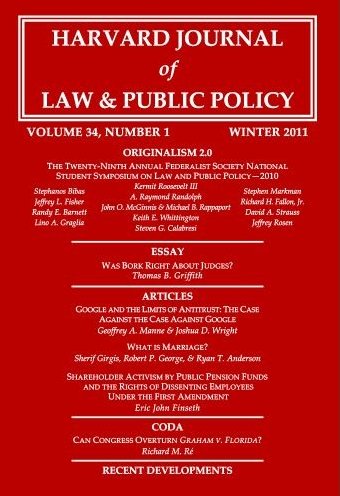
This is the second of two complimentary law review articles I am releasing this year dealing with privacy policy. The first, “The Pursuit of Privacy in a World Where Information Control is Failing,” was published in Vol. 36 of the Harvard Journal of Law & Public Policy
this Spring. (FYI: Both articles focus on privacy claims made against private actors — namely, efforts to limit private data collection — and not on privacy rights against governments.)
My new article on benefit-cost analysis in privacy debates makes a seemingly contradictory argument: benefit-cost analysis (“BCA”) is extremely challenging in online child safety and digital privacy debates, yet it remains essential that analysts and policymakers attempt to conduct such reviews. While we will never be able to perfectly determine either the benefits or costs of online safety or privacy controls, the very act of conducting a regulatory impact analysis (“RIA”) will help us to better understand the trade-offs associated with various regulatory proposals. Continue reading →

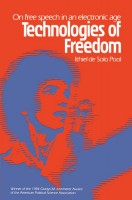 I was honored to be asked by the editors at Reason magazine to be a part of their “Revolutionary Reading” roundup of “The 9 Most Transformative Books of the Last 45 Years.” Reason is celebrating its 45th anniversary and running a wide variety of essays looking back at how liberty has fared over the past half-century. The magazine notes that “Statism has hardly gone away, but the movement to roll it back is stronger than ever.” For this particular feature, Reason’s editors “asked seven libertarians to recommend some of the books in different fields that made [the anti-statist] cultural and intellectual revolution possible.”
When Jesse Walker of
Reason first contacted me about contributing my thoughts about which technology policy books made the biggest difference, I told him I knew exactly what my choices would be: Ithiel de Sola Pool’s Technologies of Freedom (1983) and Virginia Postrel’s The Future and Its Enemies (1998). Faithful readers of this blog know all too well how much I love these two books and how I am constantly reminding people of their intellectual importance all these years later. (See, for example, this and this.) All my thinking and writing about tech policy over the past two decades has been shaped by the bold vision and recommendations set forth by Pool and Postrel in these beautiful books.
As I note in my
Reason write-up of the books: Continue reading →
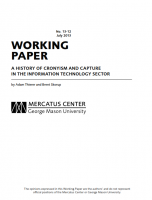 The Mercatus Center at George Mason University has just released a new paper by Brent Skorup and me entitled, “A History of Cronyism and Capture in the Information Technology Sector.” In this 73-page working paper, which we hope to place in a law review or political science journal shortly, we document the evolution of government-granted privileges, or “cronyism,” in the information and communications technology marketplace and in the media-producing sectors. Specifically, we offer detailed histories of rent-seeking and regulatory capture in: the early history of the telephony and spectrum licensing in the United States; local cable TV franchising; the universal service system; the digital TV transition in the 1990s; and modern video marketplace regulation (i.e., must-carry and retransmission consent rules, among others.
Our paper also shows how cronyism is slowly creeping into new high-technology sectors.We document how Internet companies and other high-tech giants are among the fastest-growing lobbying shops in Washington these days. According to the Center for Responsive Politics, lobbying spending by information technology sectors has almost doubled since the turn of the century, from roughly $200 million in 2000 to $390 million in 2012. The computing and Internet sector has been responsible for most of that growth in recent years. Worse yet, we document how many of these high-tech firms are increasingly seeking and receiving government favors, mostly in the form of targeted tax breaks or incentives. Continue reading →
 I’m excited to announce the release of my latest law review article, “The Pursuit of Privacy in a World Where Information Control is Failing,” which appears in the next edition (vol. 36) of the Harvard Journal of Law & Public Policy. This is the first of two complimentary law review articles that I will be releasing this year dealing with privacy policy. The second, which will be published later this summer by the George Mason University Law Review, is entitled, “A Framework for Benefit-Cost Analysis in Digital Privacy Debates.” (FYI: Both articles focus on privacy claims made against private actors — namely, efforts to limit private data collection — and not on privacy rights against governments.)
The new
Harvard Journal article is divided into three major sections. Part I focuses on some of normative challenges we face when discussing privacy and argues that there may never be a widely accepted, coherent legal standard for privacy rights or harms here in the United States. It also explores the tensions between expanded privacy regulation and online free speech. Part II turns to the many enforcement challenges that are often ignored when privacy policies are being proposed or formulated and argues that legislative and regulatory efforts aimed at protecting privacy must now be seen as an increasingly intractable information control problem. Most of the problems policymakers and average individuals face when it comes to controlling the flow of private information online are similar to the challenges they face when trying to control the free flow of digitalized bits in other information policy contexts, such as online safety, cybersecurity, and digital copyright.
If the effectiveness of law and regulation is limited by the normative considerations discussed in Part I and the practical enforcement complications discussed in Part II, what alternatives remain to assist privacy-sensitive individuals? I address that question in Part III of the paper and argue that the approach America has adopted to deal with concerns about objectionable online speech and child safety offers a path forward on the privacy front as well. Continue reading →
In an important essay this week entitled “Silicon Valley’s ‘Suicide Impulse’,” Wall Street Journal columnist L. Gordon Crovitz warns that “Silicon Valley has long prided itself on avoiding the lumbering relationship between big government and most industries, but somehow it has become one of the top lobbyists in Washington.” Crovitz is worried that Internet and technology companies are falling prey to what Milton Friedman labeled “The Business Community’s Suicidal Impulse”: the persistent propensity to persecute one’s competitors using regulation or the threat thereof. “Rather than lobby government to go after one another,” Crovitz argues, “Silicon Valley lobbyists should unite to go after overreaching government. Instead of the ‘suicide impulse’ of lobbying for more regulation, Silicon Valley should seek deregulation and a long-overdue freedom to return to its entrepreneurial roots.”
Crovitz’s essay touches upon a dangerous trend I have written about here and elsewhere in the past: the increasing politicization of the Internet and information technology sectors and the gradual rise of rent-seeking (i.e., favor-seeking) over time. I’ve written about this problem in essays like:
These essays have documented how tech companies are increasingly vying for the attention of legislators and regulators in Washington, statehouses, and international capitals across the globe.
Why should we care about the increasing politicization of the information technology sector? Continue reading →
Earlier today on Twitter, I listed what I thought were the Top 5 “Biggest Internet Policy Issues of 2012.” In case you don’t follow me on Twitter — and shame on you if you don’t! — here were my choices:
- Copyright wars reinvigorated post-SOPA; tide starting to turn in favor of copyright reform. [TLF posts on copyright.]
- Privacy still red-hot w ECPA reform, online advertising regs & kids’ privacy issues all pending. [TLF posts on privacy.]
- WCIT makes Internet governance / NetFreedom a major issue worldwide. [TLF posts on Net governance.]
- Antitrust threat looms larger w pending Google case + Apple books investigation. [TLF posts on antitrust.]
- Cybersecurity regulatory push continues in both legislative (CISPA) & executive branch. [TLF posts on cybersecurity.]
Lists like these are entirely subjective, of course, but I am basing my list on the general amount of chatter I tended to see and hear about each topic over the course of the year.
What do you think the top tech policy issues of the year were?




 The Technology Liberation Front is the tech policy blog dedicated to keeping politicians' hands off the 'net and everything else related to technology.