[This article originally appeared at Discourse on January 6, 2021.]
Time magazine recently declared 2020 “The Worst Year Ever.” By historical standards that may be a bit of hyperbole. For America’s digital technology sector, however, that headline rings true. After a remarkable 25-year run that saw an explosion of innovation and the rapid ascent of a group of U.S. companies that became household names across the globe, politicians and pundits in 2020 declared the party over.
“We now are on the cusp of a new era of tech policy, one in which the policy catches up with the technology,” says Darrell M. West of the Brookings Institution in a recent essay, “The End of Permissionless Innovation.” West cites the House Judiciary Antitrust Subcommittee’s October report on competition in digital markets—where it equates large tech firms with the “oil barons and railroad tycoons” of the Gilded Age—as the clearest sign that politicization of the internet and digital technology is accelerating.
It is hardly the only indication that America is set to abandon permissionless innovation and revisit the era of heavy-handed regulation for information and communication technology (ICT) markets. Equally significant is the growing bipartisan crusade against Section 230, the provision of the 1996 Telecommunications Act that shields “interactive computer services” from liability for information posted or published on their systems by users. No single policy has been more important to the flourishing of online speech or commerce than Sec. 230 because, without it, online platforms would be overwhelmed by regulation and lawsuits.
But now, long knives are coming out for the law, with plenty of politicians and academics calling for it to be gutted. Calls to reform or repeal Sec. 230 were once exclusively the province of left-leaning academics or policymakers, but this year it was conservatives in the White House, on Capitol Hill and at the Federal Communications Commission (FCC) who became the leading cheerleaders for scaling back or eliminating the law. President Trump railed against Sec. 230 repeatedly on Twitter, and most recently vetoed the annual National Defense Authorization Act in part because Congress did not include a repeal of the law in the measure.
Meanwhile, conservative lawmakers in Congress such as Sens. Josh Hawley and Ted Cruz have used subpoenas, angry letters and heated hearings to hammer digital tech executives about their content moderation practices. Allegations of anti-conservative bias have motivated many of these efforts. Even Supreme Court Justice Clarence Thomas questioned the law in a recent opinion.
Other proposed regulatory interventions include calls for new national privacy laws, an “Algorithmic Accountability Act” to regulate artificial intelligence technologies, and a growing variety of industrial policy measures that would open the door to widespread meddling with various tech sectors. Some officials in the Trump administration even pushed for a nationalized 5G communications network in the name of competing with China.
This growing “techlash” signals a bipartisan “Back to the Future” moment, with the possibility of the U.S. reviving a regulatory playbook that many believed had been discarded in history’s dustbin. Although plenty of politicians and pundits are taking victory laps and giving each other high-fives over the impending end of the permissionless innovation era, it is worth considering what America will be losing if we once again apply old top-down, permission slip-oriented policies to the technology sector. Continue reading →
This month’s Cato Unbound symposium features a conversation about the continuing relevance of Albert Hirschman’s Exit, Voice and Loyalty: Responses to Decline in Firms, Organizations, and States, fifty years after its publication. It was a slender by important book that has influenced scholars in many different fields over the past five decades. The Cato symposium features a discussion between me and three other scholars who have attempted to use Hirschman’s framework when thinking about modern social, political, and technological developments.
My lead essay considers how we might use Hirschman’s insights to consider how entrepreneurialism and innovative activities might be reconceptualized as types of voice and exit. Response essays by Mikayla Novak, Ilya Somin, and Max Borders broaden the discussion to highlight how to think about Hirschman’s framework in various contexts. And then I returned to the discussion this week with a response essay of my own attempting to tie those essays together and extend the discussion about how technological innovation might provide us with greater voice and exit options going forward. Each contributor offers important insights and illustrates the continuing importance of Hirschman’s book.
I encourage you to jump over to Cato Unbound to read the essays and join the conversations in the comments.
“The world should think better about catastrophic and existential risks.” So says a new feature essay in The Economist. Indeed it should, and that includes existential risks associated with emerging technologies.
The primary focus of my research these days revolves around broad-based governance trends for emerging technologies. In particular, I have spent the last few years attempting to better understand how and why “soft law” techniques have been tapped to fill governance gaps. As I noted in this recent post compiling my recent writing on the topic;
soft law refers to informal, collaborative, and constantly evolving governance mechanisms that differ from hard law in that they lack the same degree of enforceability. Soft law builds upon and operates in the shadow of hard law. But soft law lacks the same degree of formality that hard law possess. Despite many shortcomings and criticisms, compared with hard law, soft law can be more rapidly and flexibly adapted to suit new circumstances and address complex technological governance challenges. This is why many regulatory agencies are tapping soft law methods to address shortcomings in the traditional hard law governance systems.
I argued in recent law review articles as well as my latest book, despite its imperfections, I believe that soft law has an important role to play in filling governance gaps that hard law struggles to address. But there are some instances where soft law simply will not cut it. Continue reading →
I was speaking at a conference recently and discussing my life’s work, which for 30 years has been focused on the importance of innovation and intellectual battles over what we mean progress. I put together up a short list of some things I have written over the last few years on this topic and thought I would just re-post them here. I will try to keep this regularly updated, at least for a few years.
Here’s a new episode of the James Madison Institute “Policy Gone Viral” podcast in which my former Mercatus Center colleague Andrea O’Sullivan and I discuss the future of technological innovation and the public policies governing it. The video is embedded below or you can listen to just the audio here.
Marc Andreessen is interviewed by Sriram Krishan in his new newsletter, The Observer Effect, and asked what motivates him to support technological innovation and “to go read up on a new topic every day” related to tech and progress. His answer is inspirational and perfectly encapsulates why I also have made technological progress the focus of my life’s work:
I am a deep believer in – after learning a lot over the years about economic history and of cultural history – that technology really is the driver. There were basically millennia of just subsistence farming industry and all of a sudden, there was this vertical takeoff a few hundred years ago. And quality of life exploded around the world. Not evenly but starting in Europe and expanding out. It’s basically all technology. It’s always the printing press, it’s the internet and on and on. And you get this incredible upward trajectory. We have the potential over the course of the next century or over the next few centuries to really dramatically advance and have life be better for virtually everybody. Technology is quite literally the lever for being able to take natural resources and able to make something better out of them.
And so it’s just it’s the most interesting and by far the most useful and the most beneficial thing I can think of doing.
Amen, brother! I devoted my last two books
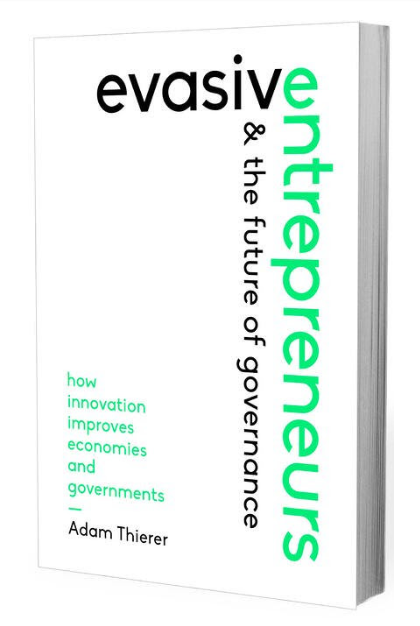
(Permissionless Innovation and Evasive Entrepreneurs) and all my life’s work, to proving that exact point. Also, I really like Andreessen’s definition of technology as, “the lever for being able to take natural resources and able to make something better out of them.” I’ve added that to my running compendium, “Defining Technology,” which features various definitions of technology.
A pandemic is no time for bad governance. As the COVID-19 crisis intensified, bureaucrats and elected officials slumbered. Government regulations prevented many in the private sector from helping with response efforts. The result was a sudden surge of evasive entrepreneurialism and technological civil disobedience. With institutions and policies collapsing around them, many people took advantage of cutting‐edge technological capabilities to evade public policies that were preventing practical solutions from emerging.
Examples were everywhere. Distilleries started producing hand sanitizers to address shortages while average folks began sharing do‐it‐yourself sanitizer recipes online. The Food and Drug Administration (FDA) looked to modify hand sanitizer guidelines quickly to allow for it, but few really cared because those rules weren’t going to stop them. Gray markets in face masks, medical face shields, and respirators developed. Some people and organizations worked together to make medical devices using off‐the‐shelf hardware and open source software. More simply, others just fired up sewing machines to make masks—and then, faced with an emerging public health consensus, the guidance from the federal government shifted dramatically: where formerly ordinary people were instructed not to buy or use masks, within a matter of days, the policy reversed, and all were encouraged to make and use cloth protective masks. Continue reading →
Congress has become a less important player in the field of technology policy. Why did that happen, and what are the ramifications for technological governance efforts going forward?
I’ve spent almost 30 years covering technology policy. There was a time in my life when I spent almost all my time as a policy analyst preoccupied with developments in the federal legislative arena. I lived in the trenches of Capitol Hill and interacted with lawmakers and their staff morning, noon, and night.
In recent years, however, I have spent very little time focused on the Legislative Branch because it has effectively become a non-actor on technology policy. It is not that congressional lawmakers stopped caring about tech policy. Interest actually remains quite high—perhaps higher than ever before. Congress also continues to introduce lots of bills, host plenty of hearings, and issue mountains of press releases related to tech policy issues.
Nonetheless, all that interest and activity has not really translated into much important legislation. Continue reading →
The endless apocalyptic rhetoric surrounding Net Neutrality and many other tech policy debates proves there’s no downside to gloom-and-doomism as a rhetorical strategy. Being a techno-Jeremiah nets one enormous media exposure and even when such a person has been shown to be laughably wrong, the press comes back for more. Not only is there is no penalty for hyper-pessimistic punditry, but the press actually furthers the cause of such “fear entrepreneurs” by repeatedly showering them with attention and letting them double-down on their doomsday-ism. Bad news sells, for both the pundit and the press.
But what is most remarkable is that the press continues to label these preachers of the techno-apocalypse as “experts” despite a track record of failed predictions. I suppose it’s because, despite all the failed predictions, they are viewed as thoughtful & well-intentioned. It is another reminder that John Stuart Mill’s 1828 observation still holds true today: “I have observed that not the man who hopes when others despair, but the man who despairs when others hope, is admired by a large class of persons as a sage.”
The Technology Liberation Front is the tech policy blog dedicated to keeping politicians' hands off the 'net and everything else related to technology. Learn more about TLF →


 Congress has become a less important player in the field of technology policy. Why did that happen, and what are the ramifications for technological governance efforts going forward?
 The Technology Liberation Front is the tech policy blog dedicated to keeping politicians' hands off the 'net and everything else related to technology.